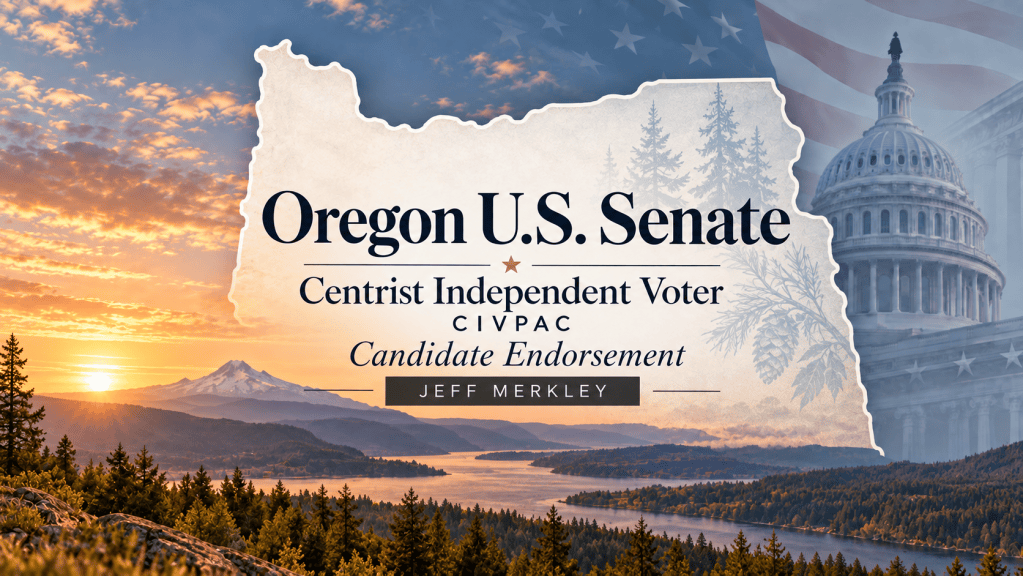
CIVPAC has published its evaluation of the 2026 U.S. Senate race in Oregon, completing its review of every Senate general-election race this year.
The Oregon evaluation endorses Democratic incumbent Jeff Merkley over Republican David Brock Smith, Libertarian Gary Dye and Progressive/Pacific Green candidate Chris Henry.
This is not an endorsement based on broad agreement with Merkley’s domestic agenda. The evaluation identifies substantial differences over Medicare for All, labor policy, wealth taxation and the use of government direction rather than market mechanisms to address climate change.
Brock Smith is closer to CIVPAC on several economic and regulatory questions. But the evaluation raises concerns about climate change, the effort to challenge the 2020 election results, voting policy and abortion. OPB has reported both his rejection of human contributions to climate change and his participation in the 2020 Texas election challenge. (OPB) opb
His relationship with President Trump is also important to the evaluation. Willamette Week described Brock Smith as an outspoken Trump supporter and reported that, when asked whether he disagreed with anything Trump had done during his second term, he did not identify an example. CIVPAC was also unable to find sufficiently clear positions from him on tariffs, Ukraine, NATO or the Iran war. (Willamette Week) Willamette Week
In the end, the value of divided government tipped the balance. The Oregon evaluation argues that congressional checks on executive authority work less effectively when members of Congress are unwilling to challenge a president of their own party. For this moment, that consideration favors returning Merkley to the Senate. The endorsement is explicitly conditional: if the White House were occupied by a Democrat, particularly one well to the left of center, Merkley would probably not receive CIVPAC’s endorsement.
With the Oregon review, CIVPAC has now reviewed every 2026 U.S. Senate general-election race. We have published endorsements in 26 races, including Alaska, published evaluations without an endorsement in 3, and have 6 completed drafts still under review and awaiting publication.
That completes the research stage of the Senate project. The races will continue to be followed, and evaluations or endorsements can be revisited if significant new information warrants it.
I did not expect Kansas to become one of the more interesting Senate races we reviewed this year.
Republican Roger Marshall begins with the advantages of incumbency and of running in a state that has not elected a Democratic senator since 1932. But the Democratic nominee, Adam Hamilton, is not a conventional candidate.
Hamilton spent more than three decades leading the Church of the Resurrection, a large United Methodist congregation containing Republicans, Democrats and independents. His career has largely involved persuading people who disagree about difficult subjects to remain in conversation with one another.
Washington could use some of that.
What attracted us most, however, was not Hamilton’s biography. It was the contrast between his understanding of public office and Marshall’s record in the Senate.
Marshall voted to reject legitimate electoral votes after the 2020 election. He has supported President Trump’s broad use of tariffs, resisted congressional efforts to reclaim war powers, and repeatedly supported controversial presidential nominees even when other Republican senators were willing to vote no.
Hamilton, by contrast, argues that Congress should reclaim authority that has migrated to the executive branch. He opposes broad unilateral tariffs, favors secure borders while supporting legal immigration, and has developed a political style based more on persuasion than partisan warfare.
That does not mean we agree with him about everything.
We would like a much clearer account of the role Hamilton believes the United States should play in the world. Ukraine and NATO are part of that question, but the issue is broader: alliances, deterrence, military restraint and the degree to which America should remain engaged internationally.
We also think he needs to say more about deficits and entitlement reform. Some of his proposed tax credits strike us as bad policy, and his health-care approach differs from our own.
His religious background raised another question for us.
Clergy are no less entitled to public office than anyone else. But public officials govern people of every religion and of no religion. Religious doctrine cannot become governmental doctrine.
Hamilton has explicitly rejected Christian nationalism and defended separation of church and state. His own position on abortion is revealing: he speaks openly about the moral value he places on unborn life while also arguing that legislators should not become women’s spiritual advisers.
That strikes us as an important distinction.
A senator is entitled to bring his values into public life. He is not entitled to turn his church’s theology into civil law.
Hamilton appears to understand that.
He remains an underdog. Kansas is still Kansas. But recent polling suggests this is not merely a symbolic candidacy, and Hamilton appears capable of assembling the kind of coalition that has elected Democratic Governor Laura Kelly: Democrats, independents and enough moderate Republicans willing to cross party lines.
Endorsements are comparative judgments, not declarations of ideological agreement.
We have reservations about Adam Hamilton. But compared with Roger Marshall’s record, Hamilton offers greater independence, greater respect for democratic institutions and a political temperament that Washington badly needs.
That was enough for us.
The Centrist Independent Voter endorses Adam Hamilton for the United States Senate from Kansas.
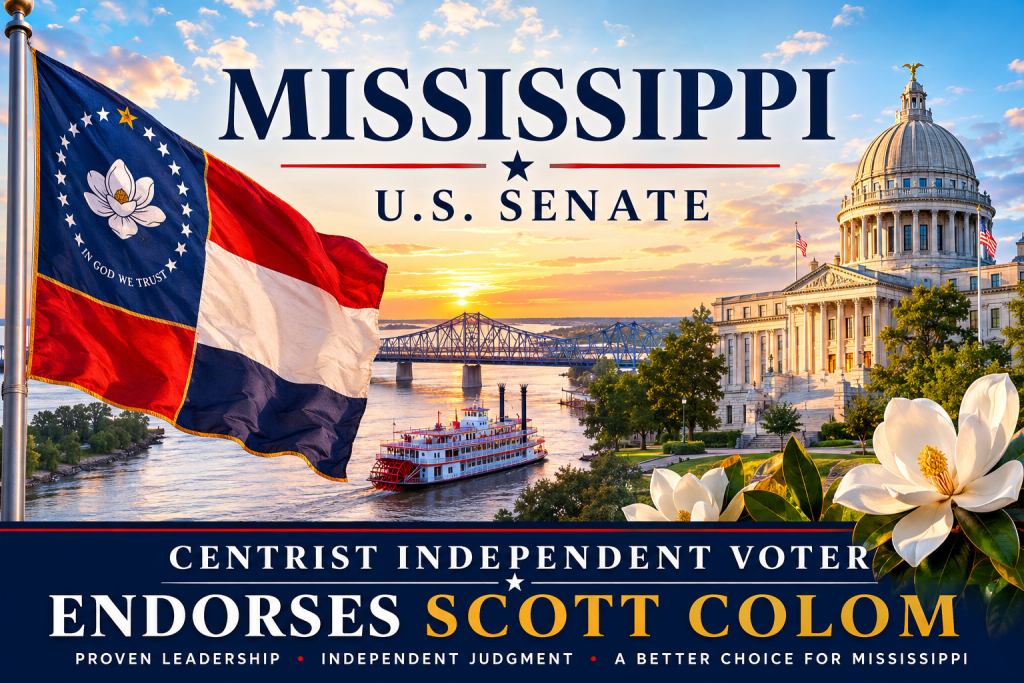
I did not expect Mississippi to produce one of our more difficult Senate endorsements.
Cindy Hyde-Smith was the easy part. Her vote to reject valid electoral votes after the 2020 election, her record on Ukraine, and her repeated willingness to defer to Donald Trump when Congress should have been defending its own constitutional powers convinced us that Mississippi would be better served by someone else.
The harder question was Scott Colom or Ty Pinkins.
Pinkins gave us something we genuinely like. He is running as an independent and says he would caucus with neither party. More importantly, he has been discussing the creation of a bloc of independent senators—a Fulcrum Caucus—that could potentially hold the balance of power in a closely divided Senate.
We have supported that idea in other races. A handful of senators who could bargain over committee organization, amendment rights and other Senate procedures might loosen the grip of the two parties and make Congress work a little more like the institution the Constitution intended.
But there is an important distinction.
I am enthusiastic about using that leverage to reform the Senate. I am much less enthusiastic about using it to make enactment of a substantially left-wing policy agenda the price of organizing the chamber. Pinkins has suggested both. His support for universal health care and other economic policies goes considerably beyond our own approach to health care.
If Pinkins were proposing to reserve the leverage of a Fulcrum Caucus primarily for institutional reform—and if he appeared to be the stronger candidate against Hyde-Smith—I think we would have endorsed him.
Neither appears to be true.
Colom, meanwhile, has a record that is unusually attractive for a Democratic candidate in a deeply Republican state. As a district attorney, he has combined aggressive prosecution of violent crime with diversion and rehabilitation for first-time nonviolent offenders. He has earned respect from Republican officials as well as Democrats and has demonstrated a willingness to pursue wrongdoing by members of his own party.
He also presently has something Pinkins does not: a plausible, although still difficult, path to defeating Hyde-Smith.
There are positions where we disagree with Colom, and I remain particularly interested in hearing a clear statement from him on Ukraine and NATO. An endorsement is not a declaration that a candidate agrees with us about everything.
It is a choice among the candidates actually running.
In Mississippi, after giving Ty Pinkins considerably more thought than I initially expected, we chose Scott Colom.
I recently traveled through the American Southwest. The scenery was spectacular, and the spring climate was remarkably pleasant.
Travel has a way of producing conversations that are different from ordinary social life. You meet people briefly, often in beautiful or unfamiliar places, and sometimes talk more freely than you might at home. Other times, of course, people avoid anything controversial.
During this recent travel, I had a few conversations about public policy and the state of American politics. Sometimes views were offered openly. In other cases, they emerged only after questions. None of the conversations were confrontational.
What struck me most, however, was not the number of political conversations, but how few there were. Despite making my interest in politics clear more than once, most people avoided the subject almost entirely.
That itself seemed revealing.
Democratic Party Politics
The easiest conversation to begin was with someone who had volunteered an interest in politics. This person had been active in Democratic Party politics and described their own views as left wing, but not far left wing.
We agreed on a number of things, including the need for Democrats to reach voters outside their normal constituencies. I shared the CIVPAC website and asked for reactions. My suspicion is that the site may have been reviewed, but it did not generate much enthusiasm.
I heard, from someone else, the view that Senator John Fetterman of Pennsylvania should leave the Democratic Party. I found that revealing. Fetterman still votes with Democrats the overwhelming majority of the time. He is also exactly the kind of culturally heterodox Democrat who may be able to reach voters the party otherwise struggles to reach.
It may be easier to accept the concept of a broader coalition in the abstract than to accept the reality of sharp disagreement from members of one’s own coalition.
A Competitive Senate Race
Another conversation concerned a competitive Senate race in the Northeast. The person I spoke with knew the race well and was clearly dissatisfied with the available choices.
The reaction was not enthusiastic support for one side so much as exhaustion with the alternatives. The sense I took away was not ideological excitement, but political fatigue.
For CIVPAC, races like this are difficult. A candidate may be more centrist on a number of public policy issues than most members of that candidate’s party and may even have broken with party leadership on some important questions. But that same candidate may also have supported party leadership on many other issues in ways that weaken any claim to independence.
At the same time, the opposing candidate may hold views on socialism, foreign policy, public safety, or political violence that many moderates find difficult to accept.
The conversation itself was short. Unlike my exchange with the Democratic activist, this did not feel like a conversation with someone trying to shape the future of a party. It felt more like a conversation with someone tired of choosing among imperfect options.
My suspicion is that this kind of voter may be more representative of the broader electorate than the activists who dominate so much political discussion.
Immigration and Economic Dislocation
I have also encountered strong views about immigration, especially when people believe immigration has affected their own economic prospects.
The H-1B visa program for highly skilled workers is a good example. At the national level, expanding the supply of skilled labor may increase growth, reduce costs, and support innovation. That is the standard economic argument, and it has real force.
But the individual experience can look very different. Someone who invests time and money in retraining for a technology-related career, only to find the door closed, may experience immigration policy not as an abstraction, but as a personal economic threat.
I am not in a position to judge whether any particular person’s career disappointment was caused by foreign labor competition. Labor markets are complicated, and individual outcomes rarely have a single cause.
But the feeling is real. And politically, feelings of unfairness matter.
Policies that appear efficient at a national level can still generate resentment and distrust if people experience the burdens and benefits as unfairly distributed. A politics that ignores those concentrated costs should not be surprised when affected voters become angry.
International Politics
Another conversation turned to European politics, immigration, and nationalism. The person was very familiar with European politics and followed political developments there closely.
The views expressed did not fit neatly into standard American categories. There was concern about democratic backsliding and authoritarian politics, but also some sympathy for European leaders who had taken a harder line on immigration. The argument was that immigration restrictions may have protected some countries from social and public-safety problems experienced elsewhere in Europe. There was also interest in pro-natalist policies, including benefits and protections for new parents.
This was not a wholehearted endorsement of European nationalism. Nor was it a full-throated condemnation.
What interested me most, however, was how poorly the conversation fit American political categories. A person with cross-border experience expressing partial sympathy for nationalist European leaders because of concerns about immigration, crime, and demographics does not fit comfortably into the ideological narratives that dominate American politics.
For myself, I viewed recent political change in parts of Europe, including the defeat of Viktor Orbán’s Fidesz party in Hungary, with guarded optimism. Guarded because it is never immediately clear how a new government will actually govern. Optimistic because cooperation with democratic allies and support for Ukraine matter a great deal.
Real voters are often more complicated than our political labels.
Conclusions
There is nothing remotely scientific about gathering political impressions while traveling. But informal conversations sometimes reveal things that polls cannot.
I had only a handful of political conversations. Despite making my interest in politics clear, most people I encountered did not express political views at all.
I increasingly think that silence itself may say something important.
Most people may simply be exhausted by the current political environment. They may also be reluctant to expose their views to criticism from people they do not know well. In many social settings, politics increasingly feels less like a conversation and more like a potential social risk.
People naturally search for conversational ground with strangers. Passing on an obvious invitation to discuss politics may therefore tell us quite a bit.
I also suspect that some vocal people already have relatively fixed political identities and voting behavior. But the quieter majority may still be politically available in ways activists and highly engaged partisans often underestimate.
Both parties should recognize that and act accordingly.
In retrospect, I also wish I had identified myself more strongly as a centrist independent and not simply as someone interested in politics. I wonder whether that would have changed some of the conversations — or perhaps encouraged more of them.
Sen. Kyrsten Sinema from Arizona, formerly a Democrat, announced recently that she is now an independent. She has vowed not to caucus with the Republican Party and expects to retain her committee assignments. I suspect she has an arrangement with Sen. Chuck Schumer (D), the Senate Majority Leader, that will allow her to retain her committee assignments in return for her support in giving the Democrats full control over the Senate. Even as a Democrat, she did not regularly attend the Democratic Caucus meetings to discuss party strategy. Whether one could say that she now “caucuses” with the Democratic Party is a matter of how one defines the term.
She has supported the Biden administration legislatively about 93% of the time. However, she broke with the Democratic Party on a number of key issues. As a self-described social liberal and fiscal conservative, she voted against the $3.5 trillion “Build Back Better” bill. She opposed dispensing with the filibuster rule and believes it should be re-instituted for judicial appointments and approval of presidential nominees for other positions. She voted against a minimum wage bill, although she is on record supporting increasing the minimum wage. I suspect her opposition was about the magnitude of the increase in the minimum wage being proposed. She is also opposed to packing the Supreme Court. Sinema voted against the nomination of Brett Kavanaugh and Amy Coney Barrett and for Ketanji Brown Jackson. She is a strong supporter of abortion rights.
Her motivation for becoming an independent may be nothing more than the fact that the Democratic Party is now incapable of accepting her, sometimes, moderate views and she therefore expects to have a well-funded, far left opponent in the 2024 primary. The Democrats are irate. Twitter is awash with snarky criticism of Sen. Sinema from the progressive left. The progressives fear that their candidate will have to split the Democratic votes with Sinema and that a Republican will win the Senate seat from Arizona. The solution for the Democrats ought to be the one that Democrats in Utah adopted: don’t run a candidate and endorse the independent. Surely a Senator who votes with you 93% of the time is better than a Republican one, who will rarely side with Democrats.
Given the kind of candidates the Republican Party has offered up lately in Arizona, I have little doubt that the Centrist Independent Voter would endorse Sen. Kyrsten Sinema for another term in the U.S. Senate.
Evan McMullin’s Failed Bid as an Independent in Utah
The Centrist Independent Voter did endorse Evan McMullin in the U.S. Senate race in Utah in 2022. The Democratic Party in Utah also endorsed his candidacy rather than offer one of their own. McMullin is a conservative but he would count as a moderate in the current Republican Party. Mike Lee, who is an election denier and Trump supporter, defeated McMullin by casting doubt on McMullin’s ability to effectively represent Utah given McMullin’s pledge that he would not caucus with either party.
I thought that McMullin’s pledge not to caucus with either party was a mistake. Maybe it was a quid pro quo for the endorsement of the Democratic Party in Utah. I think he would have been better served by a more nuanced approach like the one Sinema is taking: agree to support the majority party on establishing control in the Senate, in return for getting your desired committee assignments, but otherwise remaining independent. I don’t think this is the strategy adopted by the other two independent Senators, Bernie Sanders and Angus King, who appear to actively participate in the strategy discussions within the Democratic Caucus.
The Emergence of an Independent Caucus
If McMullin had won, it would have been easy to imagine he and Sinema forming an Independent Caucus. There would have been 50 Democratic votes (including Sanders and King), 48 Republican votes, and 2 Independents. If the Democrats wanted full control of the Senate they would have to negotiate with the Independent Caucus on committee assignments. If the Republicans wanted to keep control of the Senate split, they, too, would have been forced to negotiate with the Independent Caucus. Perhaps Sinema and McMullin could have persuaded Angus King, the moderate independent from Maine to join them. In that case they would be the key to passing any legislation in the Senate. Sadly, McMullin’s failure to win in Utah precludes this scenario for the time being.
A Potential Role for Georgia in the Creation of a True Independent Caucus
Georgia played a dramatic role in this year’s Senate race. Perhaps it could be even more important. Georgia is unusual in that it requires that candidates in the general election receive a true majority in order to win. If no candidate gets a majority, the top two candidates participate in a runoff. This happened in 2020 and 2022 for the U.S. Senate seat now occupied by Raphael Warnock. During one of the debates in Georgia in 2022, the Libertarian Candidate noted that this means that voting for your true preference in the general election, in Georgia, never means wasting your vote. If some other candidate gets 50+% your vote would not have made a difference anyway. If your candidate fails to get 50+% you will have a chance to vote for one of the other, “lesser of two evils” candidates, in the run off. If your candidate makes it into the top two, you will have a chance to put them over the top in the run off. A serious, well-funded moderate, independent candidate could win in Georgia. This is particularly true if the Republican Party continues to listen to Trump and nominates another flawed candidate. While Herschel Walker garnered a significant number of votes, he did so only because so many Georgia Republicans cannot abide being represented by a progressive Democrat in the U.S. Senate.
You might say that they had that choice with the Libertarian candidate. While there are some appealing aspects to libertarianism, their embrace of isolationism in international affairs, opposition to progressive taxation, Social Security, and Medicare keep them out of the ideological mainstream in American politics. A moderate, socially liberal and fiscally conservative, independent candidate, unburdened by Libertarian ideology, could win in Georgia. Combine that candidate with Sinema and King and you have a powerful Independent Caucus. You also have a better alternative for Evan McMullin to offer the voters in Utah, if he choses to run again.
An Ideal Outcome
My personal wish list would be an Independent Caucus comprised of Sinema, King, McMullin and a moderate, center-right candidate from Georgia. Two moderate, left-of-center Senators matched with two moderate, right-of-center Senators sitting astride a 48-48 split between the Democrats and Republicans might rescue American politics from polarization.
The Centrist Independent Voter endorsed Sen. Raphael Warnock (D) in the general election. I have been asked whether that endorsement applies to the runoff election. It is not a trivial question. The situation has changed. The Republicans have secured a slim majority in the U.S. House of Representatives and the Democrats have secured at least 50 votes in the U.S. Senate. Nevertheless, the outcome of today’s runoff election in Georgia matters. With 51 votes in the U.S. Senate, the Democrats will have complete control of committee assignments and a majority vote on those committees. The Democrats will also have the ability to appoint judicial nominees without Republican consent. Those things matter. If the Republican Party was a center-right party and if Herschel Walker was a reasonable candidate, we might endorse the Republican candidate in the runoff in order to force the Senate to operate in the most bi-partisan way possible. Sadly, neither of those things is true.
The inability of Republicans, generally, to speak out and condemn Donald Trump for his threats to the U.S. Constitution and his association with a white-nationalist, anti-semite suggests that the Republican Party needs to experience another major setback to give them a little spine. The power of the “Freedom” Caucus in the U.S. House also illustrates that the Republican Party is far to the right of center-right and needs to step back before they can step forward again.
If the Republicans in Georgia had nominated a reasonable center-right candidate with a background and temperament that suggested he would be able to fulfill the responsibilities of a U.S. Senator competently and speak out against the far right elements of the Republican Party including Donald Trump, we might reconsider. Unfortunately, nothing could be further from the truth. Herschel Walker is the handpicked candidate of Donald Trump. But for Trump, Walker would not be on the ballot. That alone is sufficient reason to oppose his election to the U.S. Senate. Beyond that, he is totally unqualified. His rambling incoherent answers to questions about the issues should give anyone pause in imagining him in the Senate.
What About Warnock and the Democrats?
You might respond by saying: yes, all of that is true, but do you really want to increase the power of the far-left by handing the Democrats a majority in the U.S. Senate. There are two major things to fear from the far left: first, eliminating the filibuster rule in the Senate and second, packing the Supreme Court. The first concern is unlikely since the Democrats would not be able to pass any legislation without consent of the Republican controlled House. Eliminating the filibuster rule creates an enormous downside for Democrats, should they lose control of the legislature and the Presidency in 2024, without any upside. The second concern, packing the court, is impossible with a Republican controlled House.
It is true that we can expect a Democratically controlled Senate to add some left-of-center federal judges. With the U.S. Supreme Court now solidly right of center, there seems little to fear from a leftward tilt in the lower courts.
And what about Sen. Raphael Warnock? Warnock is no centrist. He is a solidly left-of-center Democrat, but he represents a purple state. If he wants to remain in the Senate, he knows he cannot drift too far to the left. Brian Kemp’s solid defeat of Stacy Abrams illustrates the point. Whatever you think of Warnock’s policy positions, he is intellectually and temperamentally suited for the U.S. Senate. Sadly, that cannot be said of his opponent, Herschel Walker.
The Washington Post just published a story about 30 members of the Progressive Caucus of the Democratic Party who have urged Biden to bypass Ukraine and negotiate directly with Putin to end the war against Ukraine. This plays directly into Putin’s narrative about the war and has no chance of accomplishing a lasting peace.
Anyone who does not realize that lasting peace in Ukraine, and Eastern Europe generally, requires Russia’s defeat and Ukraine’s admission to NATO has not been paying attention.
Russia’s word on any peace agreement is meaningless. They previously agreed to respect Ukraine’s territorial integrity, including Crimea, in return for Ukraine handing over Soviet era nuclear weapons to Russia. The U.S. and the U.K. were co-signatories to that agreement. If America fails to support Ukraine, our word will also be meaningless.
If Russia is able to carve up Ukraine because it has nuclear weapons and Ukraine does not, we can expect all independent countries to acquire nuclear weapons in short order.
It is common for the far left and the far right to both be wrong. It is ironic that they are both wrong on this issue and are both taking, more or less, the same position. In this case both the extreme left and the extreme right have decided to play the role of “useful idiots” for the Kremlin.
Definition of Success for Centrist in 2022 Mid Terms.
What Outcome Should Centrists Hope for in 2022?
Here is what I’d like to see happen at the end of the 2022 mid-terms. The Senate would remain split 50-50. The Democrats would remain in control of the House by just 1 vote.
If this happens it will probably be because Trump-endorsed Republicans will have lost in contests that a more moderate Republican could easily have won. This outcome will also make it clear to Democrats that they have no mandate. Their success was the result of the other side’s foolishness (or their own hypocrisy in promoting Trump-endorsed candidates in the primaries), not because America hungers for a progressive agenda.
This outcome should make it clear to both sides that success in 2024 requires moving toward the center. Republicans should abandon Trump, as political poison. Democrats should find and promote centrist candidates within their ranks and do their best to hush up the far left. Both parties should accept that rallying your base at the expense of alienating the center is bad campaign strategy.
If you have a different vision of centrist success, please comment below.
What Should Centrists Do in the 2022 General Election?
The Centrist Independent Voter is a new organization. We have a very small, all volunteer staff. With the limited time and resources available to us this year, we have tried to identify some high profile, mostly U.S. Senate, races and endorsed candidates in the primaries and the general election in those races.
Beyond those specific endorsements, I have some general advice about how to promote a more sane and centrist approach to politics during the general election in 2022.
First, vote against any candidate that owes their position on the ballot to Donald Trump. This does not mean voting for every Democrat. It does not even mean voting against every Republican that Donald Trump endorses. Trump has endorsed many candidates who would have won easily without his support and did not go out of their way to ask for it. It does mean voting against any candidate that would not be on the ballot in the general election were it not for Donald Trump’s endorsement. Mehmet Oz and Doug Mastriano in Pennsylvania, J.D. Vance in Ohio, and Herschal Walker in Georgia come to mind. Many of these candidates show up in our Rogues Gallery of Candidates.
Second, where the first rule does not dominate, vote against Democratic candidates that are endorsed by the “Working Families Party.” This far-left organization includes Bernie Sanders and Elizabeth Warren along with the so-called Squad in the House of Representatives. Many of these candidates, also, show up in our Rogues Gallery of Candidates.
Fourth, vote for fiscally conservative Democrats who broke party ranks to oppose excessive government spending and who oppose packing the Supreme Court and ending the filibuster rule in the Senate. This rule is never in conflict with the second rule, as far as I know.
Unfortunately, there may be races where these rules conflict with each other. In those cases, I would recommend that you start with the first and work your way down.
There is nothing normal about the 2022 race for the U.S. Senate seat from Utah.
Mike Lee (R) is the incumbent and was initially a heavy favorite. The race is now too close to call. Mike Lee is a full throated Trump supporter. Lee’s opponent, Evan McMullen is a conservative who has been endorsed by the Democratic Party in Utah.
While there is no true centrist running in Utah, you would not expect to see one in what is certainly among the most conservative states.
McMullen has promised not to caucus with either party in the Senate. That may be a mistake since it would limit his access to committee appointments. In our view, if he wins, he should caucus with the majority party. This is especially valuable if he gives that party a majority, in which case he should demand key committee assignments as a quid pro quo. He should then feel free to break party ranks and vote truly independently on legislation.
For the Centrist Independent Voter this is not a difficult call. The Centrist Independent Voter enthusiastically endorses Evan McMullen for the U.S. Senate seat from Utah.