
Summary
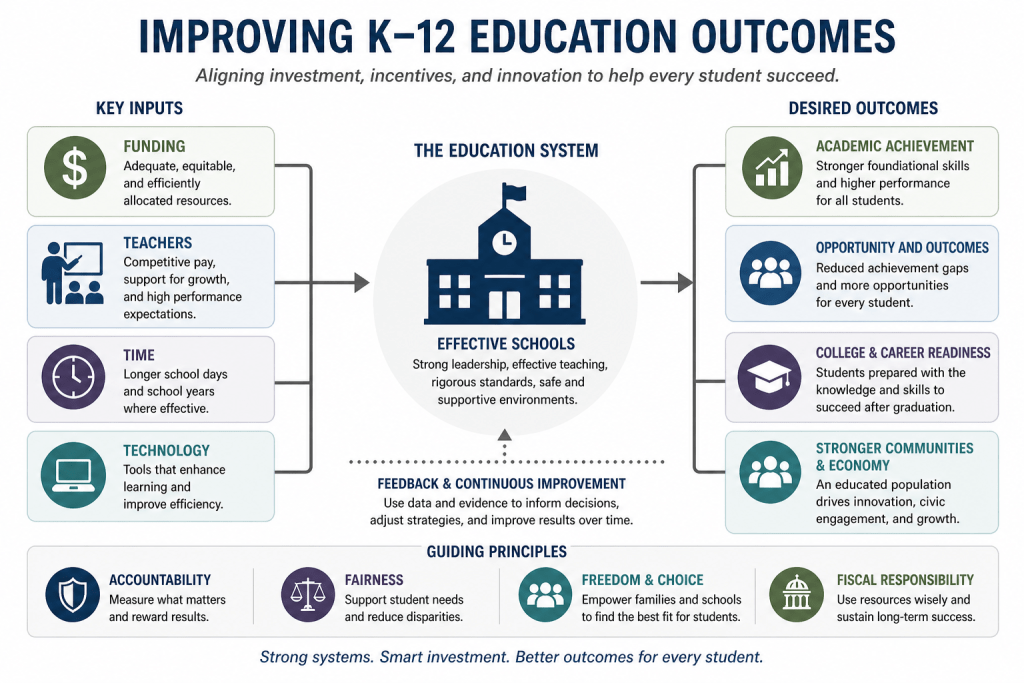
Improving K–12 education requires balancing increased investment with structural reform. Policies must align incentives, support effective teaching, and operate within the practical constraints of existing institutions.
We support:
- Increasing compensation for K–12 teachers
- Introducing performance-based elements into teacher compensation
- Expanding the use of technology to improve efficiency
- Lengthening the school day and school year where effective
- Providing additional state and federal funding to support these changes
If you have already made up your mind, then scroll to the bottom of the page and take the poll to let us know how you feel. If you need to hear more, please read the background section below.
Curious how your views compare? Early input has a meaningful impact—vote below (scroll down) to see the current results.
Your input helps us refine these policy positions.
Background
Improving educational outcomes requires both increased investment and structural reform.
Public education through the secondary level is viewed as a legal right in a number of states. While we are cautious about defining the provision of government services as rights—both because of the costs involved and the risk of diluting the meaning of fundamental constitutional rights—the economic and ethical arguments for public support of education are strong, and we support continued public funding for education.
Publicly Supported versus Publicly Provided Education
Public support for education does not necessarily require public provision. We believe the jury is still out on whether vouchers or charter schools offer a superior alternative. We therefore support experimental programs, provided they are subject to the same transparency and testing standards.
We believe that with voucher programs, it will be necessary to carefully constrain religious institutions from using public money to religiously indoctrinate students. We would support restricting or limiting the use of vouchers for religious schools if adequate safeguards cannot be established. This would be unfortunate because religious schools have been very effective in using limited funds to provide a quality education.
Teacher Compensation and Pay for Performance
Pay for performance is a complex issue in any field, and schools are no exception. Nevertheless, the principle of aligning compensation with performance is well established, and we support applying it within the public school system.
We also support higher compensation for K–12 teachers as part of broader reforms to tenure and collective bargaining. In particular, systems that make it difficult to address persistently ineffective teaching can have significant negative effects on student outcomes. Research has consistently shown that teacher quality is the most important in-school factor affecting student achievement, and that exposure to ineffective teaching can have lasting negative effects on student learning. These effects can compound when students are exposed to ineffective teaching in consecutive years.
Students’ learning must be the priority, which means supporting teachers in improving their performance while addressing persistent underperformance when it cannot be remedied.
Longer School Year and Longer School Days
We support greater financial support for primary and secondary schools to lengthen the school year and the school day. There is substantial evidence suggesting that these changes improve learning and retention.
Where Will the Money Come From
We support paying good teachers more and lengthening the school day and school year. These changes will require additional resources. We believe that the additional expense will be met partly by differentiating compensation based on performance, including retaining the most effective teachers and addressing persistently low performance, and partly by the better use of technology in schools to improve efficiency. To the extent that additional funding is necessary, we believe that it should be provided at the state or federal level. While we do not believe that funding is the principal cause of the difference between the performance of inner city versus suburban school districts, it makes sense to attempt to equalize educational funding. The measures listed may not provide sufficient funds to achieve the kind of educational outcomes that we want. If that is the case, we believe that the additional funds should come from some combination of broad-based taxes and the kind of economically efficient taxes described in the section on Taxation.
Go to the Table of Contents or to the Next Policy Position
Ready to weigh in? At this stage, each vote has a meaningful impact—see the current results after voting.
Your input helps us refine these policy positions.