Centrist Policy Positions and Politicians Worth Supporting
Author: Centrist Independent Voter, PAC
The Centrist Independent Voter Political Action Committee, Inc., also known as CIVPAC, was formally established in 2022. Its predecessor organization was founded in 2011 as the New Independent Party. CIVPAC is a nonprofit political action committee focused on moving the existing political parties toward the political center. CIVPAC’s purpose is twofold: first, to promote centrist solutions to difficult public policy problems; and second, to support moderate candidates, including Democrats, Republicans, and independents. CIVPAC’s logo is adapted from Francisco Goya’s The Sleep of Reason. The inscription in the image reads, “The Sleep of Reason Produces Monsters.”
This was a close call. Husted is stronger on several issues, school choice, right-to-work principles, and the Hyde Amendment. He also deserves credit for supporting Ukraine and for rejecting election denial after January 6.
But his Senate record matters. On controversial nominees, Trump’s tariffs, and congressional war powers, Husted has repeatedly sided with the administration even when other Republican senators chose to break with it.
Brown has plenty of positions we dislike, particularly on protectionism, unions, and price controls. But in the political environment of 2026, we believe the stronger need is for an independent legislative check on executive power.
Under a different president and Congress, this endorsement might go the other way.
Both candidates have strengths. Both have weaknesses. And under different national circumstances, I can easily imagine CIVPAC reaching the opposite conclusion.
Ashley Hinson has positions we like. She is generally more market-oriented than Turek. She supports right-to-work laws and school choice, positions substantially closer to our views on labor unions and K–12 education. She voted to accept the certified results of the 2020 presidential election and supported the Respect for Marriage Act. She is not simply an election-denying MAGA caricature.
Josh Turek, meanwhile, has plenty of positions we do not like.
He supports a wealth tax on billionaires. We do not. Our taxation, spending and debt policy favors a progressive tax system but puts considerable weight on economic efficiency, broad tax bases and long-term fiscal balance rather than new taxes on accumulated wealth.
Turek also supports federal food-price-gouging restrictions. We generally distrust price controls and laws that attempt to suppress price signals rather than address the underlying causes of scarcity.
He supports the PRO Act, which conflicts with our view that workers should be free to organize but that states should remain free to enact right-to-work laws. He would end school vouchers, while CIVPAC supports carefully designed experiments with vouchers and charter schools subject to common transparency and testing standards.
His foreign-policy views are also less developed than I would like in someone seeking a seat in the United States Senate.
So why endorse him?
Partly because endorsements are comparative judgments, not ideological purity tests.
Turek has demonstrated something we value enormously: an ability to represent people who do not necessarily share his party affiliation. Donald Trump carried his Iowa House district, yet Turek won it. He has crossed party lines on consequential votes and has been effective in a legislature overwhelmingly controlled by Republicans.
He is also substantially closer to us on abortion and personal liberty. And his combination of stronger border enforcement with a legal path for long-established undocumented residents is much closer to the compromise reflected in our immigration policy than either open-ended permissiveness or mass-deportation politics.
Turek also strongly opposes Trump’s broad tariffs. That puts him much closer to CIVPAC’s trade policy, which favors open trade, predictable rules and restoring greater congressional control over the use of tariffs.
Hinson, meanwhile, increasingly identifies herself with Donald Trump and his agenda. She has supported his broad tariff policies, which we regard as economically damaging and particularly inappropriate for an agricultural state.
She also voted against the 2026 Ukraine Support Act despite having previously expressed stronger support for resisting Russian aggression. CIVPAC’s Russia and Ukraine policy places considerable weight on deterrence, alliance reliability and denying Russia the benefits of territorial aggression.
Most importantly, the current political environment changes the weight we assign to these differences.
If Donald Trump and Trumpism were not dominant forces within the Republican Party, this endorsement might be different.
If Democrats controlled the presidency and Congress and the greater need were for a market-oriented check on the left, this endorsement might also be different.
In that environment, Hinson’s positions on taxes, school choice, labor policy and regulation might well carry greater weight.
But we do not make endorsements for an imaginary political system. We make them for the one that exists.
Today, institutional independence, constitutional restraint, respect for individual liberty, sensible trade policy, support for American alliances and a willingness by members of Congress to act as legislators rather than extensions of a president deserve unusual weight.
On balance, Turek comes out ahead.
Not by much.
That is why “endorsement by faint praise” seems about right. It is not meant as an insult to Turek. It is a recognition that serious political choices are often between imperfect alternatives.
CIVPAC’s purpose is not to find candidates with whom we agree on everything. It is to decide which available candidate is more likely to move government in a sensible, centrist and institutionally responsible direction.
In Iowa, by a narrow margin, we believe that candidate is Josh Turek.
Our endorsement of Chris Harden for Congress in Georgia’s 11th District is an unusual one because we previously endorsed his Republican opponent, John Cowan, in the Republican primary.
At the time, we admired Cowan’s willingness to challenge Marjorie Taylor Greene, reject conspiracy politics, and speak frankly about Donald Trump and the MAGA movement. We thought we were supporting an independent-minded Republican. In any case, he was still the best option among those running in the Republican primary.
After watching Cowan during the run-off primary and the general-election campaign, we no longer believe that describes the candidate before us. Cowan now says he is “100% behind President Trump.” The independence we valued seems to have disappeared just when political ambition made it inconvenient.
Harden is hardly a finished product. He is a first-time candidate and, in our view, has more learning to do—particularly on economics and foreign policy. But his background in political science, history and law shows in his strong commitment to due process, constitutional protections and the rule of law. He also describes himself as a moderate Democrat and has explicitly said that he believes in market solutions.
Most important, Harden comes across as a decent and principled person.
We do not confuse decency with policy expertise. But expertise can be acquired. Character and political independence are harder to manufacture.
As we say in the endorsement, Chris Harden may be a diamond in the rough. In this race, we would rather send someone to Washington who still has things to learn than someone who appears willing to discard deeply held principles when they conflict with political ambition.
Centrist Independent Voter has endorsed Democrat James Talarico for the United States Senate from Texas over Republican Ken Paxton.
This is not an endorsement of every part of Talarico’s agenda. He is to our left on several economic issues, and we have significant disagreements with some of his proposals on taxes, spending and health care. But he is also a thoughtful and unusually interesting candidate who has shown a willingness to talk about policy in practical rather than purely ideological terms.
Paxton’s attempt to overturn the results of the 2020 presidential election, his close identification with Trumpism and his broader record raise fundamental concerns about institutional responsibility and the independence we expect from a United States senator.
Talarico offers Texas voters a very different kind of politics. We will disagree with him, sometimes substantially. But we believe he would bring greater respect for democratic institutions, greater independence of judgment and a more constructive approach to governing.
In a Texas Senate race that has become genuinely competitive, that is enough to make the choice clear.
This is not an endorsement without reservations. Collins has too often supported President Trump when stronger independence would have been welcome. But in recent months she has also shown that she is still willing to break with her party on important institutional and policy questions, including voting against Todd Blanche for attorney general, opposing continued military action against Iran without congressional authorization, and challenging parts of the administration’s tariff and immigration policies.
Her Democratic opponent, Troy Jackson, is a serious candidate with substantial experience in Maine government. We agree with his support for Ukraine, but his positions on Medicare for All, abolishing ICE, eliminating the Senate filibuster and restructuring the Supreme Court move well beyond the pragmatic reforms CIVPAC favors.
We do not endorse Collins without reservations, but in this race we believe she is clearly the better choice.
Cooper is not a perfect fit for CIVPAC. We disagree with him on some economic and education policies, and Republican Michael Whatley is closer to us on several issues, including school choice and parts of immigration and energy policy.
But Cooper brings a long record of competent statewide leadership, experience governing with a Republican legislature, and demonstrated willingness to reach bipartisan agreements. He has also supported Ukraine, taken a pragmatic approach to immigration, and shown a healthier understanding of the institutional role of an elected official.
Whatley, by contrast, has made loyalty to President Trump central to his campaign and previously echoed unsupported claims about widespread fraud in the 2020 election.
Elections require choices among the candidates actually running. On balance, Cooper is clearly the better choice.
Centrist Independent Voter has endorsed Jessica Killin, the Democratic nominee for Congress in Colorado’s 5th Congressional District.
Killin is an Army veteran who describes herself as part of “Team Normal.” We disagree with her on some economic policies, particularly proposals aimed at restricting institutional housing investors and increasing assistance to homebuyers when housing supply remains constrained.
But Killin gets several important things right. She opposes President Trump’s tariffs, recognizes the need to increase housing supply, supports a combination of border security and legal status for otherwise law-abiding immigrants, and believes Congress should reclaim authority it has surrendered to the executive branch.
Her foreign-policy background is also important. Killin served eight years in the Army and worked on NATO expansion and peacekeeping in Europe. She has spoken strongly about the importance of American alliances and NATO to U.S. national security.
Her Republican opponent, Representative Jeff Crank, has taken the other side on several issues that matter greatly to us, including voting against the Ukraine Support Act and against congressional efforts to limit unauthorized presidential military action against Iran.
We do not expect candidates we endorse to agree with us on everything. We do expect them, on balance, to offer the better combination of sound policy, independent judgment and respect for democratic institutions.
Centrist Independent Voter has endorsed Republican Representative Brian Fitzpatrick for re-election in Pennsylvania’s 1st Congressional District.
Fitzpatrick is not a perfect match for CIVPAC on every issue. His Democratic opponent, Bob Harvie, is also a serious candidate. But Fitzpatrick has built one of the strongest records of bipartisan cooperation and independent judgment in Congress.
He co-chairs the bipartisan Problem Solvers Caucus, has repeatedly ranked among the House’s most bipartisan members, and has been a particularly strong supporter of Ukraine and America’s alliances. In 2026, he helped force a House vote on additional assistance for Ukraine despite opposition from Republican leadership.
Fitzpatrick has also demonstrated a willingness to disagree with his own party when he believes it is warranted.
Centrist Independent Voter believes that behavior should be rewarded. If we want both political parties to produce more pragmatic, institutionally serious members of Congress, independent voters have to support those who actually govern that way.
I have substantial disagreements with New York City Mayor Zohran Mamdani. He is a democratic socialist, and many of his signature proposals rely too heavily on price controls, subsidies and government provision of goods and services.
But good policy should be recognized even when it comes from someone with whom we usually disagree. To my mild surprise, Mamdani has given me several opportunities.
This is good economics. Congestion imposes costs on everyone else using the road. Charging for that scarce resource encourages some drivers to travel differently while allowing those who value the trip most to continue making it.
His recent small-business deregulation deserves credit as well. The administration has proposed more than 50 reforms eliminating obsolete permits, duplicative licenses, paperwork and unnecessary fines. Among them is eliminating a second permit for restaurants that already have a food-service permit merely to sell ice cream. Regulatory complexity is a fixed cost that falls particularly heavily on small firms and new entrants. Removing rules that accomplish little makes markets more competitive.
The usual political justification is that wealthy people can afford to pay more. I find another argument more persuasive.
Like the carbon tax CIVPAC supports, this tax has an attractive either-or quality. If owners respond strongly, some will sell their seldom-used apartments or put them into productive residential use. The tax then partly destroys its own tax base—but increases the effective housing supply. That is success, not failure.
If owners barely respond, their demand is relatively inelastic. The city receives a sustainable source of revenue while creating relatively little economic distortion.
That is close to an ideal tax: either the distortion it creates is beneficial or the distortion is small enough that the tax raises substantial revenue.
Unfortunately, Mamdani does not apply that same understanding of prices and incentives consistently.
His rent freeze is the clearest example. The Rent Guidelines Board, dominated by his appointees, voted in June to freeze rents on both one- and two-year leases covering roughly one million rent-stabilized apartments. Lowering the legal price of an existing apartment may benefit its current tenant. It does not create another apartment. Over time, price controls discourage investment, maintenance and additions to supply—the opposite of what New York needs if it wants more housing.
I am similarly skeptical of municipal grocery stores. Mamdani’s administration plans five city-supported stores offering selected groceries at prices below prevailing levels. But groceries do not become cheaper because government declares a lower retail price. Someone pays the difference. Subsidizing selected government-backed stores also forces private grocers to compete against businesses whose losses taxpayers can absorb.
Nor am I persuaded by fare-free buses or the proposed $30 minimum wage. There can be good reasons to subsidize public transportation because it produces benefits beyond the individual passenger. But zero is not automatically the economically correct fare, particularly when removing fares increases demand while eliminating revenue that could improve frequency and reliability.
And setting wages far above the market wage can help workers who retain their jobs while making it harder for less-skilled workers to obtain one.
There is a broader lesson here.
CIVPAC does not believe a policy should be judged by whether it was proposed by a democratic socialist, a conservative or a centrist. I would rather ask: Who really bears the cost? What incentives does the policy create? What happens to supply? And is the resulting distortion harmful or useful?
Apply those questions consistently and Mamdani gets some surprisingly good answers.
He also gets some very bad ones.
The interesting thing is that the same economics explains both.
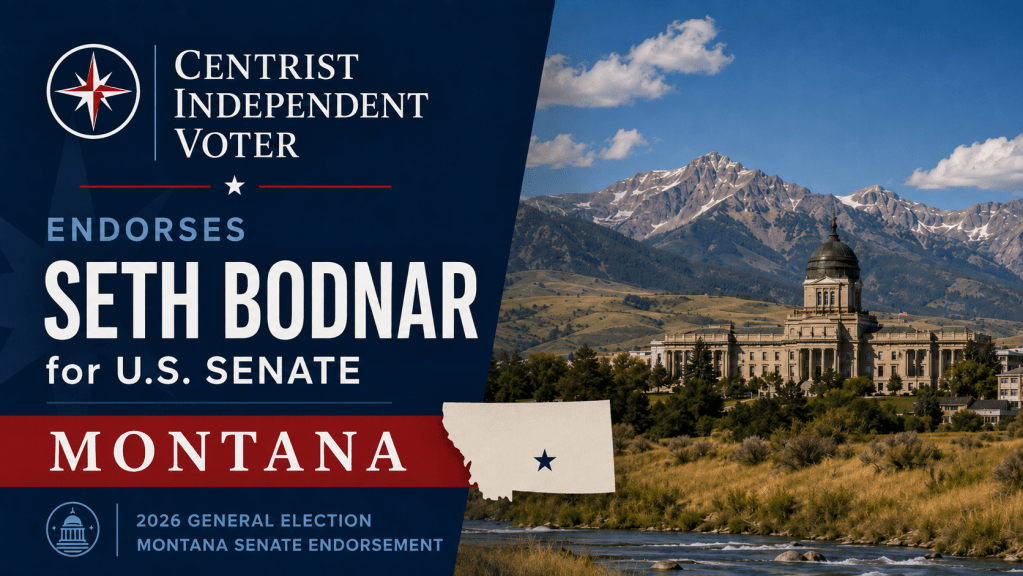
Centrist Independent Voter has endorsed independent candidate Seth Bodnar for the U.S. Senate in Montana.
Bodnar combines military service, executive leadership, and a strong commitment to restoring Congress’s constitutional role. He has also built an unusually broad coalition, with support from both prominent Republicans and Democrats.
The endorsement also addresses the central challenge facing independent candidates: the spoiler problem. In Montana, recent polling and bipartisan support suggest Bodnar may actually be the strongest alternative to Trump-aligned Republican Kurt Alme.
The independent candidate is not automatically the spoiler. Sometimes the strategic vote is the independent one.