
Summary
We believe that artificial intelligence should be regulated with a focus on clear harms, high-risk uses, competition, and existing legal obligations.
We support policies that:
- Focus first on clear harms and high-risk uses
- Protect privacy, cybersecurity, elections, national security, and critical infrastructure from fraud, impersonation, cyberattacks, and foreign interference
- Protect competition by preventing regulation from becoming a barrier that entrenches large incumbent firms
- Develop practical compensation systems for copyrighted material used in commercial AI training, preserving incentives to create without making AI development legally unworkable
- Require AI data centers to pay the full cost of the electricity, grid capacity, water, land, and infrastructure they use
- Recognize that AI may require future adjustments in labor-market, education, tax, and income-support policy
- Prevent AI from becoming a black-box workaround for existing legal duties involving accuracy, non-discrimination, due process, consumer protection, and professional responsibility
Curious how your views compare? Early input has a meaningful impact—vote below (scroll down) to see the current results.
Your input helps us refine these policy positions.
Background
Artificial intelligence presents real opportunities and real risks.
AI may improve productivity, accelerate scientific research, reduce the cost of services, expand access to expertise, and help individuals and organizations perform tasks that once required far more time and specialized knowledge.
It may also disrupt labor markets, weaken privacy, increase cybersecurity risks, distort elections, concentrate economic power, threaten intellectual property rights, and create new opportunities for fraud, manipulation, and regulatory evasion.
The central challenge is that AI may be unusually difficult to regulate well. The technology is changing rapidly, the risks are uncertain, and the firms most capable of explaining the technology to regulators often have strong incentives to shape regulation in ways that protect their own market position.
At the same time, foreign competitors may not follow U.S. rules, and rules that are too rigid may become obsolete quickly or entrench today’s dominant firms.
That does not mean government should do nothing. It means government should be cautious about both extremes: pretending that AI can be safely left entirely to private actors, and pretending that regulators can confidently design comprehensive rules for a technology still changing this quickly.
Clear Harms and High-Risk Uses
AI regulation should focus first on clear harms and high-risk uses.
The goal should not be to regulate every use of AI in the same way. Low-risk uses should generally be left alone. Higher-risk uses require greater scrutiny when AI affects safety, security, elections, critical infrastructure, fraud, impersonation, or major decisions that affect people’s lives.
A politically realistic approach should identify where AI can cause concrete harm and design rules around those risks, rather than trying to write a single comprehensive regulatory code for the entire technology.
This is a difficult balance. Rules that are too weak may allow real harms. Rules that are too burdensome may reduce competition, slow beneficial innovation, and leave the United States weaker relative to foreign competitors.
Privacy, Cybersecurity, Elections, National Security, and Critical Infrastructure
AI may create serious risks for privacy, cybersecurity, election integrity, national security, and critical infrastructure.
AI can be used to generate misleading political content, impersonate candidates or public officials, create fake audio or video, microtarget voters with false information, or flood the public square with low-cost propaganda. These risks are especially serious when foreign governments or other hostile actors use AI to influence American elections.
AI may also increase cybersecurity risks by making it easier to identify vulnerabilities, generate deceptive communications, automate attacks, or impersonate trusted individuals and institutions. These risks are especially serious when they affect financial systems, energy infrastructure, communications networks, health systems, public agencies, or military and intelligence operations.
The goal should not be to regulate ordinary political argument, satire, or the legitimate use of AI to communicate ideas. Free political speech must remain protected. But government has a legitimate role in preventing fraud, impersonation, foreign election interference, cyberattacks, and deceptive uses of AI that make it difficult for voters, consumers, or public officials to know whether they are dealing with a real person, real institution, or legitimate source of information.
Policy should focus on disclosure, authentication, enforcement against impersonation and fraud, cybersecurity, and foreign-interference prevention. AI should not become a cheap and scalable tool for deceiving voters, manipulating consumers, attacking critical systems, or undermining confidence in legitimate institutions.
Competition and Regulatory Capture
AI policy should protect competition.
A major risk is that regulation will be written in ways that favor the largest firms. Large incumbent firms may be able to absorb compliance costs that smaller competitors cannot. They may also have greater access to regulators and greater ability to shape technical standards in their own interest.
That would be a serious mistake.
Regulation should not become a moat around today’s dominant AI firms. Public policy should encourage innovation while preventing fraud, discrimination, privacy violations, cybersecurity failures, and the concentration of unchecked power.
This is another reason to focus on clear harms, high-risk uses, and market structure rather than trying to regulate every use of AI in the same way. Rules should be strong enough to address real harms, but not so burdensome that only the largest firms can comply.
Intellectual Property and Creative Work
AI policy should protect intellectual property without crippling beneficial innovation.
Copyright exists partly to preserve incentives to create. If AI systems can freely absorb copyrighted books, journalism, music, art, software, and other creative work without compensation, they may weaken the economic foundation that supports future creation. That concern is especially serious where AI outputs compete directly with the works used to train them.
At the same time, requiring individualized permission for every copyrighted work used in AI training could make compliance impossible, slow innovation, and entrench the largest firms, which are the only firms likely to afford comprehensive licensing deals.
The problem is analogous to music-streaming compensation, but harder. Streaming services distribute or perform identifiable songs, making usage easier to count. AI training often uses creative works in ways that are not directly observable in any individual output. A copyrighted book, article, image, song, or software program may influence a model without being separately identifiable in the model’s later responses.
The goal should therefore be a practical compensation system rather than either extreme. Congress and the courts should distinguish among different uses: noncommercial research, training on lawfully acquired material, training on pirated material, use of protected material to build direct substitutes, and outputs that reproduce or closely imitate protected expression. These are not all the same.
A politically realistic approach may require collective licensing, standardized royalty systems, opt-out or opt-in mechanisms for some categories of work, and stronger remedies when AI systems reproduce protected expression or are trained on unlawfully obtained material. The details will be difficult, but the principle is straightforward: AI should not destroy the incentive to produce valuable creative work, and copyright law should not prevent society from gaining the benefits of AI.
Resource Use and Infrastructure
AI infrastructure should pay the full cost of the resources it uses.
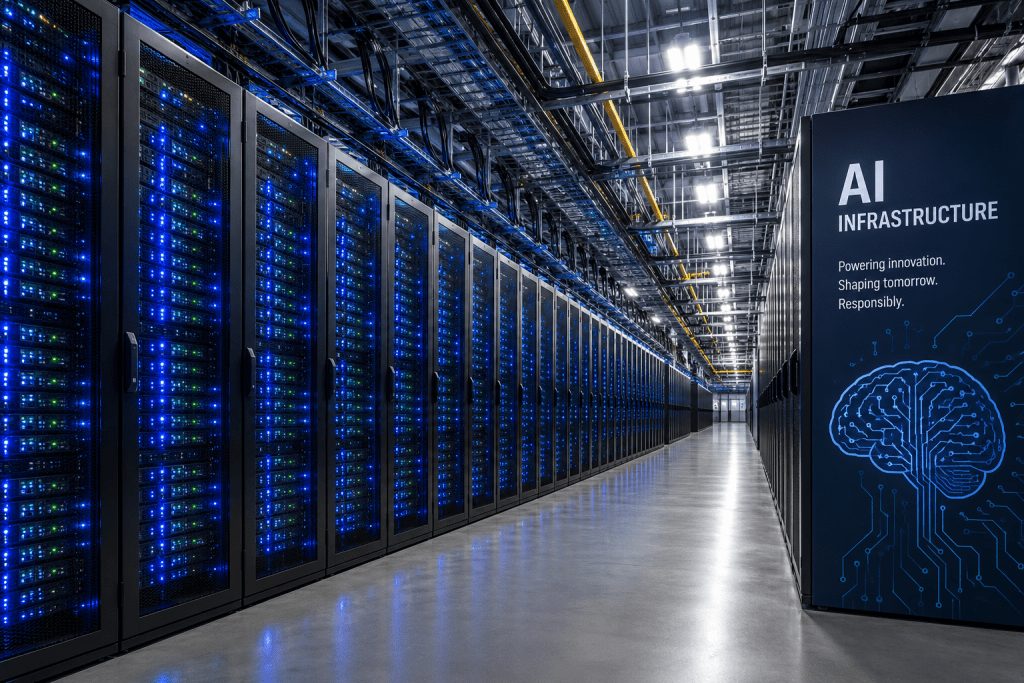
Data centers require electricity, grid capacity, water, land, transmission infrastructure, and local public services. The issue is not that AI uses resources. Valuable activities often do. The issue is whether those resources are properly priced.
Electricity, water, carbon emissions, grid reliability, and local infrastructure costs should not be hidden, subsidized, or shifted onto other consumers.
Where AI data centers impose costs on the electric grid, water systems, or local infrastructure, those costs should be reflected in prices or direct charges. Real-time electricity pricing, cost-causation in utility rates, transparent water pricing, and appropriate environmental pricing are better tools than arbitrary limits on AI development.
Labor Markets, Education, Tax Policy, and Income Support
AI may have large effects on labor markets.
If AI substantially increases productivity, it may also increase incomes, profits, and tax revenue over time. That could make it easier to finance broader income support or other public priorities without raising tax rates.
But if AI changes the demand for labor faster than workers can adapt, the adjustment could be painful. Some workers will use AI to become more productive. Others may find that the jobs they trained for change, shrink, or disappear.
The first policy response should not be to slow AI adoption or protect existing jobs from technological change. That approach would reduce productivity growth and may leave the United States weaker relative to foreign competitors.
Instead, policymakers should be honest about the limits of retraining programs, make education and credentialing systems more responsive, and consider whether broader income support becomes more important if AI increases productivity while also increasing labor-market instability.
CIVPAC’s position on a Guaranteed Basic Income is relevant here. A GBI may be a more efficient and less distortionary way to support people through economic disruption than minimum-wage mandates, industry subsidies, protectionist regulation, or a patchwork of means-tested transfer programs.
The purpose of a GBI in this context would not be to prevent technological change. It would be to help people adjust to change while preserving the productivity gains that make higher living standards possible.
Existing Legal Duties and Black-Box Evasion
AI should not become a black-box workaround for existing legal duties.
Stronger oversight is appropriate when AI affects areas already subject to legal duties, professional standards, or public accountability. These include employment, credit, insurance, health care, education, law enforcement, public benefits, national security, elections, and critical infrastructure.
The goal should not be to prohibit AI use in these areas. In some cases, AI may improve accuracy, reduce costs, or expand access. But AI should not become a way to avoid existing duties involving accuracy, non-discrimination, due process, consumer protection, or professional responsibility.
This is especially important because some AI systems cannot easily explain their recommendations in ordinary human terms. Regulation should therefore focus on auditability, testing, error correction, human responsibility, and compliance with existing legal duties rather than requiring perfect explanation of every model output.
Human decision-making is also often biased in ways decision-makers themselves do not recognize. The point is not that people are lying when they deny bias; often they sincerely believe they are judging only merit. The experience with blind auditions for orchestras illustrates the larger point: changing the decision process can reduce the influence of irrelevant personal characteristics. AI may offer similar benefits if it is designed and tested well. But AI can also reproduce historical bias or use proxies for protected characteristics.
Anti-discrimination law should therefore judge AI against realistic alternatives, including actual human decision-making, not against an impossible standard of perfect neutrality. Disparate outcomes should trigger serious review, validation, and comparison with available alternatives, including the human processes AI would replace. AI should not receive immunity from existing legal standards, but neither should it be held to a standard of neutrality that human decision-makers have never met.
Conclusion
Artificial intelligence is likely to create both real benefits and real harms.
The correct response is not panic, and it is not complacency. Government should focus first on clear harms and high-risk uses, especially where AI threatens privacy, cybersecurity, election integrity, national security, or critical infrastructure.
AI policy should also protect competition, preserve incentives to create, require honest pricing of the resources AI consumes, and recognize that AI may require future adjustments in labor-market, education, tax, and income-support policy.
At the same time, AI should not become a black-box workaround for existing legal duties. Where existing laws already require accuracy, non-discrimination, due process, consumer protection, or professional responsibility, the use of AI should not erase those obligations.
A realistic AI policy must recognize both the limits of private self-regulation and the limits of government’s ability to regulate a technology that is still changing rapidly.
Ready to weigh in? At this stage, each vote has a meaningful impact—see the current results after voting.
Your input helps us refine these policy positions.
Note: This is an ongoing CIVPAC reader poll. It is not scheduled to close, so you can ignore any Crowdsignal prompt offering to send “final results.” You should be able to see current results after voting.
Go to the Table of Contents or to the Next Policy Position