
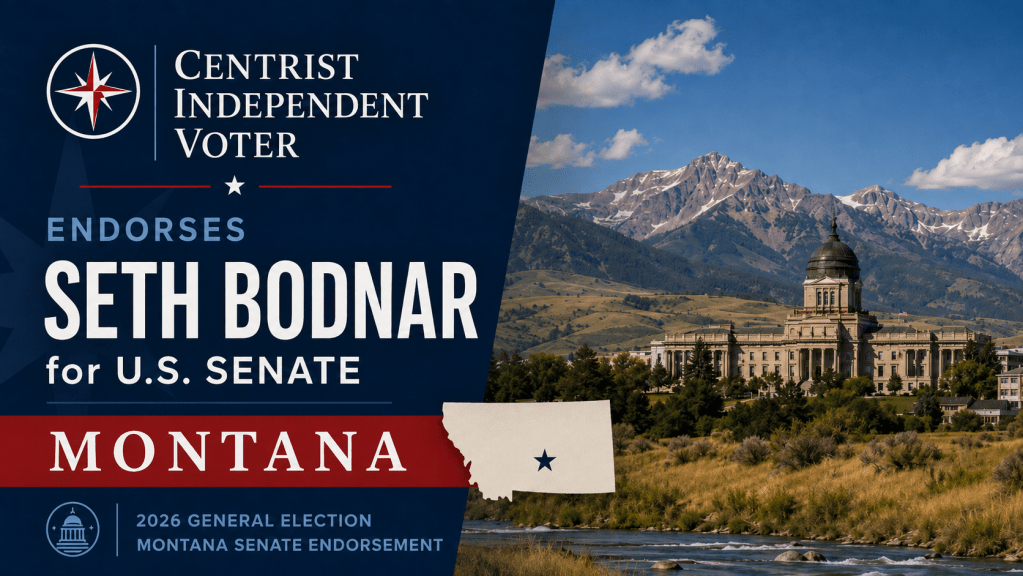
CIVPAC endorses independent candidate Seth Bodnar for the United States Senate in Montana.
Bodnar is a former Green Beret, business executive, and president of the University of Montana. His career reflects an unusual combination of military service, executive leadership, academic administration, and practical experience managing large institutions. He is running as an independent because he believes the two major parties have become more concerned with maintaining power than with governing effectively.
That diagnosis is particularly persuasive in this race. Senator Steve Daines withdrew shortly before Montana’s filing deadline, clearing the way for Kurt Alme to enter the race and quickly receive the support of Donald Trump and the Republican establishment. The maneuver effectively denied Montana Republicans a competitive primary in an open U.S. Senate race.
Alme is by background a qualified and fairly conventional Republican. In a different political environment, that would weigh substantially in his favor. But this is not a conventional political environment.
Alme has made his relationship with Donald Trump an affirmative credential for office. He emphasizes that Trump has supported him for a position three times—twice as U.S. attorney and now for the Senate—and says he looks forward to helping ensure the success of the remainder of Trump’s second term.
Centrist Independent Voter is independent; it is not indifferent. We do not begin with a preference for either Democrats or Republicans, and in a more normal political period we would expect our endorsements to divide relatively evenly between traditional candidates of the two parties. But Donald Trump’s continuing influence on the Republican Party cannot simply be treated as another disagreement over taxes, regulation or spending. His attacks on democratic institutions, willingness to disregard traditional limits on presidential power and demand for personal loyalty from Republican officeholders make allegiance to Trump a substantial negative in our evaluation of candidates.
Sometimes a Republican establishes a sufficiently independent record to overcome that concern. Alme has not done so. A few conventionally Republican positions on limited government or congressional authority do not outweigh the fact that he has chosen to present Trump’s repeated support and the advancement of Trump’s second-term agenda as reasons Montana voters should elect him.
Bodnar offers a substantially different model. He has argued that Congress must reclaim its constitutional authority over war rather than routinely surrendering that responsibility to presidents of either party. He opposes the chaotic use of tariffs that disrupts agricultural markets and raises costs, saying tariffs should be treated as “tools, not toys.” On housing, he emphasizes increasing supply, reducing regulatory barriers and addressing construction costs rather than trying to restore affordability through price controls.
His appeal also crosses ordinary party lines. Bodnar has been endorsed by former Republican Governor Marc Racicot, former Republican state party chair Susan Geise, and former Democratic Senators Jon Tester and Max Baucus. He has also attracted endorsements from organizations more commonly associated with Democratic candidates, including the Montana AFL-CIO and VoteVets.
That breadth of support is unusual. More important, it suggests that Bodnar’s independence is not merely a campaign label.
The spoiler question
The strongest argument against voting for an independent candidate is often not ideological. It is strategic.
A voter may prefer the independent but fear that voting for that candidate will divide the opposition and help elect the candidate the voter likes least. That fear is rational. It is also one of the principal reasons independent candidates have so much difficulty becoming viable in the United States.
The logic can become self-reinforcing:
I prefer the independent, but the independent cannot win. Therefore I will vote for the major-party candidate. Because voters make that calculation, the independent cannot win.
Centrist Independent Voter takes this problem seriously. Political independence is not valuable if all it accomplishes is electing someone most independent voters oppose.
But “spoiler” is not a label that automatically belongs to the independent candidate.
In a three-way race, the relevant question is not which candidate has an “I” rather than a “D” or “R” after the name. It is which candidate can assemble the coalition necessary to win. If an independent becomes the stronger alternative to the leading major-party candidate, the strategic-voting calculation changes with it.
That possibility is no longer theoretical in Montana.
The most recent public three-way polls have consistently placed Bodnar ahead of Democratic nominee Alani Bankhead. In three late-July surveys, Bodnar received 27% to Bankhead’s 22%, 27% to 24%, and 24% to 22%. A four-poll average puts the two nearly even because an older June poll had Bankhead ahead, but the movement in the more recent surveys has favored Bodnar.
Polls testing the candidates separately against Alme also provide evidence that Bodnar can attract voters who would not support a Democrat. A May survey found Bodnar tied with Alme at 50–50 while Democratic alternatives performed substantially worse. Other recent polling has likewise suggested that Bodnar has a plausible head-to-head path.
No single poll proves electability, and interested groups have sponsored much of the polling in this race. But polling is only one piece of the evidence.
Bodnar has attracted prominent Republicans and Democrats to the same candidacy. His campaign has demonstrated substantially greater financial and organizational strength than Bankhead’s. Democratic legislators themselves have publicly urged the candidates to consider consolidating behind whichever candidate offers the strongest path, noting Bodnar’s financial advantage and unusually broad endorsements.
Montana’s electoral history makes that evidence particularly important.
The last Democrat to win a statewide election in Montana was Jon Tester in 2018. Tester lost his Senate seat in 2024, leaving Republicans in control of every statewide elected office. Montana has moved from a state with a considerable tradition of ticket splitting to one in which a conventional Democratic candidate faces a substantial structural disadvantage.
Bodnar’s ability to attract Republicans, Democrats and independents is therefore not merely an attractive expression of bipartisanship. It may be the only realistic way to assemble a majority capable of defeating Alme.
Bankhead has argued that voters should reject Bodnar in significant part because of a sex-discrimination lawsuit involving the University of Montana during his presidency. The allegations deserve to be taken seriously. But they should also be described accurately.
Bodnar was not personally a defendant in the lawsuit. Some of the conduct alleged predated his arrival at the university. The university denied wrongdoing and settled without an admission of liability. Of the $350,000 settlement, the 18 plaintiffs collectively received about $33,400—roughly $1,855 each—with most of the remainder going to attorneys’ fees and litigation costs.
The litigation did not produce a finding that Bodnar discriminated against women. His campaign points out that during his presidency the University of Montana went from one female dean to seven and says that 78% of employee promotions during his tenure went to women. Those figures come from the campaign, but they provide relevant context for evaluating the broader charge against his leadership.
The filing and withdrawal deadlines have passed. There will be three serious candidates on the ballot. The strategic decision-making therefore belongs to the voters.
For voters who want an alternative to Alme, the question should be straightforward: Which candidate has demonstrated the better ability to assemble a winning coalition?
At this point, the evidence points to Seth Bodnar.
That conclusion could change if the evidence changes. But voters should not assume that supporting Bankhead is the “safe” strategic choice merely because she is the Democratic nominee, while supporting Bodnar is somehow a vote thrown away. In this race, that conventional assumption may have the problem exactly backwards.
The independent candidate is not necessarily the spoiler. If Bodnar demonstrates that he can unite the broader anti-Alme coalition while Bankhead cannot, then Bankhead’s candidacy—not Bodnar’s—is what divides the potentially winning coalition.
That is an uncomfortable conclusion for a political system organized around two parties. It is also exactly the kind of conclusion voters must occasionally be willing to reach if independent candidates are ever to become more than protest votes.
Our reservations
We will not agree with Bodnar on every issue. His approach to Medicaid and some other domestic programs is more conventionally center-left than CIVPAC’s. We would also like to see a more detailed plan for controlling federal spending and placing entitlement programs on a sustainable long-term path.
But an endorsement does not require complete agreement. It requires a judgment about character, priorities, competence, political independence and the alternatives available to voters.
Bodnar is also one of several independent Senate candidates associated with an effort to create a new caucus outside the two major parties. Even a small group of genuinely independent senators could prevent either party from automatically controlling the Senate and force genuine negotiation over leadership, budgets, appointments and legislation.
That possibility is enormously attractive to Centrist Independent Voter. But that potential power comes with an obligation.
If independent senators find themselves holding the balance of power, they should regard that result as a mandate for responsible, pragmatic government, not as a license to use outsized leverage to pursue pet ideological or populist causes. Their purpose should be to make Congress work better, strengthen its institutions and make bipartisan governing easier. Independence should loosen the grip of the two parties, not create another faction demanding ideological tribute for its votes.
Montana has a distinguished history of supporting political figures who are difficult to classify neatly and who place the state’s interests ahead of national party commands. Seth Bodnar is running in that tradition.
In this particular three-way race, political independence is not merely an argument for giving voters another choice. There is increasing evidence that it may offer them the most viable choice for defeating a Trump-aligned Republican and electing a senator capable of governing outside the constraints of either party.
CIVPAC endorses Seth Bodnar for the United States Senate.