
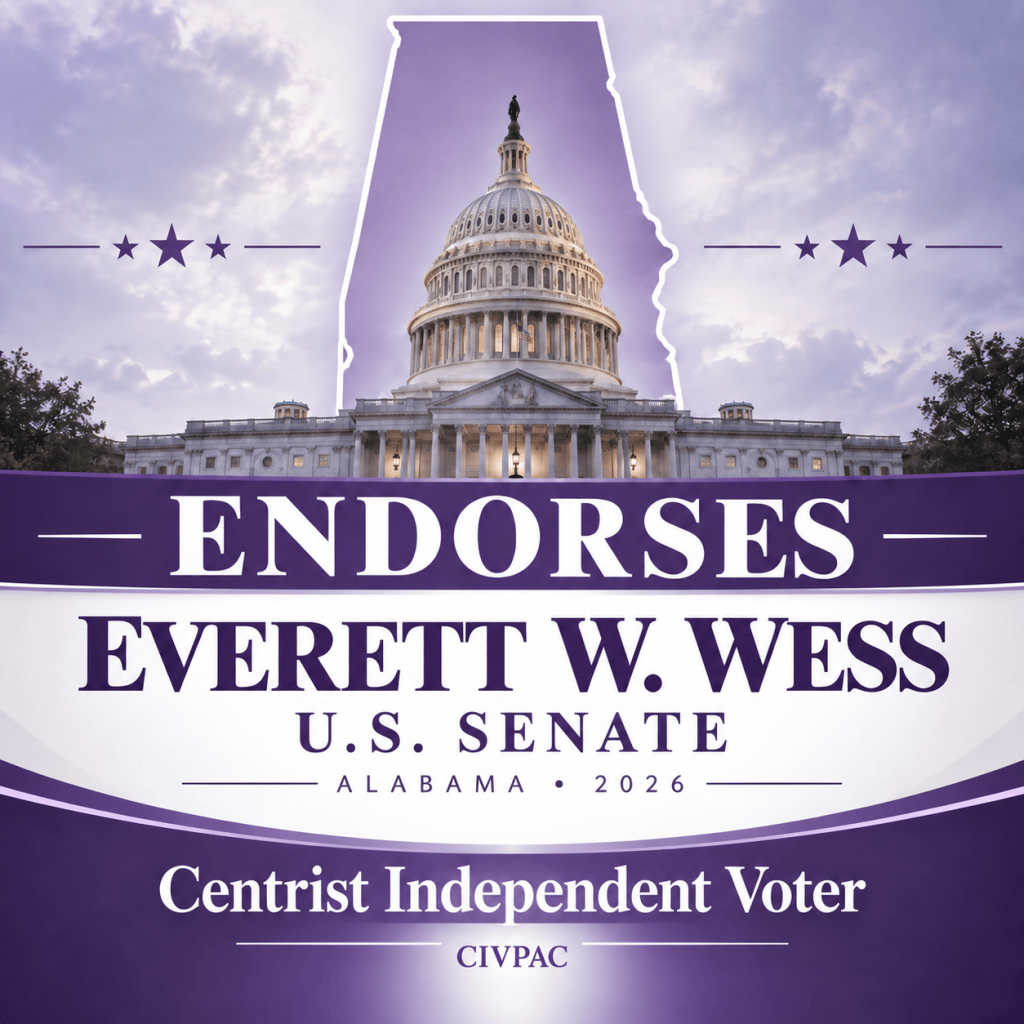
The major-party nominees for Alabama’s open United States Senate seat are Republican Congressman Barry Moore and Democratic attorney Everett W. Wess. There is also an independent candidate, Craig Jelks.
After reviewing the available record, we believe Everett W. Wess is the substantially better choice. Centrist Independent Voter therefore endorses Wess for the U.S. Senate from Alabama.
Wess is not a conventional career politician. His résumé is unusually broad. Before entering law, he spent roughly 17 years working in information technology, including work connected with NASA and the Patriot missile system, according to a May interview with Spectrum News. He later became an attorney, practiced for more than two decades, represented indigent defendants in federal court, and served as a municipal judge. His campaign biography also details degrees in computer science, business and law.
That combination of technical, business and legal experience is attractive to CIVPAC. So is something less easily summarized on a résumé: Wess appears to understand the institutional role of the United States Senate, an issue that has become increasingly important in CIVPAC’s broader philosophy.
Wess has emphasized Congress’s constitutional responsibilities and the need for greater congressional authority and accountability. In his Spectrum interview, he spoke repeatedly about restoring stability and civility to government and said he expected to work constructively with Alabama’s Republican senator, Katie Britt, despite their political differences. More recently, he has argued that Congress has an important constitutional role in trade and tariff policy and criticized excessive presidential control over those decisions.
Those are not dramatic positions. That is part of their appeal.
Wess’s stated priorities include voting rights, equal justice, affordable health care, public education and economic opportunity. His campaign has emphasized maintaining support for rural hospitals, while his Spectrum interview stressed education, university research and preserving educational opportunities such as Pell Grants.
Our Reservations
Our principal reservation about Wess is not something he has said. It is how much he has not yet said.
His campaign has published relatively little detailed policy material. We have not found sufficiently specific positions on several questions important to CIVPAC, including long-term fiscal policy, taxes and regulation, energy and climate policy, or America’s international role. Most importantly, we have not found a clear public statement from Wess on continued American support for Ukraine and the broader U.S. commitment to NATO and the postwar international order.
We would prefer to know much more.
We also do not assume that because Wess is a Democrat he necessarily shares either CIVPAC’s views or those of the national Democratic Party on issues he has not addressed. An endorsement should be based on a candidate’s own record.
But elections require choices between the candidates actually on the ballot.
Craig Jelks: The Independent
Jelks is an educator and political-science professor. He attended Howard University and Columbia University, studied at Oxford, interned on Capitol Hill for Alabama Republican Senator Richard Shelby and Senate Majority Leader Bill Frist, and now serves as Political Science Coordinator at Miles College. His campaign emphasizes education, health care and affordability rather than a comprehensive federal platform.
Jelks criticizes President Trump’s tariffs for increasing consumer prices and harming producers, including Alabama farmers. His campaign says that tariffs and trade policies are contributing to higher household costs. That is broadly consistent with CIVPAC’s trade policy, which generally favors open trade and greater congressional oversight of presidential tariff authority.
Jelks has also criticized Republicans for abandoning fiscal conservatism when supporting legislation that increases federal deficits. What we don’t see are explicit tax or spending proposals for reducing the deficit.
His position on presidential war powers is unusually explicit. During the Iran conflict, Jelks said he would support a War Powers resolution pausing military intervention until Congress authorized it, arguing that senators need to be capable of telling a president no. He later criticized Moore for supporting presidential authority over the conflict.
Reservations About Jelks
Jelks nevertheless leaves several substantial questions unresolved.
His cultural views are considerably more conservative than CIVPAC’s generally libertarian approach to personal and social questions. Jelks has said that he believes marriage should be between one man and one woman and has criticized Democratic approaches to gender identity.
Foreign policy presents a larger uncertainty.
Jelks has said the United States is “overly focused on foreign affairs” and has described foreign affairs as a distraction from domestic concerns such as groceries, health care and education. He has also criticized recent American actions abroad and argued that the United States risks being viewed as a bully.
Some of that rhetoric accompanies a legitimate constitutional argument about war powers. But Jelks has not, so far as we can determine, publicly explained his positions on Ukraine, NATO, Russia, China, Taiwan, Iran and Israel. His campaign’s published issues page contains no foreign-policy section beyond his general observation that the country is overly focused abroad.
That leaves unresolved whether Jelks is principally arguing for greater congressional control over American foreign policy or whether his views reflect a broader preference for American retrenchment. The distinction is important given CIVPAC’s emphasis on deterrence, reliable alliances and continued resistance to Russian aggression in Ukraine.
There is also an important institutional question: Jelks has not publicly explained with which party, if either, he would caucus in the Senate. His campaign says that as an independent he would answer to Alabama voters rather than party leaders, but that does not resolve who he would support for the organizational control of the Senate.
For an independent senator, particularly in a closely divided chamber, that is not a trivial question.
Finally, Jelks has yet to demonstrate a substantial statewide electoral constituency. Surprisingly, he recently called upon Wess to withdraw and argued that an independent could assemble a broader coalition, comparing the situation to independent candidacies elsewhere. But the only publicly available general-election poll we found did not test Jelks by name. It showed Moore at 47 percent, Wess at 32 percent, “someone else” at 1 percent and 20 percent undecided.
Jelks has deliberately emphasized a low-cost, message-driven campaign—his website tells supporters, “Don’t start with money. Start with the message.” That is certainly an interesting strategic choice, but there is not yet public evidence that he has developed a statewide electoral base.
That creates an unavoidable spoiler concern. Hiis argument that an independent candidacy offers the most viable alternative to Moore has not yet been demonstrated by polling or other measurable statewide support.
Even apart from those issues we find that his social conservativism and intentional dismissal of foreign policy issues would make it difficult for us to endorse him.
The Problem With Barry Moore
Our most serious concern with Moore involves democratic institutions.
Moore voted to support objections to the 2020 electoral count after the January 6 attack on the Capitol. More than five years later, his current Senate campaign website still refers to the 2020 election as a “stolen election” and presents his loyalty to Donald Trump as a principal qualification for the Senate. The campaign says that Moore will stand with President Trump in the Senate.
A senator’s first obligation is to the Constitution, not to a president of either party. CIVPAC has increasingly emphasized the need for Congress to reclaim its role as an independent constitutional branch.
We are also troubled by Moore’s record on Ukraine. On June 4, 2026, he voted against the Ukraine Support Act, which included additional military-financing loans and security assistance for Ukraine as well as sanctions and other measures directed at Russia. For CIVPAC, continued resistance to Russian aggression is not an incidental foreign-policy question. Our Russia and Ukraine policy treats support for Ukraine as important both to European security and to maintaining the credibility of American deterrence elsewhere in the world.
Nor does Moore’s economic policy record provide a compelling counterweight.
Moore’s background as a small-business owner and his skepticism toward unnecessary regulation deserve some weight. His campaign emphasizes reducing federal regulatory burdens and his firsthand experience operating a business. But its broad assertion that government should essentially “get out of the way” sometimes goes further than our preference for evaluating regulations on their costs and benefits. He also favors broad tax cuts rather than the tax reform and fiscal discipline CIVPAC would prefer.
More troublingly, Moore has strongly supported President Trump’s tariff policies, telling an Alabama news outlet that Gulf Coast industries were excited about the tariffs and arguing that they would benefit American producers and manufacturing. CIVPAC’s trade policy is skeptical of protectionism and of using tariffs as a broad or discretionary instrument of economic policy.
Wess has not yet given us all the answers we would like. Moore has given us answers on some of the questions that matter most—and too many of those answers are wrong.
Everett Wess brings substantial professional experience, respect for law, an appreciation of Congress’s constitutional responsibilities, and an expressed willingness to work across party lines. His incomplete policy record warrants continued scrutiny, but it does not outweigh the much more serious concerns raised by Barry Moore’s demonstrated record. Craig Jelks does not appear to be a viable candidate and is too socially conservative and dismissive of foreign policy to gain our endorsement.
On the evidence presently available, the Centrist Independent Voter believes Everett W. Wess has earned our support for the United States Senate from Alabama.