
Alaska gives voters something most Americans do not have: the ability to rank candidates for the United States Senate rather than simply choose one.
Although some may see Daniel J. Sullivan’s candidacy as a stunt built around his name, ranked-choice voting allows us to look past that novelty and recognize that, on policy and temperament, he presents a serious alternative.
We favor ranked-choice voting because it allows voters to express their actual preferences without worrying that a vote for a less viable first choice will help elect the candidate they like least. In this race, that matters.
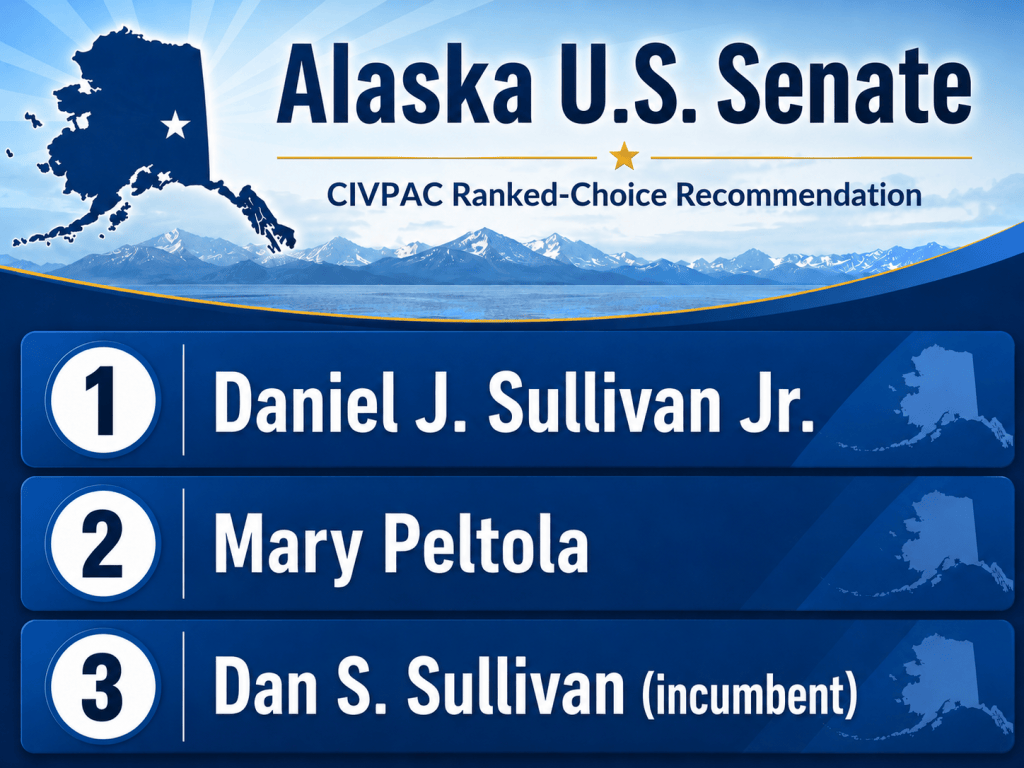
The Centrist Independent Voter recommends that Alaskans rank the candidates:
1. Daniel J. Sullivan Jr.
2. Mary Peltola
3. Dan S. Sullivan (Incumbent)
The first name on that list requires some explaining.
1. Daniel J. Sullivan Jr.
Daniel J. Sullivan Jr. is a retired teacher and former U.S. Forest Service employee from Petersburg. He also happens to have almost exactly the same name as incumbent Senator Dan S. Sullivan.
That coincidence produced one of the stranger controversies of the 2026 election. Republican officials accused Daniel J. Sullivan of entering the race to confuse voters. Alaska election officials initially sought to exclude him from the ballot, but the courts ultimately allowed his candidacy to proceed. Sullivan denies that he entered the race as a decoy, and we have seen no evidence that Mary Peltola or the Democratic Party recruited him for that purpose. (Alaska Public Media)
He finished a distant third in the primary, with about 2.5 percent of the vote, and is exceedingly unlikely to become Alaska’s next senator.
What interests us is what happened when we stopped looking at his name and started looking at his positions.
Sullivan describes a recognizably traditional Republican outlook: business-oriented, supportive of low taxes and law and order, but combined with a more compassionate view of government. He has criticized President Trump’s across-the-board tariffs, arguing that tariffs can sometimes be useful when precisely targeted but that the administration instead used a hammer and raised prices. He has also criticized indiscriminate DOGE-style cuts when they destroy useful governmental capacity and scientific information. (Alaska Public Media)
He supports Alaska’s open-primary and ranked-choice system and says he has seen no convincing evidence of widespread voter fraud. He talks about politics as requiring compromise and cooperation with people who do not share all of one’s beliefs. (Alaska Public Media)
His positions on several other issues fit us surprisingly well. On abortion, he says the federal government should stay out of personal health-care decisions. On foreign policy, he has called for American assistance to Ukraine to be increased and consistent. (Alaska Beacon voter guide)
None of this establishes that Daniel J. Sullivan would be an effective United States senator. He has never held major public office, his candidacy began under unusual circumstances, and his primary showing demonstrates that he has very little political base.
But among the candidates before us, Daniel J. Sullivan’s combination of traditional Republican economics, skepticism toward Trump, support for Ukraine, acceptance of legitimate elections, moderation on abortion and willingness to compromise comes remarkably close to what we frequently seek in a candidate.
We rank Daniel J. Sullivan Jr. first.
2. Mary Peltola
Our second choice is former Representative Mary Peltola.
Peltola has always been an unusual Democrat. Her record in the House was distinctly Alaska-centered rather than conventionally partisan. She strongly supported Alaska oil and gas development and worked aggressively for approval of the Willow project. Her approach to firearms also placed her well outside the mainstream of the national Democratic Party; the National Rifle Association endorsed her in her 2024 House race. (Alaska Beacon)
Her foreign-policy position is reasonably close to ours. Peltola supports assistance to Ukraine while saying that aid should be continually evaluated and efficiently used, and she emphasizes that the United States should stand with its allies. (Alaska Beacon voter guide)
Perhaps more importantly in this election, Peltola has emphasized the constitutional role of Congress. During the Iran conflict, she supported congressional efforts to constrain the war and argued that Congress has surrendered too much authority to the executive branch over both “tariffs or wars.” That is very close to our own concern about the continuing migration of legislative power to the presidency. (Alaska Beacon)
On abortion, Peltola believes the decision should remain with a woman and her physician. On firearms, energy and several other issues, she has demonstrated considerably more willingness than most national Democrats to depart from her party when she believes Alaska’s interests point elsewhere.
There are important disagreements.
Her affordability program relies too heavily on targeted tax preferences and subsidies, and we particularly object to her proposal for a federal price-gouging prohibition. Price controls do not make scarce goods less scarce and can make shortages worse. (Peltola affordability plan)
Peltola also voted in 2024 for a congressional resolution declaring a carbon tax detrimental to the American economy. Since a $100-per-metric-ton carbon tax is central to our preferred climate policy, that is a direct disagreement. (U.S. House Roll Call 97)
That disagreement should not be confused with her support for the Willow project. We support allowing fossil-fuel projects that would remain economic in a world where carbon emissions are properly priced. On the available evidence, Willow appears to meet that test.
As a useful benchmark, although not an exact simulation of our proposal, the International Energy Agency’s 2024 Announced Pledges Scenario assumes carbon prices in advanced economies considerably higher than our proposed $100 per metric ton—$135 in 2030, $175 in 2040 and $200 in 2050—together with other climate policies. Even under that more aggressive scenario, the IEA projects its underlying international crude-oil price at about $72 a barrel in 2030, $63 in 2040 and $58 in 2050. (International Energy Agency, Global Energy and Climate Model 2024)
Those prices remain above the Alaska Department of Revenue’s estimated NPV-10 breakeven price for Willow of roughly $49 per barrel. The estimate predates a subsequent increase in projected development costs, so the project’s current breakeven is presumably somewhat higher. But the available evidence still suggests that Willow would remain economically viable even under a substantially more aggressive carbon-pricing regime than the one we advocate. (Alaska Department of Revenue)
That distinction is important to our approach to climate policy. Rather than having government determine which energy technologies should survive, we would put a price on carbon and allow markets to make much of that decision.
Peltola’s opposition to a carbon tax therefore remains a meaningful disagreement. Her support for Willow does not.
Overall, Peltola has demonstrated independence, institutional seriousness and an ability to represent a state whose politics do not fit neatly into the national Democratic-Republican divide.
If, as appears overwhelmingly likely, the decisive contest is between Peltola and incumbent Senator Dan S. Sullivan, we prefer Peltola.
3. Dan S. Sullivan
That conclusion should not obscure the considerable strengths of the incumbent.
Senator Sullivan passed one test that has disqualified several Republican senators from our support.
After the 2020 election, he refused to join efforts to overturn certified electoral votes. He argued that Congress would be usurping the constitutional role of the states if it substituted its judgment for properly certified election results, and he voted to count the Electoral College vote. (Senator Sullivan’s statement)
That matters.
His foreign-policy record is also strong. Sullivan has been a consistent supporter of NATO, assistance to Ukraine and a vigorous American role in deterring Russia and China. He supported the major 2024 national-security supplemental providing weapons to Ukraine and other allies and has repeatedly argued for maintaining American military strength and confronting authoritarian aggression.
That puts him quite close to our own philosophy of an engaged American foreign policy backed by strong alliances and credible deterrence. (Senator Sullivan)
If those were the only questions before us, Sullivan would have a powerful case for reelection.
The difficulty is the direction of his record during President Trump’s second term.
Sullivan has supported the administration’s broad tariff policies rather than joining congressional efforts to reclaim authority over trade. In 2025, for example, he voted against terminating the emergency declaration Trump used to impose tariffs on Canadian imports while Murkowski voted to end it. That is inconsistent with our support for free trade and greater congressional control over tariff authority and is particularly troubling for a state so exposed to trade with Canada. (Alaska Current)
The same problem appears in war powers. As the Iran conflict continued, Sullivan opposed congressional attempts to reassert constitutional authority over prolonged hostilities. After the 60-day period specified by the War Powers Resolution had passed, Murkowski changed her position and voted to advance a resolution directing the removal of U.S. forces from unauthorized hostilities with Iran. Sullivan voted no. (U.S. Senate roll call)
There is also the pattern of presidential nominations.
Sullivan voted to confirm Pete Hegseth as secretary of defense when Murkowski, Susan Collins and Mitch McConnell voted no. He supported Tulsi Gabbard and Robert F. Kennedy Jr. when McConnell opposed them. He supported Kash Patel when both Murkowski and Collins voted no. And he supported Todd Blanche for attorney general while Murkowski and Collins again opposed the nomination. (Hegseth; Gabbard; Kennedy; Patel; Blanche)
None of those votes by itself would determine our judgment of a senator. Senators of a president’s own party normally support most presidential nominees.
These were not normal nominees. They presented a mix of inadequate qualifications, questionable competence and, in some cases, views or records that seemed counterproductive to the missions of the organizations they were nominated to oversee.
When unusually controversial nominations repeatedly cause other senators of the president’s party to exercise independent judgment, a senator’s consistent refusal to do so becomes relevant evidence of how he understands his own role.
President Trump has strongly endorsed Sullivan for reelection. Trump’s endorsement is not itself disqualifying. Sullivan’s own 2020 record demonstrates that he is not simply another senator who has always followed Trump wherever he leads.
That actually makes our disappointment greater.
We see in Sullivan a capable senator with a foreign-policy outlook we often admire and a demonstrated willingness, at an important moment in 2020, to put constitutional responsibility ahead of partisan pressure.
But during Trump’s second presidency, that independence has been much harder to find.
We rank Dan S. Sullivan third.
4. Gerald Heikes
We do not recommend ranking Gerald Heikes. Heikes holds a number of socially conservative positions that differ substantially from CIVPAC’s, but policy disagreement alone is not the principal concern. More troubling is the ideological and religious rhetoric he has used to justify some of those positions. In a 2024 Alaska Family Action candidate questionnaire, Heikes wrote that Democrats “need abortion to serve their Master,” and explicitly invoked Satan in explaining that view. (akvoter.com)
Heikes has also taken unusually sweeping positions on higher education. Asked whether he would restrict public funding for colleges requiring DEI training, he went substantially further, saying he would deny funding to “any and all colleges” and that there should be “no funding of any colleges anywhere in the U.S.” (akvoter.com)
He also supports repealing Alaska’s ranked-choice voting system. CIVPAC supports retaining ranked-choice voting. We regard that disagreement as a secondary concern, rather than a reason by itself to exclude him from our ranking. (akvoter.com)
Taken together, however, his rhetoric, governing temperament, and broader policy positions place him outside the range of candidates CIVPAC can recommend. Alaska voters are not required to rank every candidate; they may rank as many or as few as they wish. We therefore recommend leaving Gerald Heikes unranked. (elections.alaska.gov)
We recommend not ranking Gerald Heikes.
Our Recommendation
Alaska has produced an unusual race and, appropriately enough, an unusual endorsement.
The candidate we rank first is very unlikely to win. Our second choice is the candidate we prefer in the likely decisive contest. The incumbent we rank third has substantial strengths and has taken positions—particularly on the 2020 election and American engagement abroad—that deserve genuine credit.
Our ranking is:
1. Daniel J. Sullivan Jr.
2. Mary Peltola
3. Dan S. Sullivan
Alaska’s ranked-choice system allows us to state those preferences honestly.
The Centrist Independent Voter recommends that Alaska voters rank the candidates in that order.