
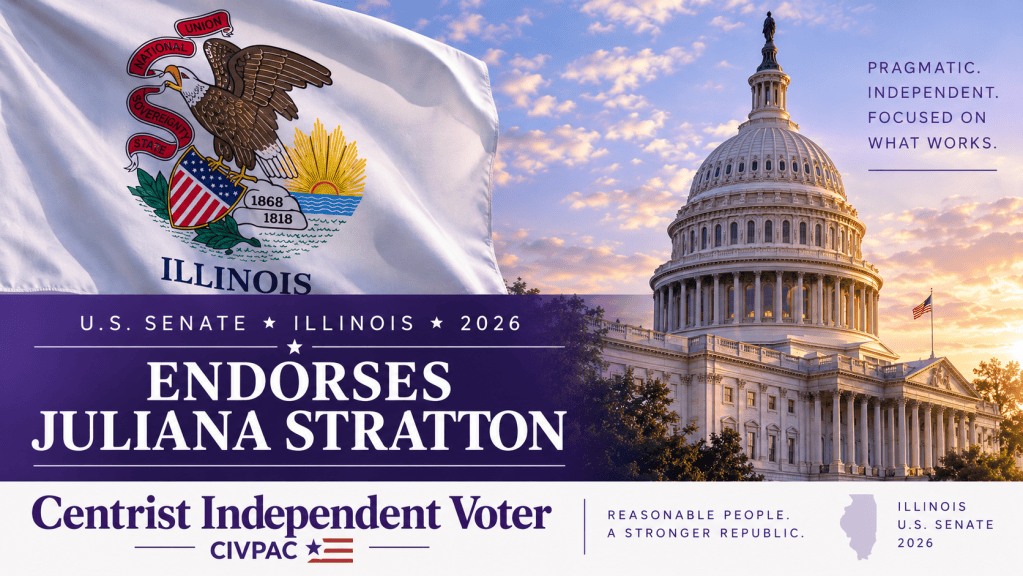
Illinois voters will choose a successor to retiring Democratic Senator Dick Durbin from a field headed by Democratic Lieutenant Governor Juliana Stratton, Republican attorney and former state party chairman Don Tracy, and American Center Party candidate Whitfield Harrington Jr.
The major-party candidates present an unusually clear ideological contrast. Stratton combines strong support for NATO, Ukraine and congressional checks on presidential power with a domestic economic agenda substantially to CIVPAC’s left. Tracy is much closer to CIVPAC on taxes, regulation, health-care markets and the role of government, while taking positions on presidential war powers, tariffs and Donald Trump that raise questions about institutional independence.
Juliana Stratton
Stratton has substantial governmental experience. She served in the Illinois House before becoming lieutenant governor in 2019 and has spent much of her public career working on criminal justice, health, economic opportunity and related state issues.
On foreign policy, Stratton’s positions are considerably closer to CIVPAC than her domestic agenda.
She supports continued American backing for Ukraine, sanctions against Russia and a strong NATO alliance. She describes Russian aggression as a threat beyond Ukraine and says the United States should remain an active and reliable NATO member. She also supports greater defense contributions from European allies.
Stratton is also explicit about congressional war powers. She argues that presidents have accumulated excessive authority to initiate military action and that Congress should reassert its constitutional role. She has opposed President Trump’s unilateral military actions and says she would vote against funding unauthorized military operations.
Those positions are substantially consistent with CIVPAC’s increasing emphasis on Congress acting as an independent constitutional branch.
Stratton also strongly opposes President Trump’s broad tariffs, arguing that they increase costs for consumers and businesses. That position is closer to CIVPAC’s preference for open markets and congressional responsibility for trade policy than the administration’s use of broad presidential tariff authority.
A Much Larger Domestic Government
The principal difficulty for CIVPAC is Stratton’s domestic economic program.
Her campaign calls for a $25 federal minimum wage, Medicare for All, abolition of ICE, expanded child and earned-income tax credits, and higher taxes on corporations and people earning more than $1 million annually. She supports restoring the abortion protections of Roe v. Wade and favors additional federal gun-control legislation.
A $25 national minimum wage is far above CIVPAC’s preferred approach to low-income employment. We are skeptical of federal wage mandates generally and particularly concerned that a wage floor appropriate for downtown Chicago may bear little relationship to labor-market conditions in lower-cost areas of the country. Apart from the fiscal implications, we are more sympathetic to using the earned income tax credit to supplement the earnings of low-income workers.
Medicare for All presents a still larger disagreement. Stratton favors replacing much of the present insurance system with federally financed universal coverage. CIVPAC favors universal access to private insurance combined with subsidies and market competition with a cap on the total per capita government subsidy rather than a single-payer system with a potentially unlimited entitlement.
This is an important fiscal issue.
Stratton proposes a middle-class tax cut financed by higher taxes on people earning more than $1 million annually. That is a specific proposal, but it should not be confused with a financing plan for Medicare for All. A single-payer system would shift enormous amounts of private health spending onto the federal budget. CBO has estimated that illustrative single-payer systems would increase federal health subsidies by roughly $1.5 trillion to $3 trillion in a single year such as 2030, requiring substantial new financing.
Independent analyses have concluded that even extremely aggressive taxation of high earners, corporations and financial activity would cover only part of the cost of a comprehensive Medicare-for-All system. Full financing would almost certainly require taxes reaching much farther down the income distribution, although those taxes would replace some current premiums and out-of-pocket expenses.
The fiscal discussion cannot realistically stop with taxes on people earning more than $1 million.
Stratton’s proposal to abolish ICE also goes considerably beyond CIVPAC’s position. She says immigration enforcement should continue through a rebuilt system with secure borders, due process and a pathway for Dreamers, but CIVPAC favors reforming immigration enforcement rather than abolishing the principal federal agency responsible for it. This may be just a difference in language but language matters. Phrases like “abolish ICE” or “Defund the Police” are unnecessarily inflammatory and suggest a lack of seriousness.
Don Tracy
Tracy offers a much more conventional market-oriented economic approach.
A lawyer and former chairman of the Illinois Republican Party, Tracy has also chaired the Illinois Gaming Board and served in numerous civic and professional organizations. His campaign emphasizes reduced regulation, lower taxes, spending restraint, greater competition in health care and an all-of-the-above energy strategy.
Those instincts are generally closer to CIVPAC’s economic philosophy than Stratton’s.
His health-care approach stresses price transparency, competition, consumer choice and control of middlemen rather than a government-run insurance system. He opposes a national abortion ban and has said abortion law should remain principally with the states.
Tracy’s immigration position is also more nuanced than simple endorsement of every administration enforcement practice. Although he favors strong border enforcement and cooperation with ICE, he has called for greater transparency, oversight of enforcement priorities, faster immigration-court processing and better federal-state coordination.
Foreign Policy and Trump
Tracy’s foreign-policy positions contain important strengths.
He supports Ukraine’s right to defend itself, argues that Russia should not be rewarded for aggression and regards NATO as vital to American security. He favors stronger allied burden-sharing but does not advocate American withdrawal from the alliance. On China, he supports deterrence, stronger Indo-Pacific alliances, export controls and protection of strategically important technology.
His position on presidential power is less reassuring.
Tracy says Congress has a constitutional role in decisions about war and supports clarifying the War Powers Resolution. But during the current Iran conflict he opposed a congressional War Powers resolution, arguing that Congress should not micromanage a rapidly moving conflict. He also defended President Trump’s use of economic pressure and broad tariffs while acknowledging their costs to farmers.
His position on tariffs is therefore more sympathetic to the administration than CIVPAC’s. Tracy says the “jury is still out” and that targeted tariffs can be useful, particularly against China, but he has not clearly embraced the view that Congress should reclaim primary control over the broad tariff authority now being exercised by the president.
There are mixed signals on institutional independence more generally.
Tracy says government power should never be used to punish political opponents, supports separation of powers and press independence, and rejects federal nationalization of election administration. Those are important statements.
On the other hand, during the Republican primary Tracy said he supported President Trump’s pardons of people convicted of offenses arising from the January 6 Capitol attack. That position deserves criticism given CIVPAC’s concern with accountability for efforts to interfere with the peaceful transfer of presidential power.
The relevant question is therefore not whether Tracy is a Republican who supports a Republican president. It is whether he has demonstrated a sufficiently clear willingness to oppose that president when executive power conflicts with congressional authority or democratic institutions.
Whitfield Harrington Jr.
The November ballot also includes Whitfield Harrington Jr., running under the newly created American Center Party label. The Illinois State Board of Elections lists him as an active candidate.
Whitfield Harrington Jr. is a political-science graduate with experience in banking, insurance, business and the ministry. He has not held elected office but presents himself as a pragmatic centrist. His economic program mixes market-oriented ideas—private-sector growth, Direct Primary Care and support for independent medical practices—with selective industrial policy and tariffs. On immigration he favors border enforcement and removal of serious offenders while supporting easier legal immigration, family unity and more humane enforcement.
Harrington’s foreign-policy position is more concerning. He calls for America to “step back, not step away,” with European allies assuming more responsibility for Ukraine and European security, while insisting that military deployments have a defined mission, cost and exit strategy approved by Congress. He also proposes several unconventional institutional reforms, including congressional term limits, changes to the filibuster and ending the public recording of individual Supreme Court justices’ votes. Those ideas, together with his limited governing experience and still-incomplete record on abortion, NATO, Russia, China, Taiwan, Iran or Israel, January 6, presidential war powers, Trump, immigration, or the federal budget leave important questions unresolved.
The available record is not yet sufficient for a serious Senate endorsement evaluation. His campaign website has some interesting ideas but as a candidate without a major party providing the brand identity he needs to address a much wider range of issues. A centrist party label is not itself evidence of either policy moderation or readiness for the Senate. Harrington would need to provide considerably more information before CIVPAC could evaluate him alongside the two major-party nominees.
The Choice
The Illinois race therefore presents a recognizable but difficult tradeoff.
Stratton is substantially closer to CIVPAC on Ukraine and NATO, reproductive rights, tariffs and congressional checks on presidential military authority. She would also provide an obvious partisan check on the Trump administration.
But her domestic agenda—particularly Medicare for All, a $25 federal minimum wage and abolition of ICE—would represent a substantially larger federal role in the economy than CIVPAC supports. The financing of that agenda also remains insufficiently developed.
Tracy is substantially closer to CIVPAC on conventional economic policy, health-care markets, regulation and the appropriate scale of domestic government. He also supports NATO and Ukrainian sovereignty.
But his greater willingness to defer to President Trump on war powers and tariffs, together with his support for the January 6 pardons, raises questions about the degree of institutional independence he would bring to the Senate.
Harrington’s candidacy is potentially interesting because he explicitly presents himself under a centrist label, but the presently available policy record is too thin to determine whether the substance matches the label.
At this stage, the questions most worth watching are straightforward.
For Stratton, how would she actually finance Medicare for All and the rest of her domestic agenda? Would the necessary taxes reach substantially into households below the $1 million annual-income threshold? How would a $25 national minimum wage affect employment in lower-wage labor markets? And what precisely would replace ICE?
For Tracy, where does congressional authority prevail over presidential preference? Would he vote to terminate presidential tariffs that he believed exceeded delegated authority? Under what circumstances would he require congressional authorization for continuing military action? And how does he reconcile his stated concern for democratic institutions with support for the January 6 pardons?
For Harrington, the questions are even more basic: what does he believe about America’s international alliances, Ukraine, presidential power, immigration, fiscal policy and the major social questions likely to confront the next Senate?
Those issues may be resolved in upcoming general-election debates but Illinois voting begins September 24, so we feel obliged to make our endorsement based on the available information. Given that constraint and our preference for divided government as a vehicle for constraining executive overreach, we endorse Juliana Stratton for the U.S. Senate from Illinois.