
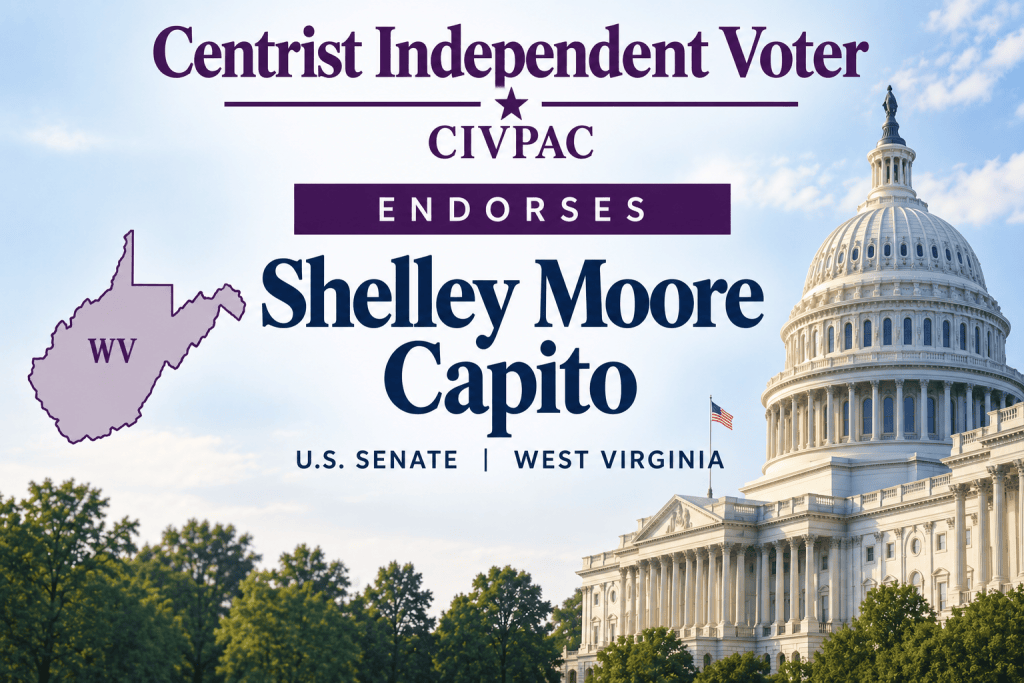
CIVPAC endorses Sen. Shelley Moore Capito for reelection to the United States Senate from West Virginia.
This is not an endorsement without reservations. We disagree with Capito on important issues, particularly reproductive freedom, and we are troubled by her willingness to defer to presidential authority in the current conflict with Iran.
But elections require comparisons among the candidates actually before the voters. On balance, Capito’s demonstrated commitment to constitutional democracy, strong support for Ukraine and the international order, pragmatic legislative record and generally market-oriented economic approach make her the better choice.
Constitutional Independence — With an Important Qualification
One of the strongest points in Capito’s favor is that her commitment to constitutional democracy has already been tested under pressure.
After the 2020 presidential election, Capito acknowledged that Donald Trump had lost, described the election as free and fair, and rejected efforts to overturn certified electoral votes.
That distinction matters greatly to CIVPAC.
Political independence is most meaningful when exercising it imposes a political cost. Capito demonstrated that, when confronted with an attempt to overturn a lawful presidential election, her obligation to the constitutional system outweighed loyalty to her own party and president.
That record is particularly important because CIVPAC generally places additional weight on congressional independence when the president and candidate belong to the same party.
However, Capito’s record on presidential war powers gives us pause.
During the current conflict with Iran, she opposed an effort to require withdrawal of U.S. forces absent congressional authorization and defended the president’s authority to continue military operations.
We disagree.
CIVPAC does not oppose the use of military force against Iran in principle. Depending on the circumstances, military action may be justified. But sustained hostilities should proceed with appropriate congressional authorization and with a clear strategy and defined objectives.
Capito’s position on Iran therefore demonstrates that her willingness to check executive power is not unlimited. That is a significant reservation in this endorsement.
A Strong Record on Ukraine and the International Order
Capito is particularly strong on one of CIVPAC’s most important foreign-policy priorities—resisting Russian aggression in Ukraine.
She has consistently supported Ukraine against Russian aggression and backed legislation imposing sanctions on countries purchasing Russian oil and gas, while emphasizing both American leadership and national security.
That reflects a broader commitment to American leadership and to the network of alliances that has helped preserve relative stability since World War II.
At a time when elements of both parties have become increasingly skeptical of sustained American international engagement, Capito’s position is an important strength.
Her Democratic opponent, Rachel Fetty Anderson, also expresses support for international alliances and democratic partners while arguing that U.S. military power should be reserved for self-defense.
We strongly agree with Anderson’s separate position that Congress, rather than the president, should authorize war, but we believe the self-defense limitation is too restrictive if interpreted literally.
American military power should not be used casually. But deterrence, defense of allies, protection of international commerce and resistance to aggression can all serve legitimate national and international interests even when the United States itself has not first been attacked.
On the broader question of America’s role in the world, Capito is closer to CIVPAC.
Governing Experience and Bipartisanship
Capito also brings a substantial record of practical governing experience.
She has served in both the House and Senate and played a significant role in bipartisan infrastructure negotiations, including work that helped shape portions of the Infrastructure Investment and Jobs Act.
That record matters to us.
CIVPAC does not equate centrism with splitting every policy difference down the middle. We value candidates who can identify areas of legitimate disagreement while still finding opportunities for constructive legislation.
Capito has demonstrated that ability repeatedly.
Economic Policy and Health Care
On economic policy, Capito is substantially closer to CIVPAC than Anderson.
Capito generally favors market competition, private investment, lower taxes and a more limited governmental role in the economy. She has supported making the 2017 tax reductions permanent and consistently argues for a more growth-oriented tax and regulatory framework.
We do not agree with every tax cut she has supported, particularly where adequate attention has not been paid to federal deficits, but her basic economic framework is closer to ours.
Anderson proposes a substantially larger governmental role. Her agenda includes higher marginal tax rates on upper-income households, stronger organized-labor protections and expanded public responsibility for health care and infrastructure.
Her health-care approach is particularly far from CIVPAC’s preferred health-care framework.
CIVPAC supports universal health coverage, but we favor achieving it primarily through competitive private insurance, appropriate subsidies and strong protections for people with preexisting conditions, without creating an open-ended federal entitlement.
Anderson proposes expanding Medicare, Medicaid and Tricare so that all Americans could obtain coverage through those public systems.
Capito’s approach, by contrast, continues to emphasize private insurance, consumer choice and health savings accounts.
On these questions, Capito is the substantially better fit.
Reproductive Freedom
Our most significant domestic-policy disagreement with Capito concerns abortion.
Capito supported the Supreme Court’s decision overturning Roe v. Wade and has backed a number of abortion restrictions, including legislation restricting abortion after 20 weeks.
CIVPAC supports policies broadly in line with the framework established by Roe v. Wade and generally opposes broad governmental interference in reproductive decisions.
On this issue, Anderson is clearly closer to our position. Her platform emphasizes bodily autonomy, privacy, contraception and an adult’s right to choose or refuse medical treatment.
Capito has sometimes taken a less absolutist approach than other members of her party. She has opposed some broader federal abortion proposals and supported efforts to expand access to contraception.
We recognize those distinctions, but the broader disagreement remains significant.
Immigration
Neither candidate presents a perfect fit on immigration.
Capito strongly emphasizes border enforcement, detention and immigration control and has supported substantial additional funding for ICE and Customs and Border Protection.
CIVPAC agrees that effective border enforcement is necessary, but enforcement alone is not a complete immigration policy. We also favor a workable legal immigration system and a realistic path to legal status for many long-term undocumented residents.
Anderson’s platform is less developed on immigration, making direct comparison difficult.
Energy and Climate Policy
On energy, the comparison is more balanced.
Capito strongly supports coal, natural gas, nuclear energy, permitting reform and carbon capture. CIVPAC shares her concern for reliability, energy abundance and technological approaches such as carbon capture, although we favor a broader market-based climate policy built around pricing carbon emissions.
Anderson places greater emphasis on renewable energy and on incorporating environmental costs into energy decisions, which brings her closer to CIVPAC on that aspect of environmental policy. Her platform nevertheless recognizes coal as an essential part of the nation’s current energy portfolio.
Capito’s emphasis on reliability, permitting, carbon capture and technological innovation also has substantial merit.
Neither candidate appears to favor exactly our approach, although both support elements of an energy portfolio that CIVPAC regards as legitimate. Our preference is not for government to determine the precise mix of coal, natural gas, nuclear power and renewables, but for markets to determine that mix after incorporating the environmental cost of carbon emissions through a carbon tax.
The Better Choice
Rachel Fetty Anderson is a serious candidate with a thoughtful platform. We agree with her on several important issues, including reproductive freedom and the need for Congress to exercise its constitutional authority over war.
But taken as a whole, her economic agenda is considerably to CIVPAC’s left, and her conception of American military responsibility appears narrower than ours.
Shelley Moore Capito is not a perfect fit either.
Her Iran war-powers position troubles us, and we disagree substantially with her on abortion. We also would prefer greater attention to fiscal discipline when considering large tax reductions.
But those reservations must be weighed against a long record of public service, genuine bipartisan legislating, strong support for Ukraine and America’s alliances, a generally market-oriented economic approach and—most importantly—a demonstrated willingness to defend the constitutional transfer of power even against a president of her own party.
That record gives us sufficient confidence to support her reelection.
CIVPAC endorses Shelley Moore Capito for reelection to the United States Senate from West Virginia.