
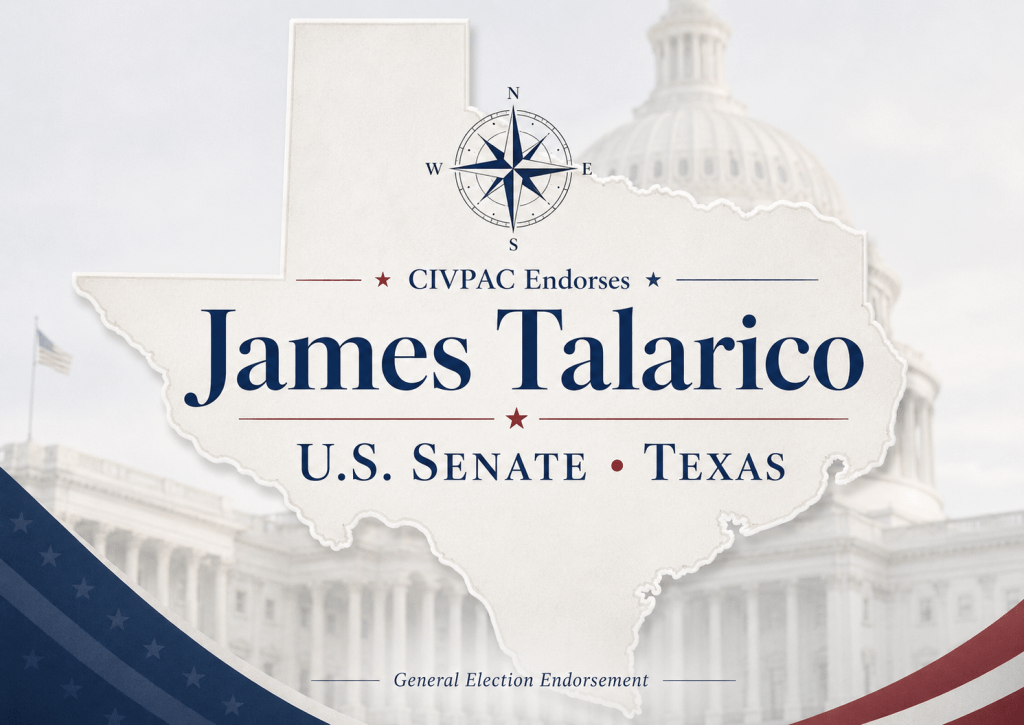
The Centrist Independent Voter endorses James Talarico for the United States Senate from Texas.
This is not an endorsement of Talarico’s entire agenda. On several important economic issues, he is well to our left. His rhetoric about billionaires and a political system divided between the “top” and the “bottom” sometimes substitutes a zero-sum view of the economy for a more complicated reality. We disagree with him on taxes, organized labor, the minimum wage, and portions of his health-care agenda. Talarico himself says that “the biggest divide in this country is not left vs. right. It’s top vs. bottom.”
But Talarico also offers something increasingly scarce in American politics: an evident willingness to reason from first principles, to listen to people who disagree with him, and to treat political opponents as fellow citizens rather than enemies.
That impression is reinforced by Talarico’s own description of friendships with people who disagree with him politically. Sometimes, he says, those relationships strengthen his convictions, but “on other things, it makes you question your own beliefs.” He has also spoken candidly about having been persuaded to change his mind. In one extended interview, he described a friendship with a conservative Republican legislator that actually caused him to reverse his position on legislation. That willingness to entertain the possibility that the other side may have a point matters for us.
Against Ken Paxton, that matters enormously.
Democracy Comes First
The extraordinary circumstances of the 2020 pandemic produced legitimate disputes over election procedures, and we do not fault Paxton for raising them. Courts and election officials in several states made or approved changes whose relationship to legislatively enacted election laws was genuinely debatable. Similar disputes arose in states that Donald Trump won as well as states that he lost.
But Paxton went much further. After the election, Paxton, as the Attorney General of Texas, asked the U.S. Supreme Court to block the certified presidential results of Pennsylvania, Georgia, Michigan and Wisconsin. The Supreme Court rejected Texas’s case because Texas lacked standing to challenge the manner in which other states conducted their elections; it did not adjudicate every underlying procedural complaint.
Across the litigation, recounts, audits and other reviews that followed, however, none established irregularities sufficient to show that the certified winner in any of the challenged states was wrong. Some claims were never decided on their underlying merits because they were brought too late or because the remedies sought would have disenfranchised voters who had reasonably relied on the rules in place when they voted. Trump’s own Attorney General, William Barr, said the Justice Department had not found fraud on a scale that could have changed the outcome. Georgia’s full hand audit and Michigan’s statewide audit likewise affirmed their presidential results.
Pennsylvania provides a useful example. Its Supreme Court declined to entertain a post-election challenge to the state’s no-excuse mail-voting law because the challengers had waited more than a year, until millions of citizens had already voted under that law. The court emphasized the substantial prejudice that would result from disenfranchising voters who had relied on the law. Another disputed Pennsylvania procedure—the three-day extension for receiving mail ballots—affected only about 10,000 ballots, compared with Joe Biden’s statewide margin of more than 80,000 votes.
Procedural irregularities deserve examination. But once they have been examined, it is crucial to democratic institutions that we distinguish disputes about election administration from evidence that the voters chose the wrong president.
Paxton’s position was not merely an artifact of the confused weeks following the 2020 election. As recently as March 2026, he was still publicly referring to the “stolen 2020 election.” In the same statement he declared that “no one has been more loyal to Donald Trump than me.”
Respect for election law matters. So does restraint in fashioning a remedy after millions of citizens have lawfully cast their votes. Paxton has repeatedly failed to make that distinction. For us, that is a serious failure of institutional judgment.
His continued repetition of the claim is also symptomatic of another troubling characteristic: loyalty to Trump appears to take precedence over an objective assessment of the facts. Hardly a quality we want in a U.S. senator.
Paxton’s record raises other concerns about institutional judgment as well. Eight senior aides in his own office reported him to the FBI for alleged abuse of office, and the Republican-controlled Texas House later impeached him. The Texas Senate acquitted him, and federal prosecutors ultimately brought no charges. But a Texas court subsequently found that Paxton’s office had unlawfully retaliated against whistleblowers who reported him. Paxton later dropped the state’s appeal of the $6.6 million judgment. We do not treat allegations as proof of corruption, but neither can we regard that record as irrelevant to his fitness for the Senate.
Immigration and the Border
On immigration, Talarico is considerably more pragmatic than the national debate often allows.
His formulation is that the border should be like a front porch: it needs both a welcome mat and a lock on the door. His program combines stronger border enforcement and action against cartels and traffickers with more legal immigration, additional immigration judges, reforms to asylum adjudication, and legal status for some undocumented immigrants. His platform calls for a path to citizenship for long-resident immigrants and groups such as DREAMers and spouses, while proposing temporary work permits for some more recent arrivals filling needed jobs.
Importantly, Talarico has also said plainly that the Biden administration failed border communities. That willingness to criticize his own party matters. He supports additional Border Patrol personnel, improved surveillance technology and more immigration judges while opposing both open borders and indiscriminate mass deportation.
That is close to the approach Centrist Independent Voter has favored in our immigration policy: control the border, enforce the law, expand orderly legal immigration, and recognize that immigration is economically valuable to the United States.
We would stop somewhat short of Talarico’s position on citizenship. For otherwise law-abiding people who have lived in the United States illegally for many years, we favor a pathway to legal residency, but not necessarily citizenship. That provides a humane and practical solution without treating illegal entry as equivalent to following the legal immigration process. Our difference with Talarico here is real, but relatively narrow.
Neither “open borders” nor mass deportation is a sensible immigration policy.
Economic Populism — Where We Part Company
Our largest reservations about Talarico concern his economic populism.
His campaign often describes the central divide in American society as “top vs. bottom” and portrays billionaires and large corporations as beneficiaries of an economy intentionally rigged against working people.
There are legitimate concerns underneath that rhetoric. Market concentration can reduce competition. Tax preferences can become indefensible privileges. Government can be captured by people with money and influence, producing what is often called crony capitalism. Economic growth does not automatically guarantee equality of opportunity.
But wealth is not generally acquired by taking a fixed quantity of money away from somebody else. Much of the extraordinary increase in American living standards came precisely because entrepreneurs and investors found ways to create things that had not existed before.
Successful businesses should pay the taxes the law requires. We are sympathetic to eliminating special tax provisions that cannot be justified economically. But becoming extremely wealthy through the creation of an extremely valuable company is not, by itself, evidence that the system has failed.
That is why we resist Talarico’s tendency to describe economic gains at the top as evidence that everyone else has necessarily lost. Markets distribute their gains imperfectly, but economic growth is not simply a transfer from the bottom to the top.
Wages and the Minimum Wage
Talarico’s platform calls for a federal minimum wage of $15 an hour.
We agree with his objective of improving the lives of low-income earners, but we differ on the best method for accomplishing that end.
We are less convinced that Congress should establish one national wage floor for an economy as diverse as the United States. The same minimum wage has very different economic consequences in Manhattan, rural Mississippi and San Francisco.
The strongest long-term wage policy is a labor market in which employers have to compete for workers. Education, training, productivity growth, mobility, immigration policy and sustained economic expansion all matter to that goal.
To the extent that those mechanisms fall short, we would rely more heavily on an expanded Earned Income Tax Credit, which targets assistance to lower-income working households without imposing the same nationwide wage floor. Talarico himself supports expanding the Earned Income Tax Credit; we simply would give that approach a much larger role.
Equality of opportunity does not require equality of outcome. But genuine equality of opportunity does require that people born without wealth or connections have a reasonable chance to build a better life through work, education, enterprise and saving. On that larger objective, we believe Talarico’s concern is legitimate even when we disagree with some of his remedies.
Abortion and Personal Liberty
On abortion, we are substantially closer to Talarico.
Texas has moved far beyond the point at which reasonable concern for fetal life becomes an appropriate basis for government policy and has imposed some of the most restrictive abortion laws in the country. Talarico supports federal legislation to codify Roe v. Wade and protect access to contraception and IVF.
Our own abortion policy recognizes that abortion presents a genuine conflict of values. We support legislation protecting abortion during the first two trimesters while permitting restrictions later in pregnancy, subject to appropriate exceptions.
We therefore agree with Talarico that Texas has placed the governmental thumb far too heavily on one side of that difficult moral question.
Religion, Schools and Culture-War Politics
Republicans have attacked Talarico for opposing state-sponsored use of Bible stories in public-school instruction and for some of his theological comments.
We see two very different questions.
The Bible unquestionably belongs in education as literature, history and a source of cultural understanding. A student who knows nothing of Isaiah, Exodus, Job or the Gospels will miss references throughout Western literature, art, music and political discourse.
But teaching students about religion is different from using a public school to teach religious belief as truth. Government should not engage in religious propaganda. That distinction is consistent with our existing policy on educational content, which argues that America should remain a secular state while protecting the free exercise of religion.
On that distinction, we are largely on Talarico’s side.
Talarico has also attracted criticism for past comments about transgender participation in female athletics. We think he was too quick to dismiss the fairness question. Competitive sports can present legitimate issues of biological advantage that cannot simply be wished away.
But we also do not believe government should dictate one universal answer. Eligibility rules are better left to organizations responsible for administering the particular sport—the NCAA, the IOC, state athletic associations and other governing bodies capable of accounting for differences among sports and levels of competition.
Talarico’s more recent acknowledgment that transgender athletics presents a difficult issue on which reasonable people should seek workable policy solutions is therefore welcome. In August 2026, he expressly described transgender participation in sports as a difficult issue on which a policy solution should be possible.
These questions illustrate something broader. Difficult cultural issues deserve serious discussion. They should not become excuses for treating political opponents—or vulnerable minorities—as objects of ridicule.
Energy and Climate
Here Talarico is much more interesting than the standard partisan categories suggest.
He describes Texas as an energy state and pairs concern about climate change with an all-of-the-above energy strategy: preserve jobs and investment in oil and gas while expanding wind, solar, batteries, geothermal and hydrogen, and streamline permitting to increase energy supply.
This is not by itself a complete strategy for reducing greenhouse-gas emissions. It is nevertheless substantially more politically and economically realistic than an approach built around rapidly eliminating fossil fuels.
We would prefer the market-based approach described in our climate-change policy: a technology-neutral carbon tax that places a price on emissions and then allows markets to determine whether the cheapest response is natural gas, renewables, nuclear power, carbon capture, efficiency or technologies that have not yet been developed.
Talarico instead relies too heavily on subsidies, tax credits and government direction of particular technologies. But his recognition that Texas should remain an energy producer—and that oil and natural gas remain part of that picture—is welcome.
Health Care
Talarico’s personal experience with Type 1 diabetes understandably gives health care a prominent place in his campaign. He supports allowing Americans of any age to buy into Medicare, protecting the Affordable Care Act, expanding subsidies and government negotiation of prescription-drug prices, and imposing additional limits on medical costs.
We share his objective of universal access but prefer a system based on competing private health plans, guaranteed issue, meaningful individual responsibility, and subsidies directed toward people who need assistance.
A Medicare public option moves in a direction we oppose. Medicare’s Hospital Insurance Trust Fund already faces a substantial financing shortfall, and any new buy-in should at a minimum be fully self-financing rather than draw resources from the existing program.
We are also wary of dramatically expanding a system whose payments to hospitals and physicians are generally below those of commercial insurance. We believe that Medicare works, to the extent that it does, partly because it operates within a broader health-care system in which commercial insurers generally pay providers substantially higher rates. The Congressional Budget Office has found that commercial insurers pay hospitals more than twice Medicare rates on average and physicians roughly one-quarter more.
Our broader alternative is described in our health-care policy, which emphasizes universal coverage while retaining competing private insurance and stronger incentives to control costs.
Still, Talarico recognizes the importance of competition in several parts of his health-care platform, including generic drugs, pricing transparency and reducing anticompetitive behavior. Those are areas where there is substantial room for agreement.
Trade
Talarico is much closer to our position on trade.
He favors repealing broad Trump-era tariffs while using trade agreements to protect American workers against countries that gain advantages through abusive labor or commercial practices.
Tariffs are taxes on trade. They increase the cost of imported goods, shelter domestic producers from competition and invite retaliation against American exports.
There are legitimate national-security reasons to protect particular supply chains and legitimate reasons to respond to foreign subsidies or other distortions. But across-the-board tariffs are an expensive way to accomplish either objective.
On this issue, Talarico’s instincts are largely right.
Foreign Policy
Talarico also rejects the growing isolationism in American politics. He supports cooperation with American allies and explicitly says that the United States has a duty to defend Ukraine against Russian aggression.
We have disagreements with portions of his Middle East policy, but his larger conception of America’s role in the world is recognizable to us: alliances are assets, Russia is an aggressor rather than a misunderstood adversary, and American withdrawal from the world would make the United States less secure rather than more secure.
That is an increasingly important distinction, and it closely parallels our own position on Russia and Ukraine, which emphasizes deterrence, alliance reliability and sustained support for Ukraine.
Let’s Reason Together
Perhaps the most attractive feature of Talarico’s candidacy is not a particular policy.
It is his apparent belief that disagreement is not evidence of bad character.
We disagree with James Talarico about a great deal. He sometimes sees an economy rigged by billionaires where we see a market economy that needs better rules and more competition. He is more comfortable with government intervention than we are. We would design his tax, health-care, labor and climate policies quite differently. We also think some of his earlier rhetoric on cultural issues was too sweeping.
But those are arguments we can have.
Indeed, Talarico’s willingness to acknowledge that disagreement can cause him to question his own beliefs may be more important to us than agreement on any single issue. A healthy political system does not require everyone to arrive at the same conclusions. It requires citizens and elected officials who accept facts, respect constitutional institutions, distinguish opponents from enemies, and remain willing to change their minds when evidence requires it.
Ken Paxton’s continuing insistence that the 2020 presidential election was stolen, combined with his troubling record in public office, crosses that line for us.
James Talarico does not.
For Texas—and for the United States Senate—the Centrist Independent Voter endorses James Talarico.