
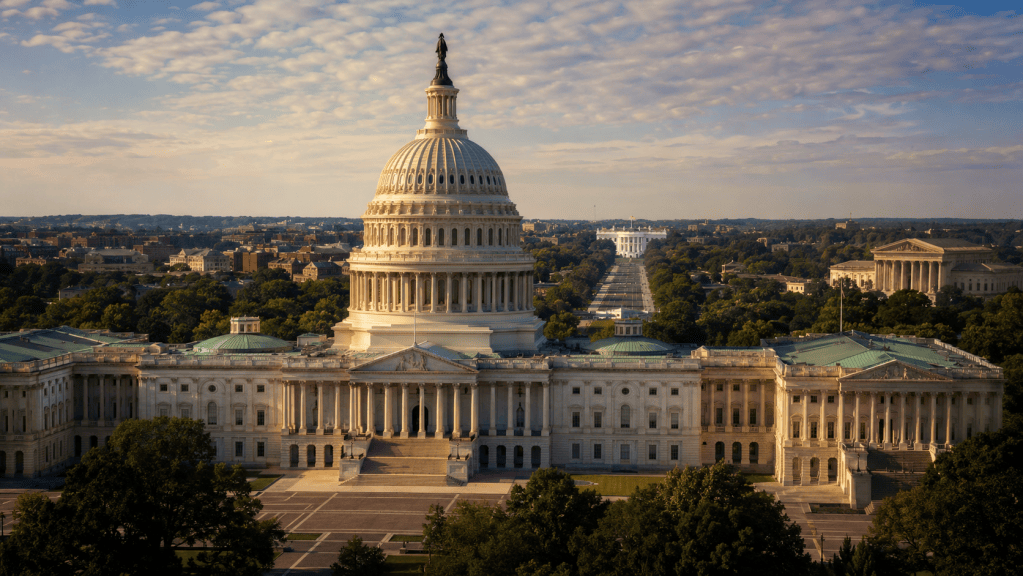
U.S. Capitol with the White House and Supreme Court in the distance, illustrating Congress’s constitutional role in checking executive power.
The Supreme Court’s recent decision allowing construction of President Trump’s White House ballroom to continue raises an issue that extends far beyond the ballroom itself.
On August 31, the Court stayed a lower-court injunction that would have halted above-ground construction. Importantly, the Court did not decide that the President had legal authority to undertake the project without congressional approval. Instead, the five-Justice majority concluded that the government was likely to prevail in showing that the National Trust for Historic Preservation lacked Article III standing to challenge it. The Court expressly said that it was not passing on the legality of the project. (Supreme Court decision)
That distinction matters.
A presidential action can potentially exceed the President’s lawful authority and yet escape judicial review because no plaintiff who objects to it can establish the concrete and particularized injury required by Article III. Indeed, Chief Justice John Roberts, joined by Justices Sotomayor, Kagan and Jackson, concluded in dissent that the ballroom construction was likely unlawful because Congress has expressly prohibited construction of buildings on federal grounds in the District of Columbia without congressional authorization. (Supreme Court decision)
We have seen versions of this problem before.
During President Trump’s first term, 215 members of Congress sued alleging that his receipt of benefits from foreign governments violated the Constitution’s Foreign Emoluments Clause. The D.C. Circuit dismissed the case because the individual legislators lacked standing to assert an institutional injury belonging to Congress. (D.C. Circuit opinion) Other litigation over the Emoluments Clauses ended without a definitive Supreme Court ruling on the merits. After Trump left office, the Supreme Court vacated judgments in two of the major cases and directed that they be dismissed as moot. (Congressional Research Service / Constitution Annotated)
Standing doctrine serves important purposes. Federal courts are not supposed to issue advisory opinions whenever someone believes a president has exceeded his authority. But the practical consequence is unavoidable: the judiciary cannot always be counted upon to police the boundary between presidential and congressional power.
Sometimes Congress has to do it itself.
That has implications for how CIVPAC evaluates candidates for the House and Senate.
Members of Congress are not simply representatives of a political party that happens to control or oppose the presidency. They are members of an independent constitutional branch. Appropriations, tariffs, war powers, oversight, confirmations, subpoenas and numerous other powers belong to Congress precisely because the Framers did not want them exercised solely by a president.
A candidate for Congress should therefore be willing to exercise those powers even when doing so means opposing a president of his or her own party.
That is becoming an increasingly important part of our endorsement decisions.
The difficulty is that genuine political independence has become uncommon in both parties. Members of Congress face enormous pressure from presidents, party leaders, activists and primary voters to treat loyalty to their party as more important than loyalty to the institution in which they serve.
When we have affirmative evidence that a candidate will resist that pressure, it should count heavily in the candidate’s favor.
Senator Susan Collins provides an example. We do not agree with every vote she casts. But she has demonstrated a willingness to defend congressional authority against a Republican president. She joined bipartisan legislation requiring congressional approval for presidential tariffs and opposed President Trump’s unilateral tariffs on Canada. (Collins on congressional tariff authority) On war powers, she has likewise maintained that sustained military action requires congressional authorization and, when the War Powers Act’s 60-day deadline was reached in the 2026 Iran conflict, voted to terminate continued hostilities absent further congressional approval. (Collins on war powers)
That kind of record matters.
When such evidence is absent, the calculation becomes more difficult.
If legislators of both parties normally support presidents of their own party, then electing members of the president’s party tends, as a practical matter, to weaken the legislative check on executive power. Electing members of the opposing party tends to strengthen it.
That does not mean CIVPAC should automatically endorse Democrats when a Republican occupies the White House, or Republicans when a Democrat does. Candidate quality, policy positions, respect for democratic institutions and the particular circumstances of the race still matter.
But other things being reasonably close, our burden of proof should change.
A congressional candidate from the president’s party should give us some reason to believe that he or she is prepared to be a legislator rather than simply a presidential ally. A demonstrated record of independence can satisfy that test. Mere assurances of independence should receive considerably less weight.
The Framers created three branches of government because they did not expect any one of them to be permanently trustworthy.
The courts cannot always intervene. When they cannot, Congress must be willing to be Congress.
