
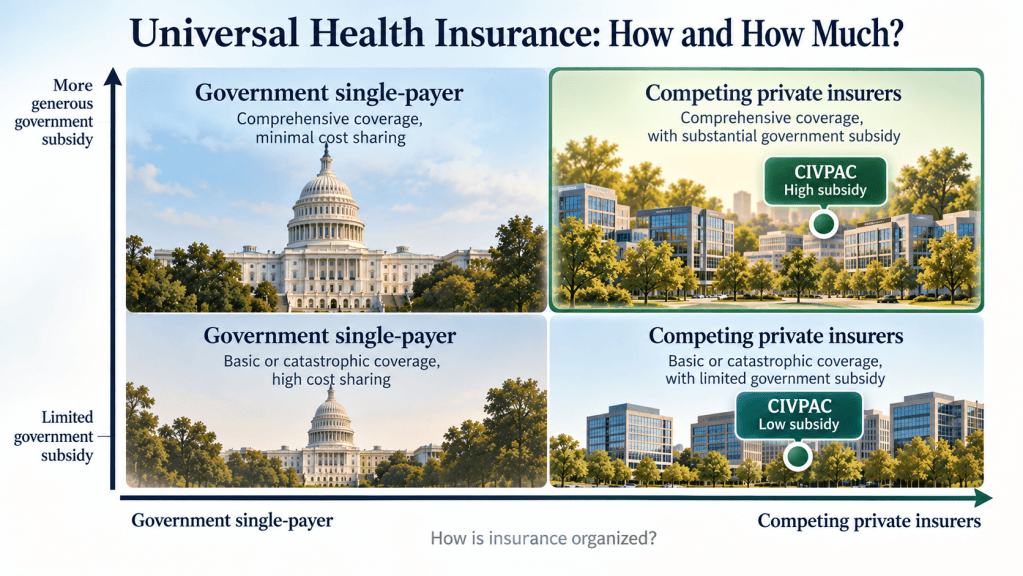
CIVPAC has substantially rewritten the discussion accompanying our health care policy proposal. The proposal itself remains unchanged. What has changed is our examination of the case for and against government single-payer health insurance, commonly called “Medicare for All.”
We continue to support universal health insurance through competing private insurers, with public subsidies, an enforceable requirement to maintain coverage, meaningful deductibles and copayments, and explicit limits on federal expenditures in real per-capita terms.
The size of those subsidies is an important policy choice. At one extreme, generous subsidies could provide something approaching comprehensive, nearly free medical care. At the other, more limited subsidies could support primarily catastrophic insurance. People with very different views about the appropriate role of government could agree on the basic structure while disagreeing about how generously it should be funded.
Our revised discussion begins by questioning the name “Medicare for All.” The proposed single-payer system differs fundamentally from Medicare as it currently operates, not only in the benefits provided but also in the economics of reimbursing medical providers.
We also examine the argument that America’s substantially higher health care expenditures demonstrate the need for government single-payer insurance.
Some of that difference reflects higher compensation for medical professionals and other choices that may provide genuine benefits to patients. Other differences, including pharmaceutical pricing, hospital market power and excessive administrative costs, present opportunities for reform.
But these problems have potential solutions that do not require replacing the existing insurance system. Stronger antitrust enforcement, pharmaceutical pricing reforms and industry cooperation on administrative standards deserve serious consideration.
Our critique also addresses the fiscal obligations, incentives, administrative pricing decisions and transition costs associated with government single-payer insurance. We recognize that such a system could offer advantages, including greater purchasing power and simplified administration. The question is whether those advantages justify replacing a competitive insurance system that can itself be improved.
Universal coverage is the objective. How we achieve it, and how much government should contribute, are separate questions.
CIVPAC believes that we can provide universal health insurance while preserving the incentives for efficiency that competition and consumer choice offer, and without creating an open-ended federal financial obligation.
We invite readers to examine our revised analysis and the policy proposal that follows it.