Florida Senate Evaluation Published: CIVPAC Makes No Endorsement

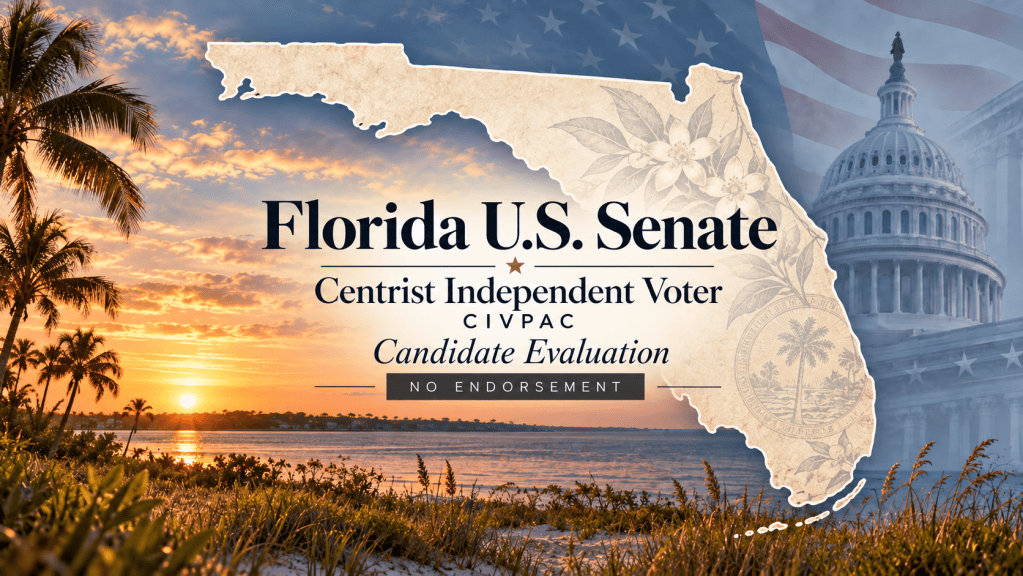
CIVPAC Florida U.S. Senate 2026 candidate evaluation — no endorsement

CIVPAC has moved its Florida U.S. Senate evaluation from the draft pool to publication and makes no endorsement among Republican incumbent Ashley Moody, Democrat Angie Nixon and No Party Affiliation candidate Neil Gillespie.

Moody is considerably closer to us on a number of economic and foreign-policy questions, including support for sanctions against Russia. But her Senate record raises serious concerns about congressional independence. She has supported a series of controversial Trump nominees, backed the administration’s exercise of emergency tariff authority and repeatedly declined to support congressional efforts to assert its constitutional authority over military action.

Nixon would provide a stronger partisan check on the administration, an important consideration given our increasing concern about executive power and the value of divided government. But her domestic agenda—including Medicare for All, a federal jobs guarantee, national rent controls, tuition-free public college, a wealth tax and abolition of right-to-work laws—lies far to our left. Her positions on Israel and unanswered questions about Ukraine, NATO and broader American international leadership create additional concerns. Nixon’s own platform confirms many of these domestic and foreign-policy positions. Angie Nixon for U.S. Senate

The Democratic primary also demonstrates that this choice was not inevitable. Nixon defeated Alexander Vindman, who offered a substantially different combination of positions and whom CIVPAC would have viewed much more favorably. We mention that not to relitigate the primary, but because it helps explain the particular choices now before Florida voters. Washington Post

Gillespie’s rejection of conventional partisan politics initially merits attention from an organization focused on independent voters, but we have found too little of a developed policy program—and no clear indication of how he would caucus in the Senate—to recommend him as an alternative.

The result is an unusual but straightforward conclusion: Moody is closer on many policies but has not demonstrated the institutional independence we want from a senator serving under a president of her own party; Nixon offers greater institutional opposition to the White House but asks us to accept domestic and foreign-policy positions too far removed from our own; and Gillespie has not yet provided enough information for a comparable evaluation.

CIVPAC therefore makes no endorsement in Florida’s 2026 U.S. Senate election.

Read the full Florida U.S. Senate evaluation and no-endorsement.

See all CIVPAC 2026 Senate endorsements and evaluations.

See all CIVAPC 2026 Endorsements

CIVPAC Provisionally Endorses Annie Andrews in South Carolina Senate Race

CIVPAC provisional endorsement of Annie Andrews in the 2026 South Carolina U.S. Senate race

CIVPAC has published its evaluation of South Carolina’s 2026 U.S. Senate race and provisionally endorsed Democrat Annie Andrews over Republican Senator Darline Graham, Libertarian Kasie Whitener and Constitution Party candidate Mark Hackett.

This is not an endorsement without reservations.

Andrews is closer to our positions on reproductive freedom, immigration, evidence-based public health and congressional war powers. We also give substantial weight at this point to congressional independence and the value of divided government as a check on executive power.

At the same time, Andrews is to our left on much of domestic economic policy. We have reservations about the size and role of government implicit in parts of her agenda, including important unanswered questions about the design of her proposed public health-insurance option.

Our largest uncertainty concerns foreign policy. Andrews has made clear that she opposes open-ended wars and believes Congress should authorize sustained military action, but we have found much less from her on Ukraine, NATO, Russia, China and the broader international order.

Graham receives substantial credit for taking over the Russia and Iran sanctions legislation championed by her late brother, Senator Lindsey Graham, and helping carry it into law. But her limited foreign-policy preparation, her pledge to have President Trump’s back “100 percent,” and her vote against allowing an Iran War Powers resolution to proceed raise questions about congressional independence.

Whitener offers a strongly market-oriented and fiscally restrained alternative and has been unusually clear in challenging unilateral presidential war-making. Questions remain about what her noninterventionist approach would mean for NATO, Ukraine, Taiwan and Israel.

Hackett is clearer: he advocates ending U.S. support for Ukraine and Israel and withdrawing from NATO and the United Nations—positions fundamentally at odds with our approach to American foreign policy.

For now, the combination of divided government, congressional independence, reproductive freedom, immigration and public health tips our evaluation toward Andrews.

The endorsement is deliberately provisional. Andrews, Graham and Whitener are scheduled to participate in the October 11 South Carolina ETV debate, and we intend to review the endorsement afterward. In particular, we will be listening for clearer answers from Andrews on Ukraine and NATO, from Graham on congressional independence, and from Whitener on the practical implications of her foreign-policy philosophy.

Read the full South Carolina U.S. Senate evaluation and provisional endorsement.

See all CIVPAC 2026 Senate endorsements and evaluations.

CIVPAC Completes Its Review of the 2026 U.S. Senate Races

CIVPAC completes review of every 2026 U.S. Senate race with Oregon endorsement of Jeff Merkley

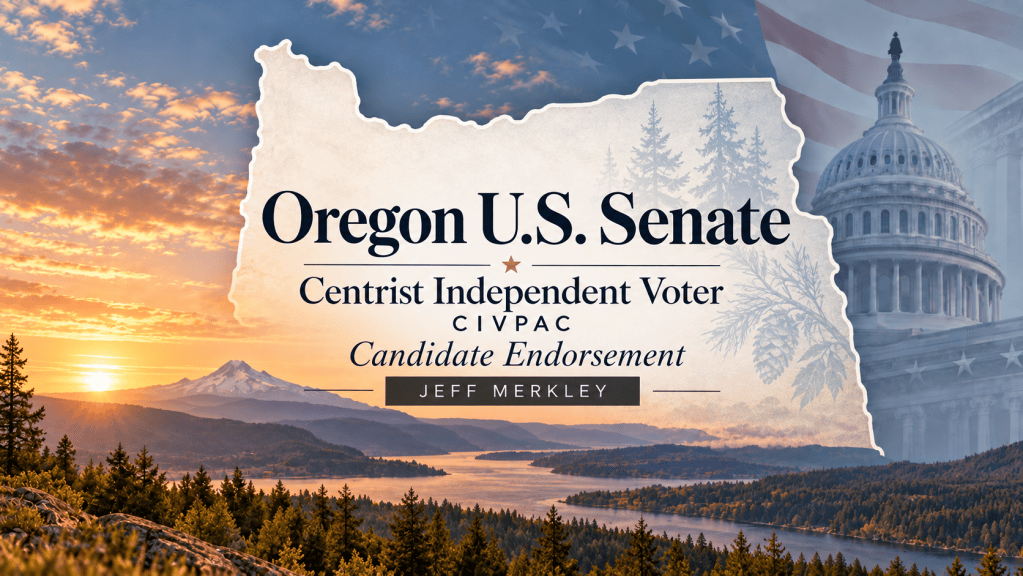
CIVPAC has published its evaluation of the 2026 U.S. Senate race in Oregon, completing its review of every Senate general-election race this year.

The Oregon evaluation endorses Democratic incumbent Jeff Merkley over Republican David Brock Smith, Libertarian Gary Dye and Progressive/Pacific Green candidate Chris Henry.

This is not an endorsement based on broad agreement with Merkley’s domestic agenda. The evaluation identifies substantial differences over Medicare for All, labor policy, wealth taxation and the use of government direction rather than market mechanisms to address climate change.

There are also important areas of agreement. Merkley has strongly supported Ukraine and has been an active advocate of Congress reclaiming its constitutional authority over decisions involving war. The evaluation also finds substantial common ground on democratic institutions and parts of Middle East policy. Merkley

Brock Smith is closer to CIVPAC on several economic and regulatory questions. But the evaluation raises concerns about climate change, the effort to challenge the 2020 election results, voting policy and abortion. OPB has reported both his rejection of human contributions to climate change and his participation in the 2020 Texas election challenge. (OPB) opb

His relationship with President Trump is also important to the evaluation. Willamette Week described Brock Smith as an outspoken Trump supporter and reported that, when asked whether he disagreed with anything Trump had done during his second term, he did not identify an example. CIVPAC was also unable to find sufficiently clear positions from him on tariffs, Ukraine, NATO or the Iran war. (Willamette Week) Willamette Week

In the end, the value of divided government tipped the balance. The Oregon evaluation argues that congressional checks on executive authority work less effectively when members of Congress are unwilling to challenge a president of their own party. For this moment, that consideration favors returning Merkley to the Senate. The endorsement is explicitly conditional: if the White House were occupied by a Democrat, particularly one well to the left of center, Merkley would probably not receive CIVPAC’s endorsement.

Read the full Oregon U.S. Senate evaluation and endorsement.

See all CIVPAC 2026 Senate endorsements and evaluations.

With the Oregon review, CIVPAC has now reviewed every 2026 U.S. Senate general-election race. We have published endorsements in 26 races, including Alaska, published evaluations without an endorsement in 3, and have 6 completed drafts still under review and awaiting publication.

That completes the research stage of the Senate project. The races will continue to be followed, and evaluations or endorsements can be revisited if significant new information warrants it.

CIVPAC has endorsed Marquita Bradshaw for the United States Senate in Tennessee.

Tennessee outline and U.S. Capitol representing CIVPAC’s 2026 Tennessee U.S. Senate endorsement.

It was not an easy decision. In fact, we had been preparing to make no endorsement at all.

Republican incumbent Bill Hagerty is substantially closer to CIVPAC on many questions of taxation, regulation and economic policy. Bradshaw’s economic philosophy remains considerably to our left, and important questions remain about her views on Ukraine, NATO and America’s broader international responsibilities. Her current campaign focuses primarily on domestic priorities including education, health care, housing, voting rights, broadband, small business and environmental issues.

But Hagerty’s record raises a different set of concerns. He has opposed U.S. assistance to Ukraine, saying that he had opposed “every cent” of such aid and arguing that the United States should focus its resources at home. He has also generally supported President Trump on issues in which CIVPAC believes congressional independence deserves particular attention, including nominations, tariffs and presidential war powers.

The final consideration came from President Trump himself.

At the Republican midterm convention in Dallas, Trump urged voters to treat the 2026 election as a referendum on his presidency, telling them to “pretend I’m on the ballot.”

CIVPAC has decided to take that invitation seriously.

For CIVPAC, divided government is not an automatic reason to support the opposition party. Candidates still have to be judged individually. But when questions of congressional independence and executive power are already central to an evaluation, the composition of the Senate becomes an additional consideration.

After weighing those factors, CIVPAC has endorsed Marquita Bradshaw for the U.S. Senate from Tennessee.

Read our full Tennessee U.S. Senate evaluation.

See all CIVPAC 2026 endorsements.

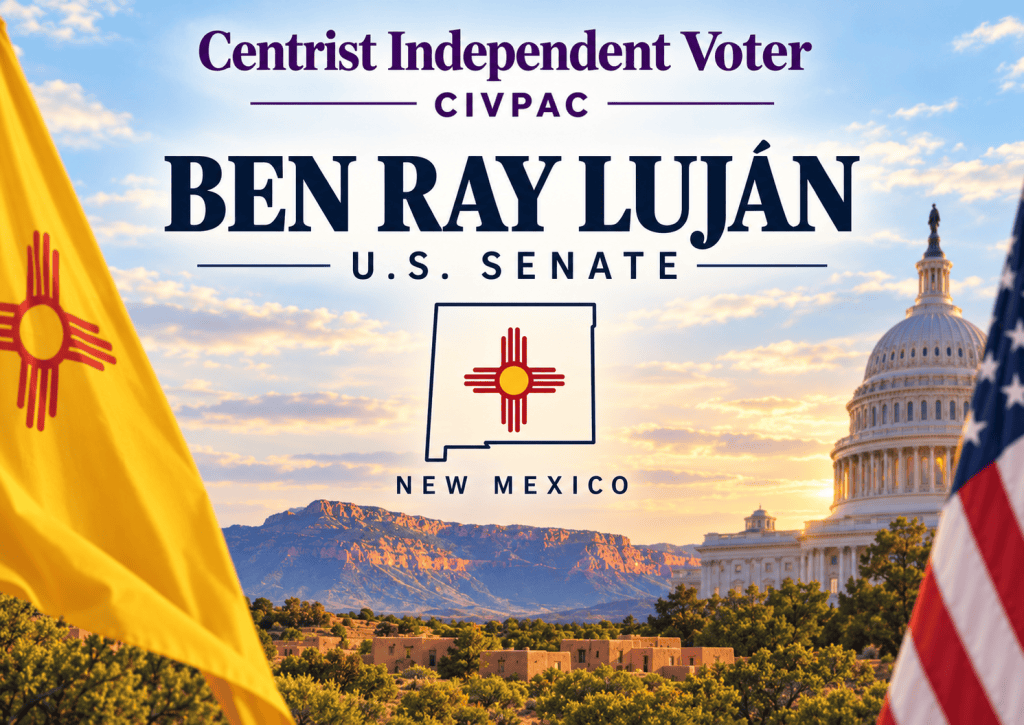
CIVPAC endorses Senator Ben Ray Luján for reelection to the U.S. Senate from New Mexico.

CIVPAC endorsement graphic for Ben Ray Luján for U.S. Senate in New Mexico, with the New Mexico state outline and U.S. Capitol.

CIVPAC Endorses Ben Ray Luján for U.S. Senate in New Mexico

The endorsement is qualified. Our comparison finds substantial differences with Luján on economic policy, while Republican Larry Marker brings useful private-sector experience. But Marker has provided relatively little information on major responsibilities of a U.S. senator, including foreign policy, health care, climate policy and several questions of constitutional government.

The endorsement also examines a separate institutional consideration: the value of divided government as a check on executive power. In the present political environment, that consideration gives the New Mexico Senate race greater significance than the candidate comparison alone.

Read our full endorsement of Ben Ray Luján for U.S. Senate.

See all of Centrist Independent Voter’s 2026 candidate endorsements.

Why CIVPAC Sometimes Favors Divided Government

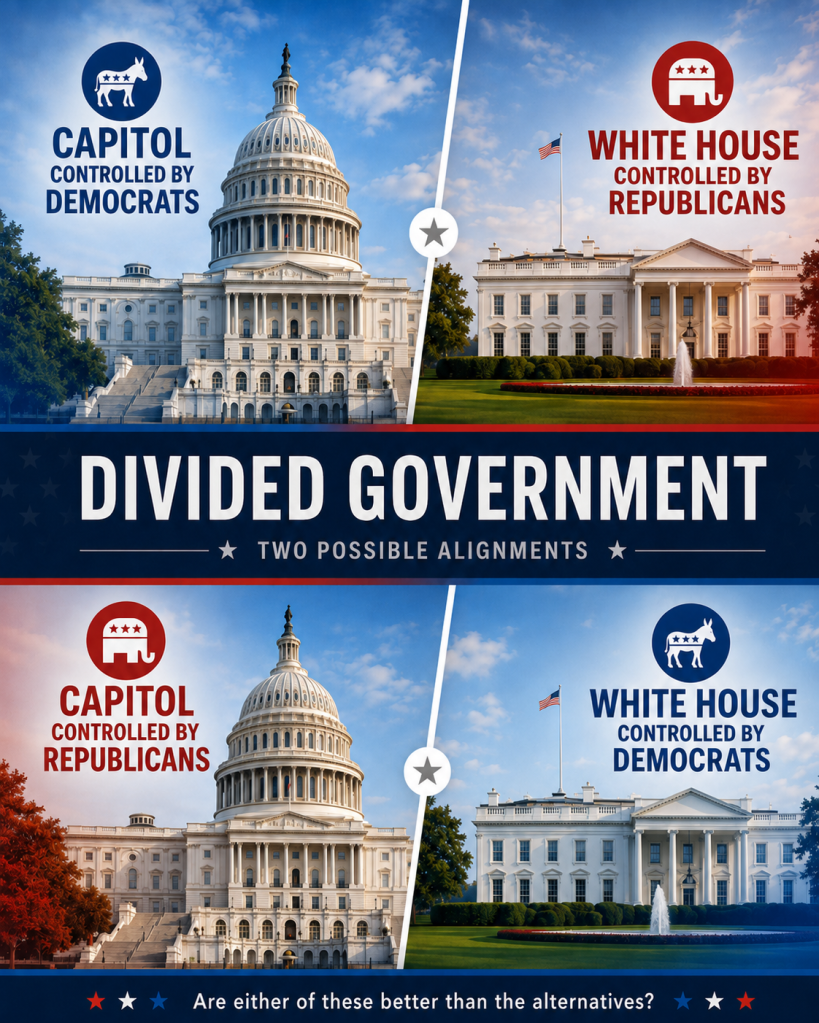
Two stacked illustrations of divided government: one shows a Democratic-controlled Capitol and Republican-controlled White House; the other reverses the parties, asking whether either arrangement is better than unified government.

CIVPAC does not favor Democratic control of Congress or Republican control of Congress in the abstract.

Our concern is institutional balance.

The Constitution assumes that Congress will defend its institutional role against the executive. In practice, party loyalty often overwhelms institutional responsibility. Members of Congress too often behave less like members of a separate branch of government and more like members of the president’s party team.

Divided government is not ideal. It is a second-best safeguard. If Congress will not check a president because it is Congress, perhaps an opposition-party Congress will check a president because it is the opposition party.

That is not a perfect solution. Divided government can produce obstruction, gridlock, posturing, and crisis. But it may still be safer than unified partisan control when party loyalty is too strong and institutional restraint is too weak.

In 2026, this principle may lead CIVPAC to favor some Democratic candidates as a check on this Republican executive. That should not be mistaken for a general endorsement of Democratic control of Congress.

In a different cycle, if Democrats held the White House — especially under a DSA-aligned or far-left president — the same principle could lead CIVPAC to favor Republican control of Congress, if Republicans nominate candidates fit to serve as a constitutional check.

Our preference is not partisan control. Our preference is constitutional balance, institutional restraint, and resistance to one-party overreach.

The more hopeful answer is that one of the two major parties might become moderate enough, responsible enough, and institutionally serious enough to be trusted with unified power. If that happened, divided government would be less necessary. But neither party has yet earned that level of trust.

This connects directly to CIVPAC’s idea of a true win-everywhere strategy.

Winning everywhere means nominating candidates who can actually represent the voters in the places they hope to serve. It means being broad enough, serious enough, and trusted enough to compete where the party’s national brand is weak. It also means having a national brand that does not make that impossible.

Too often, both parties say they want to win everywhere while behaving as if every district should be represented by the same national ideological brand.

A party captured by its ideological base cannot really win everywhere. It can win safe seats. It can hope for favorable waves. But it cannot rebuild trust in places where voters fear that unified party control would become ideological overreach.

A true win-everywhere strategy requires rejecting extreme ideological litmus tests, nominating candidates suited to their districts, respecting constitutional limits, and showing voters that winning power would not become permission for factional domination.

Candidate selection matters, even if success or failure of the party is inevitable in that state or district.

When Democratic primary voters choose practical center-left candidates over far-left or DSA-aligned alternatives, they make the Democratic Party more governable and more trustworthy. When Republican primary voters choose practical center-right candidates over MAGA, election-denying, or authoritarian-populist alternatives, they do the same for the Republican Party.

The center is not asking the two parties to become identical. Disagreement within constitutional boundaries is healthy. But there is a difference between ordinary policy disagreement and a politics that treats institutions as obstacles, opponents as enemies, and victory as permission to dominate.

Democracy is not stable merely because elections are held. It also requires parties that can be trusted with power, leaders who respect limits, and voters who reward seriousness over performance.

CIVPAC’s position is therefore straightforward: divided government may be necessary when neither party has earned full trust. The better long-term answer is for at least one party — and ideally both — to become moderate, responsible, and institutionally serious enough to be trusted with power.

The first party to learn that lesson may not merely win more elections.

It may deserve to govern.

Until then, please remember that even if your side wins by substantial majority, you do not have a mandate to pursue your wildest dreams. You have an opportunity to demonstrate that you can be trusted with power.