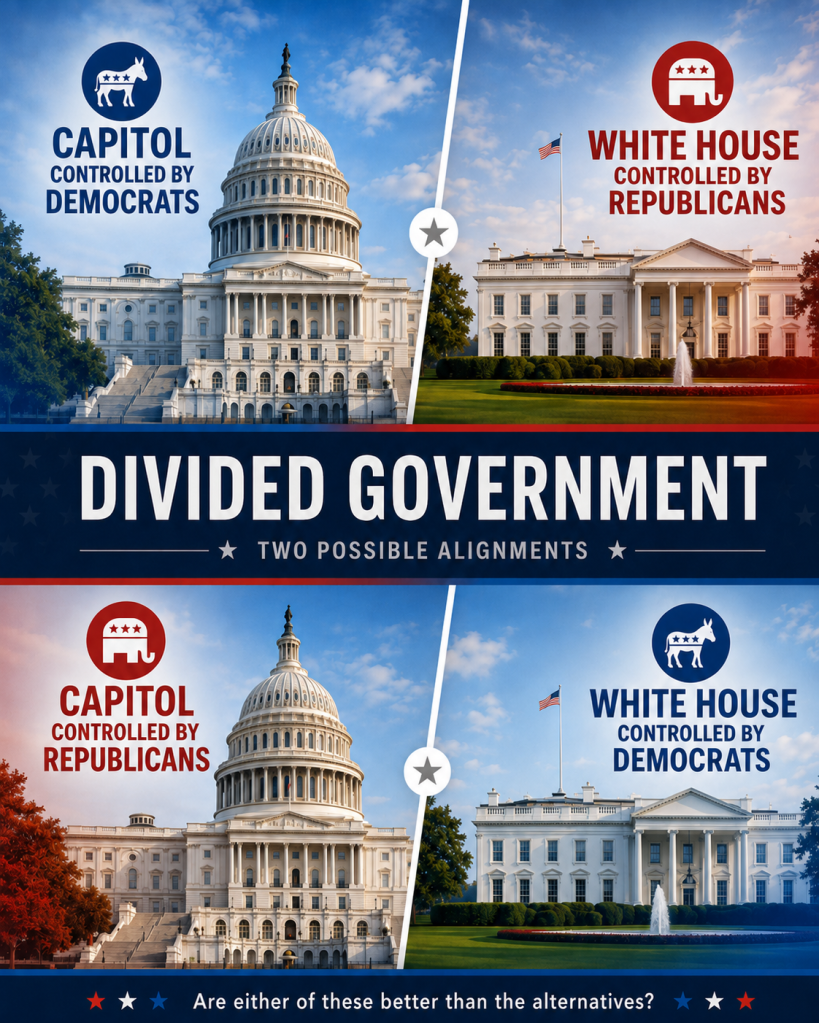
CIVPAC does not favor Democratic control of Congress or Republican control of Congress in the abstract.
Our concern is institutional balance.
The Constitution assumes that Congress will defend its institutional role against the executive. In practice, party loyalty often overwhelms institutional responsibility. Members of Congress too often behave less like members of a separate branch of government and more like members of the president’s party team.
Divided government is not ideal. It is a second-best safeguard. If Congress will not check a president because it is Congress, perhaps an opposition-party Congress will check a president because it is the opposition party.
That is not a perfect solution. Divided government can produce obstruction, gridlock, posturing, and crisis. But it may still be safer than unified partisan control when party loyalty is too strong and institutional restraint is too weak.
In 2026, this principle may lead CIVPAC to favor some Democratic candidates as a check on this Republican executive. That should not be mistaken for a general endorsement of Democratic control of Congress.
In a different cycle, if Democrats held the White House — especially under a DSA-aligned or far-left president — the same principle could lead CIVPAC to favor Republican control of Congress, if Republicans nominate candidates fit to serve as a constitutional check.
Our preference is not partisan control. Our preference is constitutional balance, institutional restraint, and resistance to one-party overreach.
The more hopeful answer is that one of the two major parties might become moderate enough, responsible enough, and institutionally serious enough to be trusted with unified power. If that happened, divided government would be less necessary. But neither party has yet earned that level of trust.
This connects directly to CIVPAC’s idea of a true win-everywhere strategy.
Winning everywhere means nominating candidates who can actually represent the voters in the places they hope to serve. It means being broad enough, serious enough, and trusted enough to compete where the party’s national brand is weak. It also means having a national brand that does not make that impossible.
Too often, both parties say they want to win everywhere while behaving as if every district should be represented by the same national ideological brand.
A party captured by its ideological base cannot really win everywhere. It can win safe seats. It can hope for favorable waves. But it cannot rebuild trust in places where voters fear that unified party control would become ideological overreach.
A true win-everywhere strategy requires rejecting extreme ideological litmus tests, nominating candidates suited to their districts, respecting constitutional limits, and showing voters that winning power would not become permission for factional domination.
Candidate selection matters, even if success or failure of the party is inevitable in that state or district.
When Democratic primary voters choose practical center-left candidates over far-left or DSA-aligned alternatives, they make the Democratic Party more governable and more trustworthy. When Republican primary voters choose practical center-right candidates over MAGA, election-denying, or authoritarian-populist alternatives, they do the same for the Republican Party.
The center is not asking the two parties to become identical. Disagreement within constitutional boundaries is healthy. But there is a difference between ordinary policy disagreement and a politics that treats institutions as obstacles, opponents as enemies, and victory as permission to dominate.
Democracy is not stable merely because elections are held. It also requires parties that can be trusted with power, leaders who respect limits, and voters who reward seriousness over performance.
CIVPAC’s position is therefore straightforward: divided government may be necessary when neither party has earned full trust. The better long-term answer is for at least one party — and ideally both — to become moderate, responsible, and institutionally serious enough to be trusted with power.
The first party to learn that lesson may not merely win more elections.
It may deserve to govern.
Until then, please remember that even if your side wins by substantial majority, you do not have a mandate to pursue your wildest dreams. You have an opportunity to demonstrate that you can be trusted with power.