
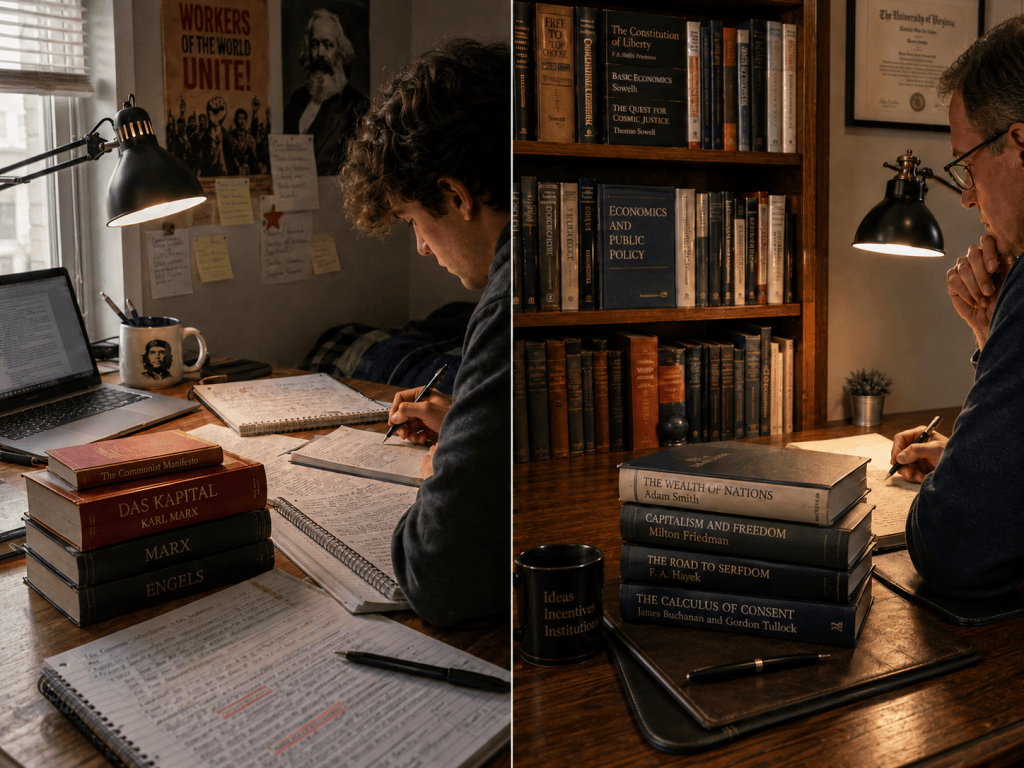
An imagined depiction of an intellectual journey from youthful socialism toward a more market-oriented view of economics and public policy. The books shown are illustrative.
Republicans have unearthed a 2020 video in which James Talarico described capitalism as one of several “oppressive systems” and spoke about dismantling it.
It was a bad comment. I disagree with it.
But I am considerably less troubled by what James Talarico said at 31 than I would be if, six years later, he still believed it.
Part of the reason is personal.
I too was, briefly, drawn to socialism when I was young. Its moral appeal is easy to understand. It begins with concerns that are real and important: poverty, inequality, unfairness, concentrated power, and the sense that too many people are denied a genuine opportunity to flourish. To a young person trying to make sense of injustice, socialism can appear not merely plausible but humane.
What changed my mind was not that I stopped caring about those things. It was experience and study.
Over time, I came to understand more clearly what markets do, how prices communicate information, how incentives shape behavior, and how difficult it is for political institutions to reproduce the decentralized knowledge contained in millions of individual economic decisions. I also learned more from history about the distance that can separate the intentions of socialism from its actual results.
That process did not make me less concerned with poverty or inequality. It changed my understanding of how best to address them.
Capitalism is imperfect. Markets require rules. Competition must be protected. Government has important responsibilities, including providing a social safety net and addressing genuine market failures. But a market economy, properly governed, remains an extraordinary mechanism for innovation, adaptation, wealth creation, and the expansion of human opportunity.
There is an old aphorism, usually attributed to one statesman or another, that a person who is not a socialist when young has no heart, while one who remains a socialist has no head. Like most aphorisms, it is too sweeping.
But I understand the truth it is trying to capture because I have lived some version of it myself.
Youth naturally places great weight on intentions and ideals. Experience teaches us to pay closer attention to consequences, incentives, tradeoffs, and the stubborn complexity of human institutions. The moral instinct that draws someone toward socialism can be admirable even when the economic conclusions that follow from it are mistaken.
That is why I see Talarico’s evolution on capitalism not simply as something to excuse, but as something worth understanding.
His earlier comments reflected an economic view I believe was wrong. His subsequent evolution suggests that he was capable of reconsidering it. That matters.
Politics increasingly encourages us to treat every statement a person made years ago as a permanent declaration of character. I think that is exactly backward. We should want leaders who are capable of learning. We should want people who encounter new evidence, acquire experience, reconsider old assumptions, and occasionally conclude that something they once believed was mistaken.
Sadly we have too many politicians who are unwilling to admit that they were ever wrong even when it is obvious to the casual observer that they frequently are.
I would be in a poor position to condemn Talarico merely for having once been attracted to ideas that also appealed to me when I was younger.
The more important question is what someone does with the years that follow.
Do they learn? Do they test their ideals against experience? Do they retain their concern for people while becoming more realistic about the institutions that can actually improve their lives?
In my own case, I hope the answer has been yes.
And Talarico’s evolution gives me reason to think the same may be true of him.
That is why the old aphorism seems particularly apt here. The young Talarico’s attraction to socialism may have reflected his heart. His willingness to rethink it suggests something about his head.
His evolution reinforces what I already had reason to believe: James Talarico appears to have both.