An imagined depiction of an intellectual journey from youthful socialism toward a more market-oriented view of economics and public policy. The books shown are illustrative.
Republicans have unearthed a 2020 video in which James Talarico described capitalism as one of several “oppressive systems” and spoke about dismantling it.
It was a bad comment. I disagree with it.
But I am considerably less troubled by what James Talarico said at 31 than I would be if, six years later, he still believed it.
Part of the reason is personal.
I too was, briefly, drawn to socialism when I was young. Its moral appeal is easy to understand. It begins with concerns that are real and important: poverty, inequality, unfairness, concentrated power, and the sense that too many people are denied a genuine opportunity to flourish. To a young person trying to make sense of injustice, socialism can appear not merely plausible but humane.
What changed my mind was not that I stopped caring about those things. It was experience and study.
Over time, I came to understand more clearly what markets do, how prices communicate information, how incentives shape behavior, and how difficult it is for political institutions to reproduce the decentralized knowledge contained in millions of individual economic decisions. I also learned more from history about the distance that can separate the intentions of socialism from its actual results.
That process did not make me less concerned with poverty or inequality. It changed my understanding of how best to address them.
Capitalism is imperfect. Markets require rules. Competition must be protected. Government has important responsibilities, including providing a social safety net and addressing genuine market failures. But a market economy, properly governed, remains an extraordinary mechanism for innovation, adaptation, wealth creation, and the expansion of human opportunity.
There is an old aphorism, usually attributed to one statesman or another, that a person who is not a socialist when young has no heart, while one who remains a socialist has no head. Like most aphorisms, it is too sweeping.
But I understand the truth it is trying to capture because I have lived some version of it myself.
Youth naturally places great weight on intentions and ideals. Experience teaches us to pay closer attention to consequences, incentives, tradeoffs, and the stubborn complexity of human institutions. The moral instinct that draws someone toward socialism can be admirable even when the economic conclusions that follow from it are mistaken.
That is why I see Talarico’s evolution on capitalism not simply as something to excuse, but as something worth understanding.
His earlier comments reflected an economic view I believe was wrong. His subsequent evolution suggests that he was capable of reconsidering it. That matters.
Politics increasingly encourages us to treat every statement a person made years ago as a permanent declaration of character. I think that is exactly backward. We should want leaders who are capable of learning. We should want people who encounter new evidence, acquire experience, reconsider old assumptions, and occasionally conclude that something they once believed was mistaken.
Sadly we have too many politicians who are unwilling to admit that they were ever wrong even when it is obvious to the casual observer that they frequently are.
I would be in a poor position to condemn Talarico merely for having once been attracted to ideas that also appealed to me when I was younger.
The more important question is what someone does with the years that follow.
Do they learn? Do they test their ideals against experience? Do they retain their concern for people while becoming more realistic about the institutions that can actually improve their lives?
In my own case, I hope the answer has been yes.
And Talarico’s evolution gives me reason to think the same may be true of him.
That is why the old aphorism seems particularly apt here. The young Talarico’s attraction to socialism may have reflected his heart. His willingness to rethink it suggests something about his head.
His evolution reinforces what I already had reason to believe: James Talarico appears to have both.
“Property is theft” is a powerful slogan. But slogans are not systems.
There was a time when a line like “property is theft” would have struck me as profound.
It is a great line. Short, shocking, morally charged, and almost impossible to forget. I remembered it for decades, although I managed to attach it to the wrong author. The phrase is Proudhon’s, not Bukharin’s, as I used to think. My memory apparently filed it somewhere in the Russian revolutionary theory drawer, between Mikhail Bakunin, who would have embraced the phrase, and Nikolai Bukharin, who might have rejected it.
That probably says something about how memory works. It also says something about how political slogans work. The best ones do not merely state a proposition. They lodge.
In high school, I was not immune to that kind of language. I had been raised working class and skeptical of inherited privilege. I had seen enough of the world to know that property was not distributed according to virtue. Some people inherited homes, money, confidence, connections, and second chances. Others inherited bills, caution, and a smaller sense of what was possible. A slogan like “property is theft” did not sound absurd to me.
And it is a phrase worth taking seriously.
Private property is not morally innocent. It can create opportunity, but it can also preserve exclusion. It can reward work, but it can also reward inheritance, luck, monopoly, political influence, and proximity to power. It can create independence, but it can also give some people power over the lives and labor of others.
So I understand the appeal of Proudhon’s line. I also understand why young people drawn to socialism, democratic socialism, or other critiques of capitalism find it clarifying. It takes the world as they see it — unequal, unfair, tilted toward owners — and gives that perception a moral vocabulary.
But slogans are not systems. CIVPAC’s broader approach to political philosophy starts from that distinction.
The strongest argument for private property is not that it is sacred. It is not that God, nature, or metaphysics somehow assigned each parcel of land, each factory, each share of stock, or each bank account to its current owner. Property rights are human institutions. They are created, defined, limited, taxed, inherited, transferred, regulated, and enforced by law.
The better argument for private property is practical.
Societies that protect private property are generally richer, more productive, more innovative, and better able to sustain broad prosperity. People invest, build, save, lend, borrow, repair, improve, and take risks in part because they expect to keep most of what they create. Societies that reject private property sometimes starve. Secure property rights are one of the great foundations of economic life.
Without them, people do not become morally purified. They become poorer.
The political argument may be even more important. Hayek and Friedman were right: economic power and political power cannot be completely separated. If the state controls jobs, housing, investment, credit, production, and the means of livelihood, it controls much more than “the economy.” It controls the practical conditions under which people speak, organize, dissent, publish, worship, move, and live.
A person who can lose only an argument is freer than a person who can lose his livelihood. A society with many employers, many property owners, many newspapers, many associations, many sources of income, and many centers of power gives dissidents room to breathe. A society in which all economic life runs through the state may promise equality, but it gives political authority a terrifying lever.
That does not make laissez-faire a sufficient theory of justice. It is not. Markets can fail. Private power can become abusive. Property can be accumulated in ways that undermine opportunity and democracy. A serious defense of private property has to include taxation, antitrust, public goods, environmental rules, social insurance, and limits on fraud, coercion, and monopoly.
But that is very different from treating property itself as theft.
A better formulation is that private property is not sacred, but it is indispensable. It is not a natural right floating above politics, but it is one of the institutions through which both prosperity and freedom become possible.
This is where I part company with the slogan. Proudhon’s line does not tell us how to build a free and prosperous society. It identifies a wound, but not a cure.
The old socialist and anarchist writers were not stupid. Many of them saw genuine injustice. Some of their questions remain good questions. Who owns? Who works? Who benefits? Who has power? Who is excluded? Those questions should still be asked.
But the history of the twentieth century should make us cautious about answers that concentrate economic power in the name of justice. When politics absorbs property, politics absorbs nearly everything.
That is why I defend private property, but not as an idol. I defend it as a practical institution, one that must be bounded by law and judged by its consequences. It helps make people richer. It can help keep power dispersed. It gives individuals, families, businesses, newspapers, churches, unions, universities, and civic organizations some space outside the direct command of the state.
Jefferson did not follow Locke’s familiar formulation of natural rights as life, liberty, and property. He chose “life, liberty, and the pursuit of happiness.” That does not mean property was unimportant to the Founders. It means property was not the highest end. Property was one of the institutions through which people could pursue security, independence, prosperity, and happiness. It was a means, not the whole moral purpose of the political order.
Property is not theft. Property is not sacred either.
Property is a tool. Like all powerful tools, it can be used badly. But without it, we are not merely poorer. We are less free.
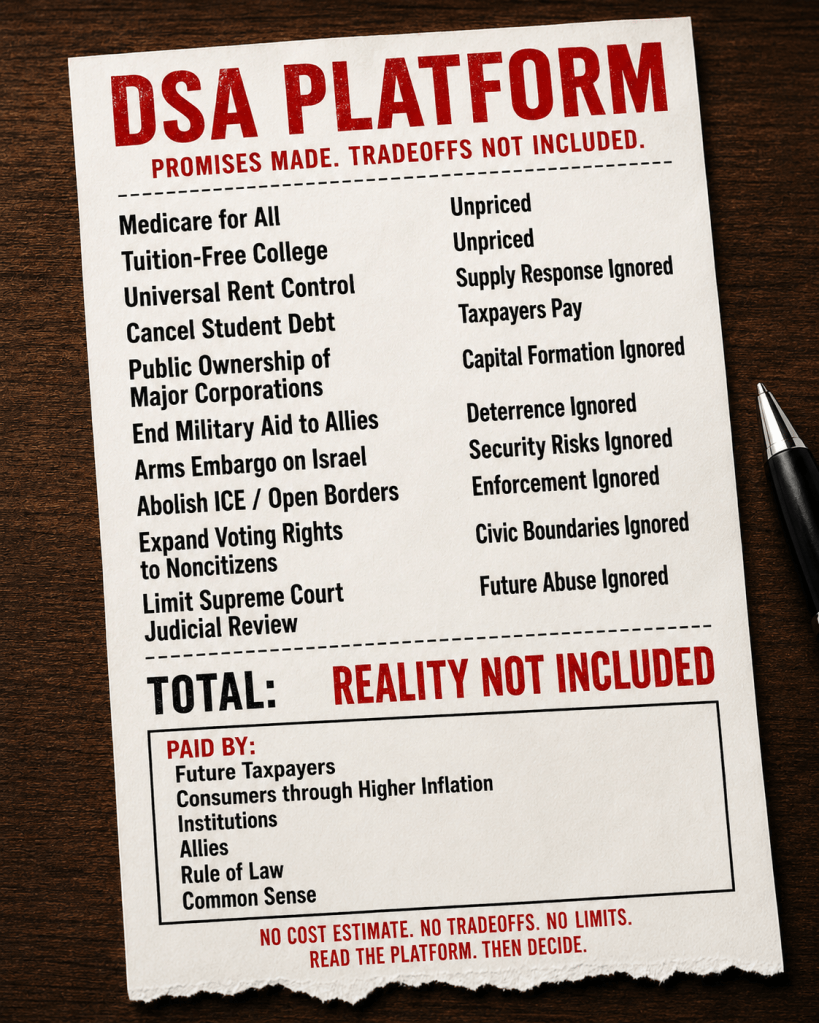
We encourage people to read it. Not excerpts. Not hostile summaries. Not campaign rhetoric from opponents. The platform itself.
Doing so is clarifying.
DSA does not merely argue for a more generous welfare state, a somewhat higher minimum wage, stronger unions, or more aggressive health-care reform. Some of its proposals overlap with familiar progressive politics, but the platform’s underlying diagnosis and proposed direction are much more radical.
DSA says the capitalist system is the cause of major social harms and calls for a socialist society in which the largest corporations are placed under public ownership and democratic control. It calls for universal rent control, tuition-free public higher education with no out-of-pocket room and board costs, cancellation of all student-loan debt, Medicare for All with no premiums, co-pays, or deductibles, a 32-hour workweek with no reduction in pay or benefits, a wealth tax, and public ownership over major transportation and energy infrastructure and natural resources.
On foreign policy, it calls for ending military and economic aid and weapons sales to Israel, greatly reducing the U.S. military budget, closing overseas bases, bringing troops home, ending economic sanctions on countries such as Cuba, Venezuela, and Iran, and allowing workers to migrate freely across borders without restrictive immigration controls. It also calls for ending immigrant detention and deportations, immediate amnesty for all immigrants regardless of current immigration status, and access to jobs, labor rights, and social services for all immigrants.
On constitutional structure, it calls for voting rights for noncitizens, proportional representation, expansion of the House of Representatives, abolition of the Senate filibuster, replacement of the Electoral College with a national popular vote, and limits on the Supreme Court’s power of judicial review.
This platform is not Denmark. It is not Franklin Roosevelt. It is not a slightly more aggressive version of mainstream Democratic liberalism.
It is a sweeping ideological program built on bad diagnosis, magical financing, weak attention to incentives, and dangerous institutional assumptions.
DSA’s platform does not become serious merely because it attaches itself to familiar grievances. High housing prices do not prove that markets have failed. In many high-cost places, the problem is that housing markets have been systematically constrained by zoning restrictions, permitting delays, local veto points, parking mandates, height limits, environmental-review abuse, and political resistance to new supply. DSA’s answer is more public control. CIVPAC’s answer is to ask what is preventing supply from responding to demand — and then try to fix that.
High medical costs do not prove that more government control is the answer. Many of the worst distortions in American health care come from decades of tax preferences, mandates, cross-subsidies, public reimbursement rules, restricted competition, employer-based coverage, and government-shaped incentives. A serious reform agenda would ask how to preserve access, restore price discipline, reduce administrative waste, and create better incentives for patients, providers, insurers, and taxpayers. DSA instead treats the problem as if government promises can repeal scarcity.
Student debt is rarely a social injustice. It is also the result of personal borrowing decisions, institutional pricing power, weak cost discipline, political encouragement of debt-financed education, and a culture that too often treated college borrowing as an entitlement regardless of expected return. Blanket cancellation shifts costs from borrowers to taxpayers, including many people who did not attend college, paid their debts, chose less expensive schools, or made other sacrifices.
The same pattern appears throughout the platform. DSA begins with moral language and ends with government command. It treats every grievance as proof of capitalism’s failure and every government promise as if it were self-financing, self-administering, and immune from abuse. It gives too little attention to costs, incentives, capital formation, administrative capacity, unintended consequences, individual responsibility, public safety, democratic allies, and constitutional limits.
CIVPAC’s objection is not that government has no role. As our philosophy and broader policy positions make clear, government has important roles: protecting civil rights, maintaining public order, supporting basic research, correcting genuine market failures, providing a safety net, protecting the environment, enforcing contracts, defending the country and our allies, and helping ensure that opportunity is not limited by accident of birth.
But there is a vast difference between responsible public policy and the belief that most social problems can be solved by transferring more power to government or politically favored collectives.
The DSA platform repeatedly assumes away the hardest questions. Who pays? Who decides? What happens when supply falls in response to incentives? What happens when capital leaves? What happens when rent control reduces construction or maintenance? What happens when public systems are captured by unions, bureaucracies, or political machines? What happens when immigration enforcement is effectively abolished? What happens when sanctions are removed from hostile regimes? What happens when American military power retreats and authoritarian states fill the vacuum? What happens when judicial review is weakened and the next illiberal majority inherits that precedent?
These are not technical quibbles. They are the questions serious people ask before giving government more power.
DSA’s foreign-policy platform is especially troubling. A politics that calls for ending arms sales to Israel, drastically reducing American military power, closing overseas bases, ending sanctions on regimes such as Cuba, Venezuela, and Iran, and loosening immigration controls to the point of practical non-enforcement is not merely idealistic. It is a worldview. It is a worldview in which American power is treated as the central danger, democratic allies are treated with deep suspicion, and hostile regimes are often treated as victims of American policy rather than responsible for their own actions.
That worldview is wrong.
CIVPAC believes the United States should use power prudently. We do not support reckless intervention, blank checks, or indifference to civilian suffering. But prudence is not retreat. A stable international order depends in part on American strength, alliances, deterrence, and a willingness to distinguish democratic allies from authoritarian adversaries and terrorist organizations.
The platform’s institutional proposals also deserve scrutiny. Some election reforms may be worth considering. CIVPAC itself supports reforms such as open primaries and ranked-choice voting where they improve representation and reduce extremism. But DSA’s broader institutional program points toward a major restructuring of constitutional government. Limiting judicial review, weakening existing checks, and redesigning institutions in the name of “working-class democracy” should not be treated as harmless reform language. Constitutional limits matter most when a political movement is convinced of its own moral certainty.
The deeper issue is not any single plank. It is the attitude toward power.
DSA’s platform imagines that if the “right” people control the state, the state can guarantee housing, health care, education, jobs, wages, migration rights, climate transformation, public ownership, and international justice. History gives us many reasons to doubt that premise. Economics gives us many more.
The center should not be embarrassed to say this plainly.
Markets are imperfect. Government is also imperfect. Private power can be abused. Public power can be abused too. Capitalism requires rules, but rules require discipline. Social insurance is valuable, but promises require funding. Compassion is admirable, but compassion that refuses to recognize costs becomes fantasy. Democracy requires majority rule, but liberal constitutional democracy also requires limits, rights, courts, pluralism, private civil society, and protection for those who lose the next election.
DSA’s platform is not simply too far left. It is unserious about the constraints that make free societies governable.
That is why CIVPAC’s 2026 endorsements emphasize practical governance over ideological performance, including our most recent endorsements of Greg Stanton, in Arizona, and Haley Stevens, in Michigan.
That is also why CIVPAC believes voters should read the DSA platform.
Do not take our word for it. Read the platform. Then ask whether this is the direction the Democratic Party, or the country, should go.
CIVPAC believes the answer is no.
CIVPAC welcomes comments, corrections, and opposing views. Please share your thoughts on our Contact Us page or leave a comment below. If you are commenting on a particular candidate or race, please include that in your comment.