Centrist Policy Positions and Politicians Worth Supporting
Author: Centrist Independent Voter, PAC
The Centrist Independent Voter Political Action Committee, Inc., also known as CIVPAC, was formally established in 2022. Its predecessor organization was founded in 2011 as the New Independent Party. CIVPAC is a nonprofit political action committee focused on moving the existing political parties toward the political center. CIVPAC’s purpose is twofold: first, to promote centrist solutions to difficult public policy problems; and second, to support moderate candidates, including Democrats, Republicans, and independents. CIVPAC’s logo is adapted from Francisco Goya’s The Sleep of Reason. The inscription in the image reads, “The Sleep of Reason Produces Monsters.”
Centrist Independent Voter has endorsed Republican Representative Brian Fitzpatrick for re-election in Pennsylvania’s 1st Congressional District.
Fitzpatrick is not a perfect match for CIVPAC on every issue. His Democratic opponent, Bob Harvie, is also a serious candidate. But Fitzpatrick has built one of the strongest records of bipartisan cooperation and independent judgment in Congress.
He co-chairs the bipartisan Problem Solvers Caucus, has repeatedly ranked among the House’s most bipartisan members, and has been a particularly strong supporter of Ukraine and America’s alliances. In 2026, he helped force a House vote on additional assistance for Ukraine despite opposition from Republican leadership.
Fitzpatrick has also demonstrated a willingness to disagree with his own party when he believes it is warranted.
Centrist Independent Voter believes that behavior should be rewarded. If we want both political parties to produce more pragmatic, institutionally serious members of Congress, independent voters have to support those who actually govern that way.
I have substantial disagreements with New York City Mayor Zohran Mamdani. He is a democratic socialist, and many of his signature proposals rely too heavily on price controls, subsidies and government provision of goods and services.
But good policy should be recognized even when it comes from someone with whom we usually disagree. To my mild surprise, Mamdani has given me several opportunities.
This is good economics. Congestion imposes costs on everyone else using the road. Charging for that scarce resource encourages some drivers to travel differently while allowing those who value the trip most to continue making it.
His recent small-business deregulation deserves credit as well. The administration has proposed more than 50 reforms eliminating obsolete permits, duplicative licenses, paperwork and unnecessary fines. Among them is eliminating a second permit for restaurants that already have a food-service permit merely to sell ice cream. Regulatory complexity is a fixed cost that falls particularly heavily on small firms and new entrants. Removing rules that accomplish little makes markets more competitive.
The usual political justification is that wealthy people can afford to pay more. I find another argument more persuasive.
Like the carbon tax CIVPAC supports, this tax has an attractive either-or quality. If owners respond strongly, some will sell their seldom-used apartments or put them into productive residential use. The tax then partly destroys its own tax base—but increases the effective housing supply. That is success, not failure.
If owners barely respond, their demand is relatively inelastic. The city receives a sustainable source of revenue while creating relatively little economic distortion.
That is close to an ideal tax: either the distortion it creates is beneficial or the distortion is small enough that the tax raises substantial revenue.
Unfortunately, Mamdani does not apply that same understanding of prices and incentives consistently.
His rent freeze is the clearest example. The Rent Guidelines Board, dominated by his appointees, voted in June to freeze rents on both one- and two-year leases covering roughly one million rent-stabilized apartments. Lowering the legal price of an existing apartment may benefit its current tenant. It does not create another apartment. Over time, price controls discourage investment, maintenance and additions to supply—the opposite of what New York needs if it wants more housing.
I am similarly skeptical of municipal grocery stores. Mamdani’s administration plans five city-supported stores offering selected groceries at prices below prevailing levels. But groceries do not become cheaper because government declares a lower retail price. Someone pays the difference. Subsidizing selected government-backed stores also forces private grocers to compete against businesses whose losses taxpayers can absorb.
Nor am I persuaded by fare-free buses or the proposed $30 minimum wage. There can be good reasons to subsidize public transportation because it produces benefits beyond the individual passenger. But zero is not automatically the economically correct fare, particularly when removing fares increases demand while eliminating revenue that could improve frequency and reliability.
And setting wages far above the market wage can help workers who retain their jobs while making it harder for less-skilled workers to obtain one.
There is a broader lesson here.
CIVPAC does not believe a policy should be judged by whether it was proposed by a democratic socialist, a conservative or a centrist. I would rather ask: Who really bears the cost? What incentives does the policy create? What happens to supply? And is the resulting distortion harmful or useful?
Apply those questions consistently and Mamdani gets some surprisingly good answers.
He also gets some very bad ones.
The interesting thing is that the same economics explains both.
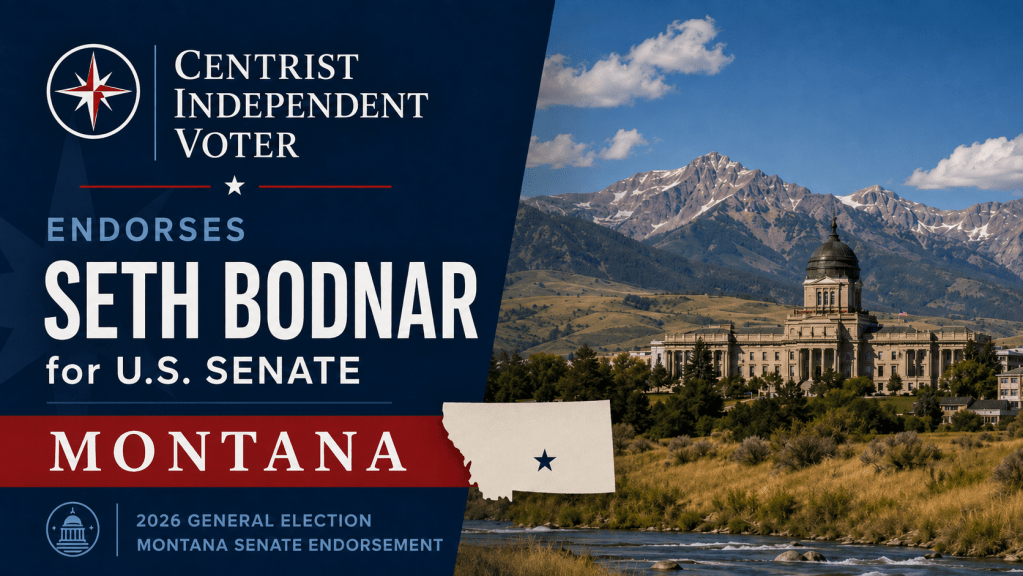
Centrist Independent Voter has endorsed independent candidate Seth Bodnar for the U.S. Senate in Montana.
Bodnar combines military service, executive leadership, and a strong commitment to restoring Congress’s constitutional role. He has also built an unusually broad coalition, with support from both prominent Republicans and Democrats.
The endorsement also addresses the central challenge facing independent candidates: the spoiler problem. In Montana, recent polling and bipartisan support suggest Bodnar may actually be the strongest alternative to Trump-aligned Republican Kurt Alme.
The independent candidate is not automatically the spoiler. Sometimes the strategic vote is the independent one.
Centrist Independent Voter has endorsed independent candidate Dan Osborn for the U.S. Senate in Nebraska.
Osborn is not a perfect policy match for us. We have substantial reservations about parts of his economic agenda, particularly some of his more populist proposals. But his commitment to political independence, opposition to blanket tariffs, support for Ukraine, and emphasis on restoring Congress’s constitutional role make a compelling case.
Republican Senator Pete Ricketts deserves credit for his strong support of Ukraine. But on several important institutional questions—including presidential appointments, war powers, tariffs and voting legislation—he has too often sided with President Trump rather than asserting Congress’s independent responsibilities.
Osborn says he will caucus with neither Democrats nor Republicans and could become part of a small bloc of genuinely independent senators. Such a bloc could help loosen the grip of party leadership and encourage bipartisan governing.
That potential power should be used responsibly—not to pursue pet populist crusades, but to make Congress work better.
Nebraska voters have an opportunity to send the Senate something it badly needs: a genuinely independent voice.
Centrist Independent Voter has endorsed Senator Jack Reed in Rhode Island’s September 9 Democratic primary for the United States Senate.
Reed combines deep national-security experience with strong support for Ukraine, opposition to economically damaging tariffs and a record of practical bipartisan legislation. His judgment and institutional experience make him the strongest choice in the Democratic primary.
Centrist Independent Voter has endorsed Senator Chris Coons in Delaware’s September 15 Democratic primary for the United States Senate.
Coons has built the kind of record we would like to see more often in Congress: serious about American leadership abroad, willing to work across party lines and prepared to confront difficult fiscal and institutional questions rather than simply repeat his party’s preferred talking points.
He has been a strong supporter of Ukraine and America’s alliances, while supporting Israel’s security without treating support for Israel as an endorsement of every decision made by its government. He has also joined bipartisan efforts to address Social Security’s long-term finances and has opposed tariffs that raise costs for American consumers and businesses.
On immigration, Coons combines support for secure borders and enforcement with comprehensive reform and due-process protections. That approach is much closer to Centrist Independent Voter’s view than treating enforcement and humane immigration policy as opposing choices.
Coons faces three Democratic challengers, but none has made a persuasive case for replacing an experienced senator with his record of bipartisan and institutionally serious governing.
Centrist Independent Voter has endorsed Representative Maggie Goodlander in the September 8 Democratic primary for New Hampshire’s 2nd Congressional District.
Goodlander has served in Congress only since January 2025, but she has already demonstrated the institutional seriousness and willingness to work across party lines that Centrist Independent Voter looks for in candidates.
Her background includes service as a Navy Reserve intelligence officer, constitutional-law professor, Justice Department official and adviser to Senators John McCain and Joseph Lieberman. In Congress, she has worked on government transparency, Pentagon accountability, fiscal responsibility and ethics reform.
Goodlander also supports Ukraine, favors immigration reform that combines secure borders with a legal path for long-established undocumented residents, and has signed the Promise to America, whose principles include capitalism, fiscal responsibility, free speech, secure borders and continued American leadership abroad.
We do have an important disagreement with Goodlander over her vote to end $3.3 billion in annual direct military assistance to Israel. But she continues to support Israel’s security and American assistance for Israeli air defense. Her primary opponent, Paige Beauchemin, takes a considerably more restrictive position on American support for Israel and is also challenging Goodlander from the party’s ideological left on several other issues.
No candidate will agree with us on everything. Goodlander offers the stronger combination of experience, institutional judgment, political realism and bipartisan potential.
Centrist Independent Voter has endorsed Brian Shortsleeve in Massachusetts’s Republican primary for governor.
Shortsleeve is a conservative on fiscal matters but considerably more moderate than many Republicans on social issues. In a state as heavily Democratic as Massachusetts, we think that combination gives him a better chance to govern effectively and work with a legislature that will almost certainly remain controlled by Democrats.
Shortsleeve’s record in business and public administration, his fiscal seriousness and his willingness to depart from Republican orthodoxy make him the stronger choice in the primary.
We do not agree with Shortsleeve on every issue. The full endorsement discusses those differences as well as the reasons we believe they are outweighed by his experience, pragmatism and ability to govern across partisan lines.
Centrist Independent Voter has endorsed Gentner Drummond in Oklahoma’s August 25 Republican runoff for governor.
Drummond is a conservative Republican, and we disagree with him on several important issues. But his record as Oklahoma attorney general demonstrates something we increasingly value in elected officials: a willingness to exercise independent judgment even when doing so puts him at odds with powerful members of his own party.
That independence has appeared repeatedly. Drummond challenged Oklahoma’s proposed publicly funded religious charter school, sought a new trial for death-row inmate Richard Glossip after concluding that his original trial was unfair, pursued a more cooperative relationship with Oklahoma’s tribal nations, and has continued opposing the proposed Inola aluminum smelter despite President Trump’s support for the project.
We do not necessarily agree with every decision Drummond has made. What matters is that the evidence suggests those decisions are based on his understanding of Oklahoma’s interests and the law rather than simply on presidential or party preference.
That makes him the stronger choice in the Republican runoff.
Centrist Independent Voter has endorsed independent candidate Todd Achilles for the U.S. Senate from Idaho.
Achilles is challenging longtime Republican Senator Jim Risch. With the Democratic nominee no longer in the race, Achilles is now the principal alternative to Risch in November.
There is much to like in Achilles’s background and platform. He is an Army veteran, former technology executive, public-policy teacher and former member of the Idaho House. He takes the federal debt seriously, supports legal immigration alongside border enforcement, defends personal freedoms and favors reforms intended to make Congress more accountable.
We also disagree with him on several issues, including parts of his tax, economic and political-reform agenda.
But the most important reason for our endorsement goes beyond Achilles himself.
The Fulcrum Caucus
Achilles is working with several other independent Senate candidates to create what they call a Fulcrum Caucus. Rather than automatically joining either major-party caucus, these senators would organize as an independent bloc.
In a closely divided Senate, even a small number of independent senators could hold the balance of power. They could use that leverage to encourage bipartisan legislation, strengthen congressional independence and require both parties to negotiate over how the Senate is organized.
The idea resembles the strategy Charles Wheelan proposed in The Centrist Manifesto: elect enough centrist senators that neither major party can govern without dealing with them.
We have long regarded some version of this approach as one of the most plausible ways to give centrist and independent voters genuine institutional power.
Achilles is a long shot in strongly Republican Idaho. But endorsements should identify candidates who offer a better path to responsible government, not simply predict who is most likely to win.