“Property is theft” is a powerful slogan. But slogans are not systems.
There was a time when a line like “property is theft” would have struck me as profound.
It is a great line. Short, shocking, morally charged, and almost impossible to forget. I remembered it for decades, although I managed to attach it to the wrong author. The phrase is Proudhon’s, not Bukharin’s, as I used to think. My memory apparently filed it somewhere in the Russian revolutionary theory drawer, between Mikhail Bakunin, who would have embraced the phrase, and Nikolai Bukharin, who might have rejected it.
That probably says something about how memory works. It also says something about how political slogans work. The best ones do not merely state a proposition. They lodge.
In high school, I was not immune to that kind of language. I had been raised working class and skeptical of inherited privilege. I had seen enough of the world to know that property was not distributed according to virtue. Some people inherited homes, money, confidence, connections, and second chances. Others inherited bills, caution, and a smaller sense of what was possible. A slogan like “property is theft” did not sound absurd to me.
And it is a phrase worth taking seriously.
Private property is not morally innocent. It can create opportunity, but it can also preserve exclusion. It can reward work, but it can also reward inheritance, luck, monopoly, political influence, and proximity to power. It can create independence, but it can also give some people power over the lives and labor of others.
So I understand the appeal of Proudhon’s line. I also understand why young people drawn to socialism, democratic socialism, or other critiques of capitalism find it clarifying. It takes the world as they see it — unequal, unfair, tilted toward owners — and gives that perception a moral vocabulary.
But slogans are not systems. CIVPAC’s broader approach to political philosophy starts from that distinction.
The strongest argument for private property is not that it is sacred. It is not that God, nature, or metaphysics somehow assigned each parcel of land, each factory, each share of stock, or each bank account to its current owner. Property rights are human institutions. They are created, defined, limited, taxed, inherited, transferred, regulated, and enforced by law.
The better argument for private property is practical.
Societies that protect private property are generally richer, more productive, more innovative, and better able to sustain broad prosperity. People invest, build, save, lend, borrow, repair, improve, and take risks in part because they expect to keep most of what they create. Societies that reject private property sometimes starve. Secure property rights are one of the great foundations of economic life.
Without them, people do not become morally purified. They become poorer.
The political argument may be even more important. Hayek and Friedman were right: economic power and political power cannot be completely separated. If the state controls jobs, housing, investment, credit, production, and the means of livelihood, it controls much more than “the economy.” It controls the practical conditions under which people speak, organize, dissent, publish, worship, move, and live.
A person who can lose only an argument is freer than a person who can lose his livelihood. A society with many employers, many property owners, many newspapers, many associations, many sources of income, and many centers of power gives dissidents room to breathe. A society in which all economic life runs through the state may promise equality, but it gives political authority a terrifying lever.
That does not make laissez-faire a sufficient theory of justice. It is not. Markets can fail. Private power can become abusive. Property can be accumulated in ways that undermine opportunity and democracy. A serious defense of private property has to include taxation, antitrust, public goods, environmental rules, social insurance, and limits on fraud, coercion, and monopoly.
But that is very different from treating property itself as theft.
A better formulation is that private property is not sacred, but it is indispensable. It is not a natural right floating above politics, but it is one of the institutions through which both prosperity and freedom become possible.
This is where I part company with the slogan. Proudhon’s line does not tell us how to build a free and prosperous society. It identifies a wound, but not a cure.
The old socialist and anarchist writers were not stupid. Many of them saw genuine injustice. Some of their questions remain good questions. Who owns? Who works? Who benefits? Who has power? Who is excluded? Those questions should still be asked.
But the history of the twentieth century should make us cautious about answers that concentrate economic power in the name of justice. When politics absorbs property, politics absorbs nearly everything.
That is why I defend private property, but not as an idol. I defend it as a practical institution, one that must be bounded by law and judged by its consequences. It helps make people richer. It can help keep power dispersed. It gives individuals, families, businesses, newspapers, churches, unions, universities, and civic organizations some space outside the direct command of the state.
Jefferson did not follow Locke’s familiar formulation of natural rights as life, liberty, and property. He chose “life, liberty, and the pursuit of happiness.” That does not mean property was unimportant to the Founders. It means property was not the highest end. Property was one of the institutions through which people could pursue security, independence, prosperity, and happiness. It was a means, not the whole moral purpose of the political order.
Property is not theft. Property is not sacred either.
Property is a tool. Like all powerful tools, it can be used badly. But without it, we are not merely poorer. We are less free.
The scarce resource is not money. It is ideas and judgment.
That is an odd thing for a political action committee to say.
Political action committees are supposed to ask for money. They are supposed to build lists, cultivate donors, send urgent emails, and explain why democracy, freedom, sanity, or civilization itself depends on a contribution before midnight.
We are not going to do that.
This is not because money never matters in politics. It does. But for an organization like CIVPAC, and for the kind of politics we are trying to encourage, money is not the scarce resource. Judgment is. Seriousness is. A willingness to think clearly about tradeoffs is. A willingness to support good candidates even when they are imperfect, and to oppose bad policies even when they come from one’s own side, is.
A recent Atlantic article by Idrees Kahloon makes the point sharply. Small-dollar donors were once imagined as the democratic answer to big money in politics. (CIVPAC has even taken that position itself.) Instead, the evidence increasingly suggests that small-dollar fundraising can reward outrage, ideological extremity, nationalized grievance, and performative politics. Kahloon cites examples of vast sums flowing into long-shot races because donors despised the opposing candidate: $55 million in small donations to Amy McGrath’s 2020 race against Mitch McConnell, $71 million to Jaime Harrison’s race against Lindsey Graham, and nearly $10 million already raised by Eileen Laubacher against Lauren Boebert in a Colorado district Donald Trump carried by 18 points in 2024. The problem is not civic engagement. The problem is that anger is easy to monetize, and anger does not allocate political resources wisely.
The underlying research by Zachary Albert and Raymond La Raja is even more sobering. Their book, Small Donors in US Politics, finds that small donors are not a representative cross-section of ordinary voters. They tend to be more socioeconomically advantaged, more intensely partisan, and more ideological than non-donors. They often give to high-profile, ideologically extreme, nationally visible candidates rather than to competitive local or down-ballot races where money might do more good.
There is a reasonable counterargument. Small donors are citizens. They are participating. Wealthy donors and dark money remain serious problems, and small-donor systems can sometimes broaden participation. (That is the case that CIVPAC was making.) The Brennan Center argues that critics overstate the role of small donors in polarization and that public financing can encourage candidates to raise money from their own constituents rather than chase national notoriety.
That is a fair caution. The lesson is not that small donors are bad people. The lesson is that money, including small money, can create bad incentives. A politics funded by emotional reaction can become a politics designed to produce emotional reaction. Candidates learn to perform for the donor class, not the electorate. Consultants learn to write the email that gets opened, not the argument that deserves to be believed. The system rewards the person who can make you furious faster than the person who can help you think.
Centrists should be especially wary of this trap.
There is a long history of expensive centrist efforts that produced far less than their funders hoped.
Americans Elect spent a reported $35 million in 2012 trying to build a centrist third-party vehicle and then failed to find a candidate who could meet its own support thresholds. That may well have been because in 2012 we were confronted by two major-party presidential candidates, Barack Obama and Mitt Romney, who, with the benefit of hindsight, feel remarkably centrist.
No Labels later raised tens of millions for a 2024 “unity ticket” effort; Reuters reported that the group said it had raised $50 million, even as its leaders warned that no viable candidates might emerge. The effort ultimately ended without a ticket because no candidate with a credible path to winning emerged.
Those two efforts alone involved roughly $85 million. Other centrist projects, reform organizations, unity campaigns, ballot-access drives, and good-government efforts add many millions more. Some of that work was honorable. Some of it may have helped indirectly. But the record should make us humble.
A large pile of money does not magically create a constituency. It does not change the fact that America’s winner-take-all elections make third-party politics brutally difficult. It does not substitute for the slow work of persuasion.
For CIVPAC, the juice is not worth the squeeze.
We do not need to become another organization that spends most of its energy raising money so that it can spend money asking for more money. We do not need to build a direct-mail machine, hire fundraising consultants, or discover which subject line produces the highest level of panic. We do not want to confuse political seriousness with fundraising success.
What we want is more valuable and harder to buy.
We want people to argue with us. We want people to tell us when we have missed something important about a race. We want local knowledge about candidates who are serious, practical, pro-democracy, and willing to govern rather than perform. We want better definitions of centrism — not mushy moderation, not splitting the difference, not “both sides” reflexes, but a politics grounded in liberal democracy, institutional stability, fiscal realism, and personal freedom. We believe in market economics — capitalism, if you like — not as a tribal slogan, but because markets usually work better than politics at allocating resources. We also believe in competent government where government is necessary.
We want readers who will ask: Is this candidate trying to solve problems or build a brand on the back of outrage and anger? Is this policy efficient, fair, and politically sustainable? Does this argument survive contact with facts? Does it respect tradeoffs? Does it strengthen democratic institutions or weaken them? Does it make compromise easier or harder?
That kind of engagement is more useful to us than a check.
CIVPAC’s endorsements are not, at this stage, kingmaking exercises. We are not pretending that our support will decide most races. Our endorsements are public markers: statements about the kind of politics we believe deserves support and the kind of politics we believe should be resisted.
That may sound modest. It is modest. But it is also honest.
The country does not lack political money. It lacks political judgment. It lacks citizens willing to say that some candidates on their own side are reckless, some candidates on the other side are responsible.
So no, we are not asking for your money.
We are asking for your attention, your criticism, your local knowledge, your arguments, and your willingness to help build a politics that rewards seriousness instead of outrage.
If that sounds like less than a contribution, it is not.
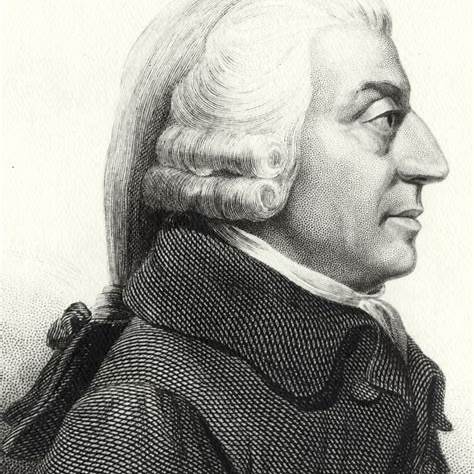
Adam Smith, author of The Wealth of Nations and The Theory of Moral Sentiments. Public domain image via Wikimedia Commons.
In 2026, Americans will celebrate the 250th anniversary of the Declaration of Independence. That anniversary deserves attention. But there is another 250th anniversary worth remembering: the publication of Adam Smith’s The Wealth of Nations in 1776.
The two anniversaries are not unrelated. The modern case for political liberty and the modern case for economic liberty developed in the same historical moment. Both reflected suspicion of concentrated power. Both challenged inherited systems of privilege. Both assumed that ordinary people should have more freedom to make decisions without permission from distant authorities.
That does not mean Adam Smith should be treated as a simple mascot for free-market politics. He was not that. Smith was a moral philosopher as well as an economist. He understood self-interest, but he also understood vanity, overconfidence, monopoly, privilege, collusion, and the human tendency to justify one’s own advantage as public virtue.
That is one reason Smith remains useful. He does not fit comfortably into modern slogans.
Smith respected markets because markets allow people to cooperate without central command. They allow millions of people, each with limited knowledge, to produce, exchange, save, invest, specialize, and adapt. Prices carry information. Competition disciplines producers. Voluntary exchange allows people to pursue their own plans while often creating value for others.
But Smith did not worship businessmen. He famously warned that people in the same trade rarely gather without the conversation ending in some effort to raise prices or conspire against the public. That is not a minor aside. It is central to Smith’s understanding of political economy. Business interests often seek protection from competition. They may ask government for tariffs, subsidies, licensing rules, monopoly privileges, regulatory barriers, or other arrangements that protect incumbents at public expense.
Smith defended competition, not collusion. He defended voluntary exchange, not monopoly. He defended commercial society, not crony capitalism.
Markets Deserve a Presumption, Not Worship
CIVPAC’s view is not that markets always work perfectly. They do not. Markets can be distorted by monopoly power, externalities, public goods, asymmetric information, fraud, and poorly designed rules. They can also produce outcomes that society may choose to modify for distributional reasons.
But markets deserve a presumption in their favor because they do several things government usually cannot do as well. They coordinate dispersed information. They reward production that others value. They allow decentralized choice. They permit experimentation. They create incentives for efficiency and innovation. They also limit concentrations of power by allowing people to work, buy, sell, invest, and organize without asking government to allocate every opportunity.
This is where Smith connects to Friedrich Hayek and Milton Friedman.
Hayek emphasized the knowledge problem. No central planner can possess all the local, changing, practical information embedded in prices, preferences, technology, costs, and circumstances. Markets are not merely a moral preference. They are information systems.
Friedman emphasized the relationship between economic freedom and political freedom. If government controls employment, capital, prices, production, education, housing, and access to opportunity, political liberty becomes fragile. A person who depends on the state for livelihood is less free to dissent from the state.
Those arguments can be overstated. Monopoly power can threaten liberty. Fraud can undermine consent. Pollution can impose costs on unwilling parties. Government is also necessary to enforce contracts, protect property, maintain courts, provide public goods, restrain violence, and preserve the rules under which markets function.
But the connection between markets and freedom is real. A society that weakens market institutions too casually should not be surprised when it also weakens individual independence.
Economics Is Not Conservative, but It Is Disciplined
Some people think economics is inherently conservative. That is not quite right.
Economics can support many policies associated with the left. Externalities can justify environmental regulation or carbon pricing. Public goods can justify national defense, basic research, infrastructure, and disease surveillance. Asymmetric information can justify rules in insurance, finance, medicine, food safety, and consumer markets. Monopoly power can justify antitrust and utility regulation. Diminishing marginal utility of income and wealth can support progressive taxation and redistribution.
Progressive policy does not have to be anti-economic. It can be stated in economic terms.
But economics imposes discipline. It asks uncomfortable questions of every political tendency. What is the market failure? How large is it? Is the proposed intervention likely to solve it? What incentives will the remedy create? Who pays? What happens at the margin? Are we correcting an efficiency problem, redistributing income, protecting liberty, or responding to a government-created distortion?
Nor is it enough to show that a market is imperfect. Markets are imperfect because human beings are imperfect. Governments are made of the same material. Public officials, regulators, legislators, voters, interest groups, and experts all have incomplete information and imperfect incentives.
A market imperfection therefore does not automatically justify government intervention. The relevant question is comparative: is the proposed intervention likely to improve the result after taking account of government error, political capture, administrative cost, incentive effects, and unintended consequences?
That places a real burden of proof on intervention. The burden is not impossible to meet. Pollution, monopoly power, fraud, public goods, and severe information failures may justify public action. Distributional objectives may justify redistribution. But the imperfection should be substantial enough, and the remedy plausible enough, to justify replacing one imperfect process with another.
The status quo is not presumed perfect. It is merely presumed to be the condition that must be improved upon, not just criticized.
The Difference Between Market Failure and Market Dislike
This distinction separates CIVPAC’s approach from democratic socialism and Marxism.
Marxist analysis often begins from the premise that capitalism itself is inherently exploitative. In that framework, market outcomes are suspect because they are market outcomes. The central issue is not whether there is a particular externality, monopoly, information failure, public good, or government distortion. The central issue is ownership, class power, and control over production.
Some democratic socialists hold a softer version of that view. Others are closer to ordinary social democrats who accept markets but want more redistribution and regulation. But the instinct is often similar: market outcomes require political correction because markets are assumed to reflect unequal power rather than legitimate exchange.
CIVPAC begins differently.
We begin with the presumption that markets are valuable institutions. They are not perfect. They are not sacred. But they are essential mechanisms for coordinating human activity, transmitting information, dispersing power, and preserving individual choice.
That presumption can be overcome. Government intervention may be justified. But the justification should be explicit. Is the problem monopoly power? An externality? A public good? Asymmetric information? A distributional objective? A threat to democratic institutions? A government rule that prevents the market from functioning properly?
If the answer is only “we do not like the outcome,” that may begin a moral or political conversation. It does not complete an economic argument.
Smith Was Suspicious of Business Too
Smith’s understanding of markets was more subtle than many modern arguments that invoke him.
He knew that merchants and manufacturers often prefer protection from competition. They may present their private interests as national interests. They may seek rules that raise prices, restrict entry, or shift risk to the public. The fact that a business asks for a policy does not mean the policy is pro-market. It may be anti-market.
This is one reason CIVPAC is skeptical of both anti-business populism and business-friendly corporatism.
The anti-business populist sees corporate power and assumes the solution is to punish or restrict business. The corporatist sees business success and assumes the public interest is served by helping incumbent firms. Smith warns against both mistakes.
A market economy requires competition, not merely private ownership. It requires open entry, not protection for insiders. It requires rules of fair dealing, not favoritism. When businesses seek subsidies, tariffs, regulatory barriers, licensing restrictions, or protection from competition, they are not defending free markets. They are often trying to escape them.
Overconfidence Is Also Part of the Human Condition
Smith also understood something modern behavioral economics later formalized: human beings are overconfident.
He wrote of the “over-weening conceit” many people have in their own abilities and the “absurd presumption” people often have in their own good fortune. That observation helps explain why risky professions can become overcrowded and why people take chances that look irrational from the outside.
This matters for policy. Markets involve error. People misjudge. Investors chase returns. Entrepreneurs fail. Consumers overpay. Voters misunderstand. Politicians overpromise. Experts overestimate what they know.
The fact that people make mistakes does not prove that government should make choices for them. Government officials are also human. They have their own incentives, blind spots, overconfidence, constituencies, and institutional biases. The question is not whether markets produce mistakes. They do. The question is whether a proposed intervention is likely to reduce error or merely move it into a political process with weaker feedback and fewer exit options.
Markets do not make people wise. But they create feedback. Losses, prices, competition, entry, exit, and consumer choice discipline error in ways political systems often resist.
Housing as an Example
Housing policy illustrates why language discipline matters.
It is easy to say that America has a “housing shortage” or that housing is “unaffordable.” Those phrases are familiar. They may point toward a real problem. But they can also smuggle in assumptions.
Housing has not literally disappeared. In high-demand communities, housing can still be bought or rented by households with enough income or wealth. The more precise problem is that, in many jurisdictions, housing prices and rents have risen faster than residents, buyers, employers, and local governments would have expected only a few years ago. Housing therefore requires a larger share of income or wealth than many households reasonably planned for.
That is a supply-constrained price problem.
In many places, state and local governments have restricted the ability of housing supply to respond to demand. Zoning rules, permitting delays, parking mandates, density limits, environmental-review processes, and neighborhood veto points prevent markets from adjusting normally. When quantity cannot adjust, prices do more of the work.
A democratic-socialist interpretation may begin with the idea that housing is too expensive because capitalism treats homes as commodities and allows profit-seeking actors to exploit need. A market-oriented institutional interpretation asks a different question: what is preventing supply from responding?
The answer is often government.
That does not mean no government should act. It means government should act on the actual distortion. If government rules are preventing homes from being built, the solution is to reform those rules. Demand subsidies or symbolic attacks on disfavored buyers may be politically satisfying, but they do not solve the underlying problem.
This is the Smith-Hayek-Friedman lesson in practice. Let prices convey information. Let markets respond. Do not let incumbent interests use government to prevent competition. Intervene where there is a real market failure or distributional objective, but do not mistake every disliked price signal for proof that markets have failed.
The CIVPAC Standard
The lesson of The Wealth of Nations is not that business should always win. It is not that government should never act. It is not that inequality is irrelevant or that markets are morally self-justifying.
The lesson is that prosperity and liberty require institutions that channel self-interest toward useful production, competition, innovation, and exchange. Those institutions include markets, but also courts, property rights, contract enforcement, stable money, public goods, antitrust where appropriate, and rules against fraud, coercion, and favoritism.
CIVPAC’s standard is therefore straightforward:
Before government intervenes in a market, identify the problem.
Is it a market failure? A public good? An externality? Monopoly power? Asymmetric information? A distributional objective? A government-created distortion? Does the proposed remedy address the actual problem? What incentives and unintended consequences will it create?
That is not a left-wing or right-wing checklist. It is a discipline.
Smith’s anniversary is worth celebrating because he helped teach the modern world that free exchange, specialization, and competition can produce enormous public benefit without central direction. It is also worth celebrating because Smith was wise enough not to confuse markets with merchants, capitalism with monopoly, or self-interest with virtue.
The country could use more of that wisdom.
At a time when both parties are tempted by populist villain-hunting, economic nationalism, industrial favoritism, and distrust of institutions, Adam Smith remains a useful corrective. He reminds us that markets are powerful not because business is noble, but because competition disciplines self-interest. He reminds us that government is necessary, but also easily captured. He reminds us that ordinary people know things planners do not. He reminds us that liberty depends not only on elections, but on the ability of people to make choices in their economic lives.
The 250th anniversary of the Declaration of Independence will rightly celebrate political liberty. The 250th anniversary of The Wealth of Nations should remind us that economic liberty is part of the same inheritance.
Both require institutions. Both require discipline. And both require skepticism toward concentrated power, whether it comes from government, business, or movements convinced that they alone know how society should be ordered.
When CIVPAC began, we expected much of our work to involve supporting center-left and center-right candidates in primaries, with the hope of nudging both parties toward the political center. That task has changed. Increasingly, CIVPAC finds itself supporting conventional left-wing or right-wing candidates against more extreme alternatives that, not long ago, would have seemed unlikely to gain serious traction in American politics.
When this effort began, through CIVPAC’s predecessor organization, the New Independent Party, the national political world was still recognizable. The 2012 presidential race was Mitt Romney against Barack Obama. CIVPAC would have had criticisms of both candidates, but both were serious, constitutional, mainstream figures. The distance between that world and today’s politics explains why CIVPAC’s task has changed.
Espaillat is not a centrist Democrat. He is a mainstream progressive Democrat with a reliable party-line voting record. But the question in NY-13 is not whether voters should choose a centrist over a progressive. The question is whether Democratic primary voters should replace an experienced incumbent with Darializa Avila Chevalier, a democratic-socialist challenger backed by Mayor Zohran Mamdani.
That race is part of a larger pattern. Mamdani has endorsed three congressional candidates in New York: Avila Chevalier in NY-13, Brad Lander in NY-10, and Claire Valdez in NY-7. CIVPAC is not making endorsements in all three races at this time. But the slate matters because it has become a national signal about the direction of the Democratic Party in its most heavily Democratic urban districts.
Deep-blue primaries are not politically isolated. New York City helps shape the Democratic Party’s national brand. When candidates running on democratic-socialist, movement-left politics become the face of the party in highly visible urban districts, voters outside New York notice. So do Republican media and campaign strategists.
If Democrats believe Mamdani’s strategy and the candidates he is backing are likely to succeed nationally, they should ask why Fox News is so eager to make that strategy visible to voters outside New York City.
CIVPAC does not object to new candidates merely because they are new. Parties need competition, new voices, and serious challenges to complacency. Nor does CIVPAC believe incumbents are entitled to renomination. But not every insurgency is an improvement.
This is one of those situations. The work now feels less like gently nudging the parties toward the center than trying to keep the planets from being flung out of the solar system.
Our concern is the road to “Blue MAGA.” We do not mean that left-wing populism and Trumpism are identical. They are not. But both can reward tribal certainty, ideological escalation, contempt for persuasion, and the belief that political intensity is a substitute for broad public appeal.
In NY-13, CIVPAC believes the better choice is clear. Representative Espaillat is not a CIVPAC ideal candidate, but he offers experience, institutional knowledge, and continuity. Replacing him with a movement-left challenger would strengthen the very tendency CIVPAC has warned about: the temptation to make deep-blue urban politics the face of the national Democratic Party.
That is bad politics for Democrats and bad politics for the country.
CIVPAC therefore endorses Representative Adriano Espaillat in the Democratic primary for the U.S. House in New York’s 13th Congressional District.
AI-generated symbolic image of a blue road roller paving the road to “Blue MAGA.”
Democrats have spent years warning, correctly, that Trumpism has damaged American politics. But one lesson they should not take from Trumpism is that politics is only about mobilizing the most emotionally committed members of the base.
That way lies what some have called “Blue MAGA.”
By “Blue MAGA,” we do not mean that left-wing populism is identical to Trumpism. It is not. Nor do we mean that Democrats should reject working-class appeal, fresh candidates, economic populism, or a willingness to fight. Democrats may need more of some of those things.
By “Blue MAGA,” we mean the temptation to copy some of MAGA’s worst political habits: tribal loyalty, contempt for persuasion, and the belief that emotional intensity is a substitute for broad public appeal. We realize that this term can be used in a variety of ways. We think, right now, it most accurately applies to the illiberal-left, with its fondness for analysis by slogan and its intolerance for anyone, even those within the same party, who holds opposing views.
Democrats face this temptation now. After years of Trump, many Democratic primary voters understandably want candidates who sound angry, uncompromising, and morally certain. That may feel satisfying. It may even win some blue districts and blue cities. But it is a poor strategy for winning red, pink, and purple places where Democrats need converts, independents, moderates, suburban voters, disaffected Republicans, and people who are tired of politics as permanent combat.
Georgia offered a useful test.
Geoff Duncan was not a conventional Democrat. That was the point. He was a former Republican lieutenant governor who broke with Trump over election integrity and paid a political price inside his own party. Democrats did not need to agree with Duncan on every issue to recognize the strategic value of his candidacy. If the defense of democracy is as important as Democrats say it is, then a pro-democracy former Republican should have been treated as an asset, not an intruder.
Instead, Democrats chose a more conventional path. Keisha Lance Bottoms won the Democratic nomination for governor without a runoff. She is a well-known Democrat and a serious political figure. But her nomination also raises the familiar question: are Democrats trying to build a broader governing coalition, or are they choosing candidates who make the base feel more comfortable? The problem is not that Bottoms is unserious. The problem is that Duncan offered a different kind of coalition opportunity.
This is not just a Georgia problem. It is a national problem for Democrats in red and purple territory. The party cannot say it wants to win everywhere while rejecting candidates who might appeal to people who do not already think like Democratic primary voters.
The point is not that every former Republican should be welcomed uncritically. Parties need standards. Candidates who switch parties for convenience or ambition should be examined carefully. But Duncan’s break with Trump was not a minor branding choice. It went to the central institutional question of the last several years: whether elected officials would defend election integrity when pressured by their own side.
If Democrats cannot make room for that, they should stop pretending that defending democracy is a coalition project.
The road to “Blue MAGA” is paved by the belief that the other side’s extremism justifies our side’s extremism. It is paved by the assumption that persuasion is weakness, that moderation is betrayal, and that candidates should be judged first by whether they make activists feel seen.
That road may produce candidates who sound good in a primary and lose races that were winnable. It may also produce candidates who win in heavily Democratic places but govern in ways that drive away the voters needed to build durable majorities nationally.
This does not mean Democrats should reject efforts to recruit new candidates. They should do the opposite. A stale bench, safe résumés, and candidates who speak only to existing Democratic primary voters will not solve the party’s problem. Candidate recruitment matters.
But “new blood” is not automatically the same thing as better blood. There is a difference between recruiting candidates who can broaden the party’s appeal and recruiting candidates who simply give activists a more satisfying fight. Democrats need candidates who can win voters they do not already have, not candidates who merely express the frustrations of voters they already do.
Groups trying to build a stronger Democratic bench may be doing important work. Some of that work points in the right direction. Democrats need candidates with compelling stories, state and district ties, practical experience, and the ability to speak beyond the party’s current coalition. But the test should not be novelty alone. The question is whether they expand the party’s reach or merely intensify its internal mood.
There are promising models.
Democrats should be looking for more candidates in the mold of Roy Cooper in North Carolina, Josh Shapiro in Pennsylvania, Daniel Lurie in San Francisco, and, in Georgia, the opportunity Geoff Duncan represented. These are not identical figures, and they come from different political environments. But they share something important: they try to solve problems in a way that reaches beyond the most ideological voters in their own coalition.
Cooper showed that a Democrat could win statewide in a Republican-leaning state by projecting steadiness, moderation, and practical concern for schools, health care, and economic development. Shapiro has shown a similar ability in Pennsylvania, combining mainstream Democratic commitments with a governing style that does not seem designed primarily for activist approval. Lurie offers a different but related lesson from a deeply Democratic city: even in blue places, voters may be hungry for competence, public order, housing reform, economic recovery, and a government that works.
That is the kind of new blood Democrats should want. Not candidates who merely intensify the party’s internal mood, but candidates who expand its reach.
There are also warning signs that the search for new faces is veering off course.
Kara Eastman defeated a more moderate Democrat in Nebraska’s 2nd Congressional District and then lost the general election twice, including in 2020 when Joe Biden carried the district’s electoral vote. Randy Bryce became a national progressive celebrity as “Iron Stache,” raised money, won attention, and still failed to turn Wisconsin’s 1st Congressional District blue. Paula Jean Swearengin offered a compelling Appalachian populist story in West Virginia, won the Democratic Senate nomination, and lost by more than 40 points.
These examples do not prove that every moderate would have won. They do show that biography, anger, online enthusiasm, and populist rhetoric are not substitutes for persuading the voters who actually decide red and purple races.
Graham Platner points to a current version of the same risk. His outsider profile, veteran biography, rural appeal, and anti-establishment message are exactly why some Democrats find him exciting. But that is also why his candidacy is a useful test. Populist energy, outsider branding, and intense primary enthusiasm may not survive contact with a general electorate.
A candidate like Zohran Mamdani may be viable in New York City. That does not mean the same style travels well to Maine, Georgia, Nebraska, Pennsylvania, North Carolina, or other places Democrats must compete if they want governing majorities. CIVPAC does not argue that left populists can never win anywhere. We argue that Democrats are making a mistake if they treat deep-blue or idiosyncratic-city success as a model for red and purple territory.
The recent mayoral results in New York City, Washington, D.C., and San Francisco are worth taking seriously because they say something about the Democratic brand when general-election constraint is weak. In places where the real contest is often the Democratic primary, voters and activists can reveal what kind of politics they prefer when they do not have to worry very much about Republican opposition.
New York and D.C. point in one direction. Zohran Mamdani’s victory in New York City and Janeese Lewis George’s victory in the D.C. mayoral primary suggest that left-populist politics has real strength in some of the party’s most visible urban centers. That matters nationally because New York and Washington are not just local governments. They are symbols. They help define what many voters elsewhere think Democrats are becoming.
San Francisco points in a different direction. Daniel Lurie’s victory did not make San Francisco conservative. It remains one of the most liberal cities in America. But it did suggest that even deeply liberal voters can become impatient with public disorder, visible dysfunction, housing paralysis, downtown weakness, and a city government that does not seem able to execute. In San Francisco, pragmatic competence became the change candidate. That is a brand image that could have national appeal.
That contrast is important. The problem is not that Democrats should never nominate left-populists in cities where left-populists can win. The problem is treating those victories as a national model. A style of politics that can win New York City or Washington, D.C. may still damage the Democratic brand in Maine, Georgia, Nebraska, Pennsylvania, North Carolina, or other places where Democrats need voters who do not already identify with the party’s most progressive urban wing.
This is another reason candidate recruitment matters. Deep-blue cities can become laboratories for policy innovation, but they can also become laboratories for national brand damage. When Democrats are unconstrained by serious general-election competition, they should ask not only what their local primary electorate wants, but what their choices tell the rest of the country about the party they are building.
Progressives sometimes make a mirror-image argument: that centrist Democrats in red or purple states damage the national Democratic brand by making the party look cautious, compromised, or insufficiently committed to progressive change. That argument should not be dismissed out of hand. Party brands are real, and candidates in one state can affect how voters see the party elsewhere. But a national party is not a boutique ideological label. It is a coalition built to govern a large, diverse country. A party that cannot tolerate candidates who fit West Virginia, Georgia, North Carolina, Maine, or Pennsylvania may preserve a cleaner brand, but it will have fewer seats, less power, and less ability to enact anything at all.
Joe Manchin offers a related lesson from the other direction. Manchin was not a model national Democrat, and many Democrats understandably found him infuriating given their policy preferences. He protected the filibuster, resisted major parts of President Biden’s domestic agenda, defended fossil-fuel interests important to West Virginia, and often used his leverage in ways that frustrated Democratic leaders.
CIVPAC does not share every Manchin position. But the strategic fact remains: he could win a Senate seat in West Virginia as a Democrat. A party that can hold a Senate seat in West Virginia through a moderate Democrat is stronger than a party that treats such figures as embarrassments and then watches the seat become unwinnable.
That lesson applies beyond Manchin. A party serious about building a durable governing coalition cannot demand that every candidate in every state sound like the median activist in a national primary. It has to tolerate members who fit their states, represent different electorates, and sometimes frustrate national party priorities.
That is what coalition politics means.
CIVPAC’s view is different from both partisan purity and performative moderation. Parties should nominate candidates who can govern effectively and appeal beyond their own faction. That sometimes means choosing a Democrat. Sometimes it means choosing a Republican. In rare cases, like Angus King of Maine, it might mean supporting an independent with a plausible path to success.
It is fine to lose after making the strongest possible case to the voters. It is something else to lose after rejecting the better candidate because the better candidate did not flatter the party’s internal mood.
When that happens, the answer to the party that loses the general election is simple: you had a better choice. You chose not to take it.
AI Generated Symbolic Illustration of White House in Fog
The Fog Beyond the Battlefield
Wars are hard to understand while they are being fought. The fog of war applies to more than just the battlefield itself. That is especially true when the conflict involves Iran, Israel, the United States, nuclear facilities, regional proxies, intelligence claims, authoritarian censorship, partisan politics, and a flood of propaganda from every direction.
That does not mean citizens should say nothing. It does mean we should be careful about what we claim to know.
Much of the information coming from this war is unreliable, incomplete, or strategically framed. Casualty figures may be wrong. Damage assessments may be exaggerated or understated. Claims about nuclear facilities may be true in part and misleading in part. Images and videos may be old, staged, mislabeled, or generated by artificial intelligence. Governments, media organizations, political factions, and foreign actors all have incentives to shape public perception.
That is not a reason for moral paralysis. Iran’s regime is repressive, dangerous, hostile to the United States, hostile to Israel, and committed to projecting power through proxies and intimidation. Iran’s nuclear program is a legitimate concern. Israel has a right to defend itself. The United States has real interests in preventing nuclear proliferation, protecting allies, preserving freedom of navigation, and maintaining some degree of regional stability.
But none of that eliminates the need for disciplined judgment. The fact that Iran is dangerous does not make every claim about the war reliable. The fact that a military action may be justified in principle does not prove that this particular military action was the best course. The fact that some critics of the war may be naive or reflexively anti-American does not mean that all criticism is unserious.
Democracies Fight With the Consent of the Governed
A democracy has to think differently about war than an authoritarian state does.
A dictator can begin a war with greater confidence that he can suppress dissent, hide losses, control information, punish critics, and continue the conflict long after the original rationale has become doubtful. A democratic government cannot assume that. America may have superior military power, but it must keep explaining why the war is necessary, what the objective is, what costs are justified, and how success will be measured.
That is both a strength and a weakness.
It is a strength because public consent disciplines the use of force. It makes it harder to sustain wars based on vanity, ideology, vague ambition, or wishful thinking. It forces leaders to answer questions that dictators can evade. Why this war? Why now? What is the achievable objective? What would count as enough? What happens afterward?
It is a weakness because our adversaries understand it. They can play for time. They can absorb punishment, manipulate civilian-casualty narratives, exploit partisan divisions, spread disinformation, wait for elections, and bet that democratic publics will tire before authoritarian regimes crack.
That has been a recurring feature of many conflicts involving the United States. It was true in Vietnam. It was true in Iraq. It was true in Afghanistan. It is true in Ukraine, where Russia’s strategy depends heavily on the belief that the United States and Europe will eventually lose patience. It is also relevant to any conflict involving Iran.
The mistake is not that democracies require consent. That is one of their virtues. The mistake is entering or escalating conflicts without recognizing that public consent is part of the battlefield.
That Makes Truth a Strategic Resource
There is an old children’s story that some public officials seem never to have learned, or have forgotten: “The Boy Who Cried Wolf.” The lesson is not that wolves never come. The lesson is that a person who lies repeatedly destroys his ability to be believed when the danger is real.
That lesson applies with special force to war. Blatant lies by government officials, even on issues unrelated to the conflict, weaken the public’s willingness to believe the government when it may be telling the truth about the conflict itself. Trust cannot be turned on and off at the convenience of those in power. A democracy that may need public support in a crisis cannot afford leaders who treat truth as a tactical instrument.
This is not just a matter of civic virtue. It is a matter of national security.
If the public believes that government officials routinely lie about elections, crime, inflation, immigration, health, corruption, or their own conduct, then the public will also discount official statements about war. Some of that discounting will be healthy skepticism. Some of it will become destructive cynicism. But leaders who have squandered credibility should not be surprised when citizens hesitate to believe them in a crisis.
That is one reason the Iran war is so difficult to assess. We do not know enough. We do not know the full damage to Iran’s nuclear program. We do not know which claims of battlefield success are reliable. We do not know how much of Iran’s military capability has been degraded and how much has been hidden, dispersed, or preserved. We do not know whether Iran’s leadership will respond with caution, revenge, negotiation, or delay. We do not know whether regional actors will be deterred or emboldened. We do not know whether a ceasefire is the beginning of a settlement or merely an interval before the next phase.
The Hardest Question May Take Years to Answer
We also do not know whether the costs will prove justified.
That may be the hardest truth. However this war ends, if it ends, we may not know for many years whether the costs were justified. We may never know. If Iran’s nuclear program is delayed for a decade and a wider regional war is avoided, some will call the war a success. If the program is only briefly disrupted, if Iran emerges more determined, if civilian suffering fuels radicalization, if allies lose confidence, or if the conflict returns in a more dangerous form, the judgment may be very different.
History rarely gives clean answers in real time. Sometimes it does not give them at all.
Force Requires a Clear Objective
That does not mean democracies should never use force. Pacifism is not a strategy. Some threats are real. Some regimes are aggressive. Some dangers grow worse when ignored. A world in which Iran acquires nuclear weapons would be more dangerous. A world in which authoritarian regimes learn that democracies will never act is also dangerous.
But military force should be tied to a clear objective that citizens can understand and sustain. If the goal is to delay Iran’s nuclear program, say so. If the goal is deterrence, say so. If the goal is to protect shipping and regional stability, say so. If the goal is regime change, the burden of proof is vastly higher. A democracy should not drift from one rationale to another as events unfold.
Citizens should also resist the temptation to treat uncertainty as permission to believe whatever is emotionally satisfying. Supporters of military action should not assume every strike is successful, every critic is weak, or every official claim is true. Opponents of military action should not assume every American or Israeli action is reckless, every Iranian claim of victimhood is reliable, or every use of force is imperial folly.
The responsible position is harder. It requires opposing Iran’s nuclear ambitions while demanding honest evidence about what military action has achieved. It requires supporting Israel’s right to security while recognizing the risks of escalation. It requires resisting authoritarian propaganda while also refusing to become a captive of our own side’s wishful thinking. It requires understanding that in a democracy, sustaining public consent is not a public-relations problem. It is part of the strategy.
That is the civic discipline war requires.
When facts are uncertain, principles matter more, not less. Those principles should include opposition to nuclear proliferation, respect for democratic accountability, skepticism toward authoritarian propaganda, skepticism toward domestic political spin, concern for civilian life, and insistence on achievable objectives.
Strength Requires Credibility
The United States should not be casual about war. It should not be casual about Iran’s nuclear ambitions either. Serious policy requires holding both thoughts at once.
The public does not need leaders who pretend to know everything. It needs leaders who can be expected to tell the truth about what they know, what they do not know, what they are trying to accomplish, and what costs they are asking the country to bear.
That is not weakness. That is how a democracy prepares itself to act with strength when strength is truly necessary.