
We Have Revised Our Climate Change Policy

Wind, solar, natural gas, and nuclear energy representing a market-based, all-of-the-above climate policy.

CIVPAC has published a substantially revised version of our Climate Change policy.

The basic position has not changed. We continue to support a $100-per-metric-ton carbon tax, comparable carbon charges on imports from countries that do not adopt similar policies, and a market-based approach that allows competing technologies to determine the least expensive ways to reduce greenhouse-gas emissions.

What has changed is the depth of the analysis.

As we have continued to think through the proposal, several questions deserved more explicit answers: What would a $100 carbon tax actually do to household energy bills? How should carbon capture be treated? What happens to existing coal and natural-gas power plants? Who really bears the economic burden of the tax? And what should we do with what could initially be several hundred billion dollars a year in revenue?

Being More Explicit About the Costs

The revised policy now says much more clearly what a $100 carbon tax would mean for consumers.

If fully reflected in retail prices, it would mechanically add about 89 cents per gallon to gasoline. At today’s generating mix, it could initially raise the average residential electricity bill by roughly 20 percent, although the effect would vary enormously depending on how electricity is generated. Residential natural-gas bills could initially rise by roughly 35 to 40 percent.

Those numbers are not forecasts of permanent prices. Consumers, utilities and producers would respond. Demand for fossil fuels would fall, generating systems would change, and some of the economic burden would be reflected in lower prices for fossil fuels and lower values for fossil-fuel reserves and carbon-intensive assets rather than simply higher consumer prices.

But a serious climate policy should not hide the central point: changing relative prices is how a carbon tax reduces emissions.

Carbon Capture and an All-of-the-Above Strategy

The revised policy also makes our treatment of carbon capture much clearer.

Carbon that has already been taxed and is later captured and permanently stored should receive a credit equal to the carbon tax previously imposed. That is not an additional subsidy. It simply means the tax ultimately applies to carbon released into the atmosphere.

Direct removal of carbon that is already in the atmosphere is different and may justify separate public support for research and deployment and ultimately a payment or credit reflecting the value of the carbon removed from the atmosphere.

We also expanded the discussion of existing power plants. A carbon tax does not order a coal or natural-gas plant to close. It gives the owner choices: pay the higher fuel price resulting from the tax, capture the carbon, operate less often, or retire the plant.

That is what we mean by an all-of-the-above energy policy. Government should price the environmental harm and allow coal, natural gas, nuclear, solar, wind, hydro, geothermal, storage and technologies not yet developed to compete.

Using the Revenue

Another revision of the policy from its original form, which was mentioned in our last iteration, was to use most of the remaining carbon-tax revenue to help finance Social Security rather than create a large new stream of revenue that might be viewed as justification for permanently higher federal spending.

That approach is now developed much more fully.

A successful carbon tax should produce declining revenue over time as emissions fall. That makes it poorly suited to financing any permanent spending program, but potentially well suited to providing transitional financing for Social Security while longer-term reforms are phased in.

In practical terms, carbon-tax revenue could reduce federal borrowing and reduce or delay the need for future increases in payroll taxes or reductions in benefits.

We would still devote a portion of the revenue to basic research in low-carbon energy, direct atmospheric carbon removal and potentially useful geo-engineering.

The Principle Has Not Changed

The revision also expands our discussion of carbon tariffs, the distribution of the tax burden, carbon taxes versus cap-and-trade, the developing world, nuclear power and the economics of coal and natural gas.

But the central principle remains simple:

Price the environmental harm, allow markets to search for the least-cost response, encourage the rest of the world to do the same, and use government research dollars where private markets are least able to capture the benefits.

A $100 carbon tax would not painlessly solve climate change. Some energy prices would rise. Some existing assets would lose value. Coal use would probably decline substantially. Other technologies would gain.

Those are not unintended consequences. They are the means by which the policy works.

You can read the full revised Climate Change policy position and review our other public policy positions.

CIVPAC Publishes Its Artificial Intelligence Policy

Modern data center representing the infrastructure, innovation, and governance challenges of artificial intelligence.

CIVPAC has published its new policy position on artificial intelligence.

AI is likely to be one of the most consequential technologies of our time. It will increase productivity, alter the way many jobs are performed, create new industries, and displace some existing forms of work. Our view is that public policy should encourage those gains rather than try to preserve obsolete jobs simply because they are familiar.

That does not mean adopting a laissez-faire attitude toward every consequence of AI.

Where Government Should Focus

Our policy focuses government attention where it is most needed: cybersecurity, terrorism and other malicious uses, competition and market power, infrastructure constraints, and the need for appropriate internal controls as increasingly capable systems are developed and deployed.

Our approach is therefore neither to suppress AI development nor to assume that every problem will solve itself. We favor rapid innovation, competitive markets and broad adoption of productivity-enhancing technology, combined with focused safeguards where genuine risks exist.

Who Is Responsible When AI Causes Harm?

We believe that one of the most important questions in AI policy is too often neglected: who is legally responsible when an AI system causes harm?

The existence of an autonomous or partially autonomous system should not create a liability vacuum. Responsibility should be allocated among developers, deployers, owners and users according to who controlled the relevant risks and who was in the best position to prevent the harm.

Clear rules of liability can provide powerful incentives for safety without requiring government to prescribe every technical decision in advance.

Why Not Give Them Spoons?

We are also skeptical of policies designed principally to protect existing jobs from technological change. Economic history gives us little reason to believe that making production deliberately less efficient leaves society better off. The challenge is not to prevent productivity growth, but to help people adapt to it and to ensure that the gains are broadly shared.

There is an old story, usually attributed to Milton Friedman, that captures the point nicely. Friedman was visiting a public works project where workers were using shovels rather than modern machinery. When he asked why, he was told that the purpose was to create more jobs. His response was essentially: why not give them spoons?

I have always liked that story because it exposes the flaw in the argument so neatly. Jobs are not themselves the objective of an economy. The objective is to produce things people value as efficiently as possible and allow the resulting prosperity to create new opportunities. Artificial intelligence does not change that principle simply because the productivity gains may arrive unusually quickly.

Artificial intelligence will create difficult policy questions, and our position will undoubtedly evolve as the technology develops. But the basic principles are already clear: encourage innovation, preserve competition, address identifiable risks, assign responsibility clearly, and resist the temptation either to panic about technological change or to regulate simply for the sake of regulating.

You can read CIVPAC’s full Artificial Intelligence policy position and review our other public policy positions.

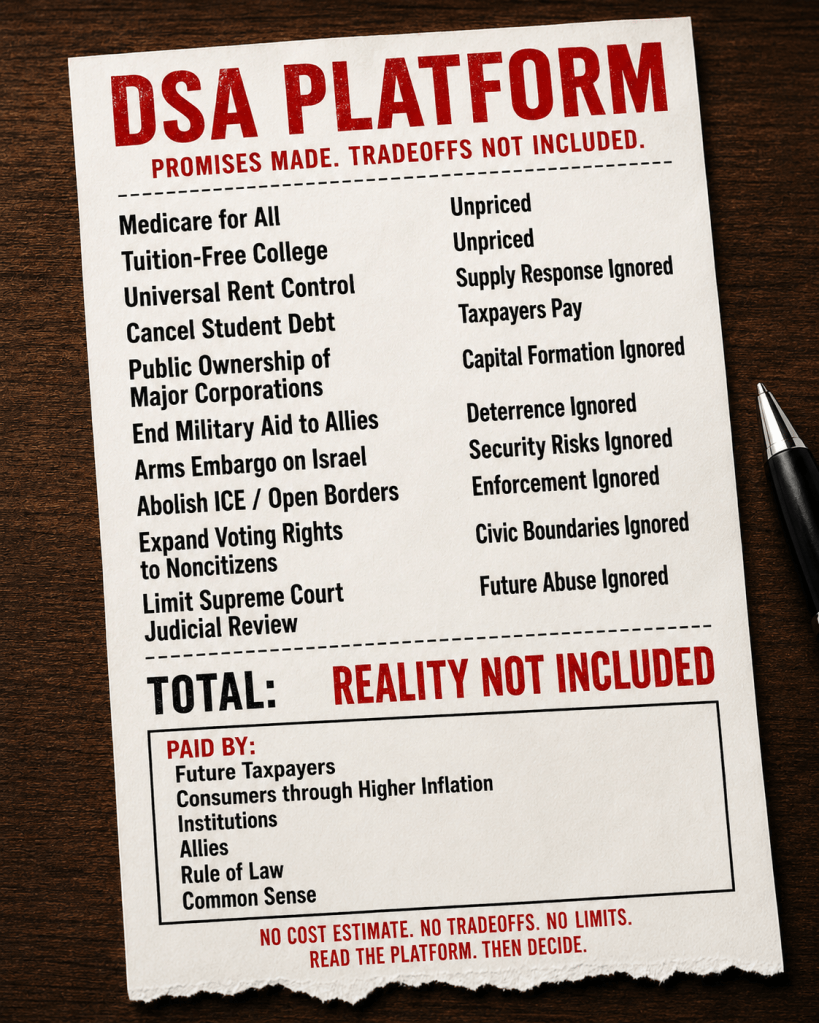
The DSA Platform Is Worse Than the Slogan

Satirical receipt labeled “DSA Platform,” listing major policy promises with tradeoffs marked as ignored and a total reading “Reality Not Included.”

DSA promises benefits without taking tradeoffs seriously. Read the platform. Then decide.

CIVPAC believes readers should see the Democratic Socialists of America (DSA) platform for themselves.

The current DSA program is available here: Democratic Socialists of America Platform.

We encourage people to read it. Not excerpts. Not hostile summaries. Not campaign rhetoric from opponents. The platform itself.

Doing so is clarifying.

DSA does not merely argue for a more generous welfare state, a somewhat higher minimum wage, stronger unions, or more aggressive health-care reform. Some of its proposals overlap with familiar progressive politics, but the platform’s underlying diagnosis and proposed direction are much more radical.

DSA says the capitalist system is the cause of major social harms and calls for a socialist society in which the largest corporations are placed under public ownership and democratic control. It calls for universal rent control, tuition-free public higher education with no out-of-pocket room and board costs, cancellation of all student-loan debt, Medicare for All with no premiums, co-pays, or deductibles, a 32-hour workweek with no reduction in pay or benefits, a wealth tax, and public ownership over major transportation and energy infrastructure and natural resources.

On foreign policy, it calls for ending military and economic aid and weapons sales to Israel, greatly reducing the U.S. military budget, closing overseas bases, bringing troops home, ending economic sanctions on countries such as Cuba, Venezuela, and Iran, and allowing workers to migrate freely across borders without restrictive immigration controls. It also calls for ending immigrant detention and deportations, immediate amnesty for all immigrants regardless of current immigration status, and access to jobs, labor rights, and social services for all immigrants.

On constitutional structure, it calls for voting rights for noncitizens, proportional representation, expansion of the House of Representatives, abolition of the Senate filibuster, replacement of the Electoral College with a national popular vote, and limits on the Supreme Court’s power of judicial review.

This platform is not Denmark. It is not Franklin Roosevelt. It is not a slightly more aggressive version of mainstream Democratic liberalism.

It is a sweeping ideological program built on bad diagnosis, magical financing, weak attention to incentives, and dangerous institutional assumptions.

DSA’s platform does not become serious merely because it attaches itself to familiar grievances. High housing prices do not prove that markets have failed. In many high-cost places, the problem is that housing markets have been systematically constrained by zoning restrictions, permitting delays, local veto points, parking mandates, height limits, environmental-review abuse, and political resistance to new supply. DSA’s answer is more public control. CIVPAC’s answer is to ask what is preventing supply from responding to demand — and then try to fix that.

High medical costs do not prove that more government control is the answer. Many of the worst distortions in American health care come from decades of tax preferences, mandates, cross-subsidies, public reimbursement rules, restricted competition, employer-based coverage, and government-shaped incentives. A serious reform agenda would ask how to preserve access, restore price discipline, reduce administrative waste, and create better incentives for patients, providers, insurers, and taxpayers. DSA instead treats the problem as if government promises can repeal scarcity.

Student debt is rarely a social injustice. It is also the result of personal borrowing decisions, institutional pricing power, weak cost discipline, political encouragement of debt-financed education, and a culture that too often treated college borrowing as an entitlement regardless of expected return. Blanket cancellation shifts costs from borrowers to taxpayers, including many people who did not attend college, paid their debts, chose less expensive schools, or made other sacrifices.

The same pattern appears throughout the platform. DSA begins with moral language and ends with government command. It treats every grievance as proof of capitalism’s failure and every government promise as if it were self-financing, self-administering, and immune from abuse. It gives too little attention to costs, incentives, capital formation, administrative capacity, unintended consequences, individual responsibility, public safety, democratic allies, and constitutional limits.

CIVPAC’s objection is not that government has no role. As our philosophy and broader policy positions make clear, government has important roles: protecting civil rights, maintaining public order, supporting basic research, correcting genuine market failures, providing a safety net, protecting the environment, enforcing contracts, defending the country and our allies, and helping ensure that opportunity is not limited by accident of birth.

But there is a vast difference between responsible public policy and the belief that most social problems can be solved by transferring more power to government or politically favored collectives.

The DSA platform repeatedly assumes away the hardest questions. Who pays? Who decides? What happens when supply falls in response to incentives? What happens when capital leaves? What happens when rent control reduces construction or maintenance? What happens when public systems are captured by unions, bureaucracies, or political machines? What happens when immigration enforcement is effectively abolished? What happens when sanctions are removed from hostile regimes? What happens when American military power retreats and authoritarian states fill the vacuum? What happens when judicial review is weakened and the next illiberal majority inherits that precedent?

These are not technical quibbles. They are the questions serious people ask before giving government more power.

DSA’s foreign-policy platform is especially troubling. A politics that calls for ending arms sales to Israel, drastically reducing American military power, closing overseas bases, ending sanctions on regimes such as Cuba, Venezuela, and Iran, and loosening immigration controls to the point of practical non-enforcement is not merely idealistic. It is a worldview. It is a worldview in which American power is treated as the central danger, democratic allies are treated with deep suspicion, and hostile regimes are often treated as victims of American policy rather than responsible for their own actions.

That worldview is wrong.

CIVPAC believes the United States should use power prudently. We do not support reckless intervention, blank checks, or indifference to civilian suffering. But prudence is not retreat. A stable international order depends in part on American strength, alliances, deterrence, and a willingness to distinguish democratic allies from authoritarian adversaries and terrorist organizations.

The platform’s institutional proposals also deserve scrutiny. Some election reforms may be worth considering. CIVPAC itself supports reforms such as open primaries and ranked-choice voting where they improve representation and reduce extremism. But DSA’s broader institutional program points toward a major restructuring of constitutional government. Limiting judicial review, weakening existing checks, and redesigning institutions in the name of “working-class democracy” should not be treated as harmless reform language. Constitutional limits matter most when a political movement is convinced of its own moral certainty.

The deeper issue is not any single plank. It is the attitude toward power.

DSA’s platform imagines that if the “right” people control the state, the state can guarantee housing, health care, education, jobs, wages, migration rights, climate transformation, public ownership, and international justice. History gives us many reasons to doubt that premise. Economics gives us many more.

The center should not be embarrassed to say this plainly.

Markets are imperfect. Government is also imperfect. Private power can be abused. Public power can be abused too. Capitalism requires rules, but rules require discipline. Social insurance is valuable, but promises require funding. Compassion is admirable, but compassion that refuses to recognize costs becomes fantasy. Democracy requires majority rule, but liberal constitutional democracy also requires limits, rights, courts, pluralism, private civil society, and protection for those who lose the next election.

DSA’s platform is not simply too far left. It is unserious about the constraints that make free societies governable.

That is why CIVPAC’s 2026 endorsements emphasize practical governance over ideological performance, including our most recent endorsements of Greg Stanton, in Arizona, and Haley Stevens, in Michigan.

That is also why CIVPAC believes voters should read the DSA platform.

Do not take our word for it. Read the platform. Then ask whether this is the direction the Democratic Party, or the country, should go.

CIVPAC believes the answer is no.

CIVPAC welcomes comments, corrections, and opposing views. Please share your thoughts on our Contact Us page or leave a comment below. If you are commenting on a particular candidate or race, please include that in your comment.