A couple of days ago, I heard Felix Frisch discuss Promise to America with Elie Honig on SiriusXM. I came away thinking that we had found an organization that belongs on CIVPAC’s list of centrist resources.
Promise to America is an effort to give moderate Democrats something they have often lacked: a simple, affirmative statement of what they believe. It was developed by a group of young political organizers working with Democratic Representatives Tom Suozzi of New York and Adam Gray of California—the only two Democrats who captured Republican-held House districts won by Donald Trump in 2024.
The organization is directed by Felix Frisch, the 20-year-old son of former Colorado congressional candidate Adam Frisch. Felix worked on his father’s two campaigns and says he drove more than 50,000 miles through western and southern Colorado. That experience appears to have taught him something national political organizations sometimes forget: candidates must listen to the voters they need to persuade, not merely repeat the views of the activists.
Promise to America asks Democratic candidates and elected officials to embrace six broad principles:
- Growth, competition and broadly shared prosperity
- Safety, security and human dignity
- Fiscal discipline
- Government that works
- Free speech, respect and common purpose
- Confident patriotism and national renewal
The pledge summarizes those principles in unusually direct language:
“We are capitalist, not socialist.”
“We want safety, not lawlessness.”
“We are responsible, not reckless.”
“We believe government should solve problems, not create them.”
“We are mainstream, not extreme.”
“We are proud, not ashamed of America.”
CIVPAC agrees with all six statements.
That does not mean that slogans are a substitute for policy. Saying that government should be fiscally responsible is easier than identifying which programs should be reduced, which taxes should be increased or which promises should be reconsidered. Supporting secure borders does not by itself tell us what a workable immigration system would look like. Supporting capitalism does not relieve government of the responsibility to preserve competition, protect opportunity and address genuine market failures.
But political organizations need both policies and an identity. Voters want to know not only what a candidate proposes to do, but also what kind of person—or party—they are being asked to trust.
Promise to America offers a recognizable identity: economically pragmatic, socially tolerant, patriotic, serious about public safety, supportive of effective government and willing to persuade people who do not already agree.
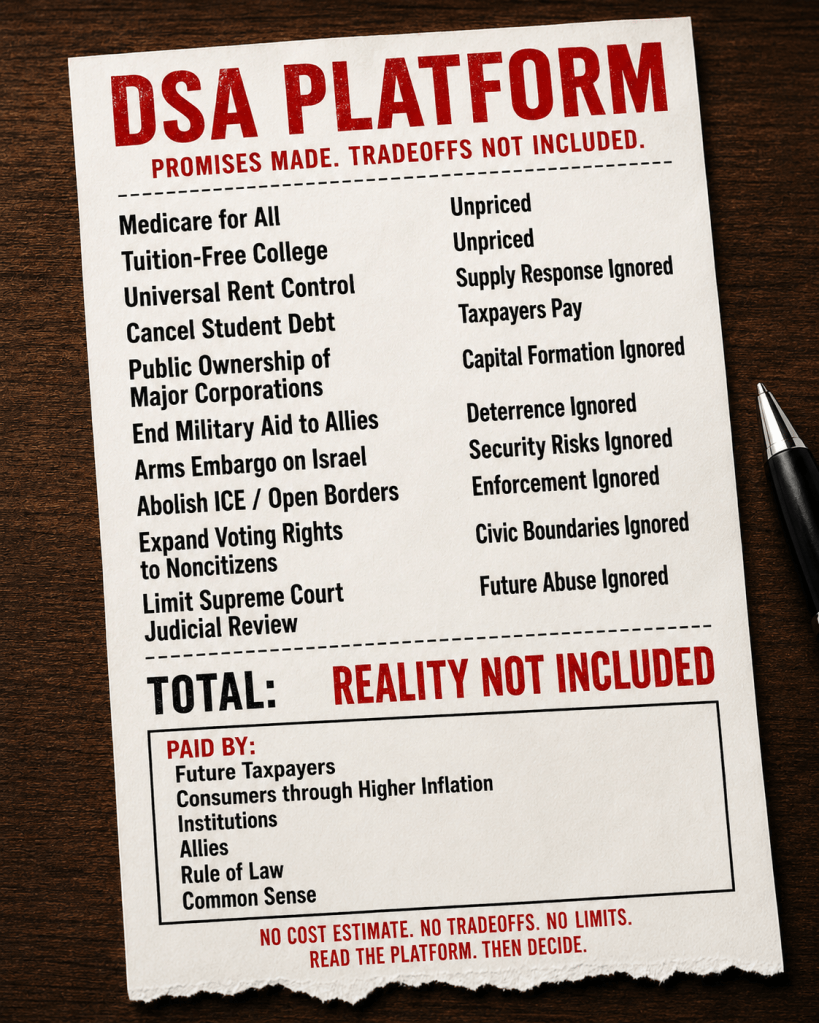
That is a useful answer to the impression that Democrats must choose between offering no clear governing philosophy and adopting the philosophy of the democratic socialist left.
The pledge’s emphasis on persuasion may be especially important. American elections are not won by assembling the purest possible collection of beliefs. They are won by building coalitions. That requires candidates to speak respectfully to voters who may disagree with them on abortion, guns, immigration, taxes, policing, climate policy or cultural questions.
A political party that treats disagreement as evidence of moral failure will steadily shrink the number of people it can represent.
The Democratic Party needs people who understand that defeating MAGA politics requires winning voters outside safely Democratic cities and districts. The party cannot build a durable national majority by telling culturally moderate, working-class, rural and suburban voters that they must accept every position favored by the progressive left.
Centrists should not limit themselves to warning Democrats about what they must reject. They need to describe what they are for.
Promise to America has made a promising start.
Its principles do not constitute a complete governing program, but they describe a political temperament that is badly needed: confident without being arrogant, patriotic without being uncritical, market-oriented without being indifferent, and moderate without being timid.
We are therefore adding Promise to America to CIVPAC’s list of centrist organizations. We hope its candidates and supporters will move beyond a pledge to develop specific, credible policies. It took CIVPAC years to develop our current portfolio of centrist public policies. Promise to America has existed for only a few weeks.
We also hope Democratic leaders will listen to people such as Tom Suozzi and Adam Gray, who have demonstrated that they can win voters in places where elections are genuinely contested.
And we will be watching Felix Frisch. It is encouraging to hear a young political leader speak about persuasion, pluralism and coalition-building with a maturity that is often missing from American politics.