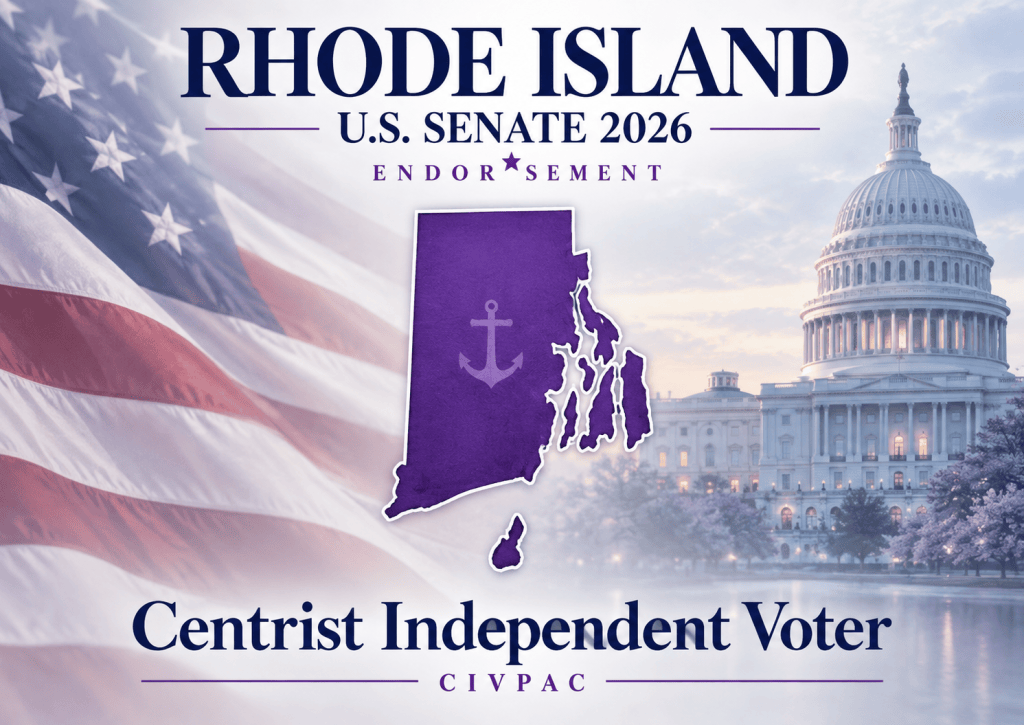
CIVPAC has endorsed Jack Reed for reelection to the United States Senate from Rhode Island.

Rhode Island outline and U.S. Capitol representing CIVPAC’s 2026 endorsement of Jack Reed for U.S. Senate.

This is not an endorsement based on broad ideological agreement. Reed remains substantially to our left on labor policy, taxation and the proper scope of government. We disagree with him on important domestic economic questions.

But Reed is unusually strong on several issues that have become increasingly important in CIVPAC’s 2026 Senate evaluations.

He has been a consistent supporter of Ukraine and of America’s alliances, brings substantial experience in national security, and has repeatedly defended Congress’s constitutional authority over war powers and presidential use of emergency powers. His record gives us considerable confidence that he views the Senate as an independent branch of government rather than simply an extension of the executive.

The alternatives did not overcome that advantage. Republican Ray McKay is closer to CIVPAC on some conventional economic issues, but his campaign has closely identified itself with President Trump and has provided relatively little detail on Ukraine, NATO and congressional independence. Independent Michael Bahry offers a more developed foreign-policy position, but his support for American withdrawal from NATO is fundamentally at odds with CIVPAC’s view of the United States’ international responsibilities.

On balance, Reed’s strengths on foreign policy, Ukraine and institutional responsibility outweigh our significant disagreements with him on domestic policy.

CIVPAC therefore endorses Jack Reed for reelection to the U.S. Senate from Rhode Island.

Read our full Rhode Island U.S. Senate evaluation.

See all CIVPAC 2026 endorsements.

Minnesota U.S. Senate: No Endorsement, but a Detailed Evaluation

CIVPAC evaluation of the 2026 Minnesota U.S. Senate race between Peggy Flanagan and Michele Tafoya

CIVPAC has completed its review of the 2026 Minnesota U.S. Senate race between Peggy Flanagan and Michele Tafoya.

This is a different kind of non-endorsement.

We did not conclude that neither candidate is acceptable. Instead, our criteria point in different directions. Flanagan is closer to CIVPAC on issues including Ukraine and NATO, reproductive freedom and the value of divided government. Tafoya is closer on market economics, reduced taxes and regulation, law enforcement and limiting federal spending. Both also depart from CIVPAC in important ways, and several of Tafoya’s positions on major Senate issues remain insufficiently developed.

The result illustrates why political choices cannot always be reduced to a checklist. Two centrist independent voters could agree with every CIVPAC policy position—and even agree with our evaluation of both candidates—yet reasonably vote differently because they assign different weights to the competing issues.

Rather than manufacture an endorsement, we have tried to give Minnesota voters the information needed to make that judgment for themselves.

Read the full Minnesota U.S. Senate evaluation.

See CIVPAC’s complete 2026 endorsements and evaluations.

And if you know of additional candidate positions that would help resolve some of the unanswered questions, we invite you to comment. Better information could yet lead us to an endorsement.

Why Adam Hamilton Earned Our Endorsement in Kansas

Adam Hamilton Kansas U.S. Senate endorsement by the Centrist Independent Voter

I did not expect Kansas to become one of the more interesting Senate races we reviewed this year.

Republican Roger Marshall begins with the advantages of incumbency and of running in a state that has not elected a Democratic senator since 1932. But the Democratic nominee, Adam Hamilton, is not a conventional candidate.

Hamilton spent more than three decades leading the Church of the Resurrection, a large United Methodist congregation containing Republicans, Democrats and independents. His career has largely involved persuading people who disagree about difficult subjects to remain in conversation with one another.

Washington could use some of that.

What attracted us most, however, was not Hamilton’s biography. It was the contrast between his understanding of public office and Marshall’s record in the Senate.

Marshall voted to reject legitimate electoral votes after the 2020 election. He has supported President Trump’s broad use of tariffs, resisted congressional efforts to reclaim war powers, and repeatedly supported controversial presidential nominees even when other Republican senators were willing to vote no.

Hamilton, by contrast, argues that Congress should reclaim authority that has migrated to the executive branch. He opposes broad unilateral tariffs, favors secure borders while supporting legal immigration, and has developed a political style based more on persuasion than partisan warfare.

That does not mean we agree with him about everything.

We would like a much clearer account of the role Hamilton believes the United States should play in the world. Ukraine and NATO are part of that question, but the issue is broader: alliances, deterrence, military restraint and the degree to which America should remain engaged internationally.

We also think he needs to say more about deficits and entitlement reform. Some of his proposed tax credits strike us as bad policy, and his health-care approach differs from our own.

His religious background raised another question for us.

Clergy are no less entitled to public office than anyone else. But public officials govern people of every religion and of no religion. Religious doctrine cannot become governmental doctrine.

Hamilton has explicitly rejected Christian nationalism and defended separation of church and state. His own position on abortion is revealing: he speaks openly about the moral value he places on unborn life while also arguing that legislators should not become women’s spiritual advisers.

That strikes us as an important distinction.

A senator is entitled to bring his values into public life. He is not entitled to turn his church’s theology into civil law.

Hamilton appears to understand that.

He remains an underdog. Kansas is still Kansas. But recent polling suggests this is not merely a symbolic candidacy, and Hamilton appears capable of assembling the kind of coalition that has elected Democratic Governor Laura Kelly: Democrats, independents and enough moderate Republicans willing to cross party lines.

Endorsements are comparative judgments, not declarations of ideological agreement.

We have reservations about Adam Hamilton. But compared with Roger Marshall’s record, Hamilton offers greater independence, greater respect for democratic institutions and a political temperament that Washington badly needs.

That was enough for us.

The Centrist Independent Voter endorses Adam Hamilton for the United States Senate from Kansas.

Read our full endorsement of Adam Hamilton for U.S. Senate.

See all of Centrist Independent Voter’s 2026 U.S. Senate endorsements and races under review.

Why We Chose Scott Colom in Mississippi

The Centrist Independent Voter endorses Scott Colom for Mississippi U.S. Senate

I did not expect Mississippi to produce one of our more difficult Senate endorsements.

Cindy Hyde-Smith was the easy part. Her vote to reject valid electoral votes after the 2020 election, her record on Ukraine, and her repeated willingness to defer to Donald Trump when Congress should have been defending its own constitutional powers convinced us that Mississippi would be better served by someone else.

The harder question was Scott Colom or Ty Pinkins.

Pinkins gave us something we genuinely like. He is running as an independent and says he would caucus with neither party. More importantly, he has been discussing the creation of a bloc of independent senators—a Fulcrum Caucus—that could potentially hold the balance of power in a closely divided Senate.

We have supported that idea in other races. A handful of senators who could bargain over committee organization, amendment rights and other Senate procedures might loosen the grip of the two parties and make Congress work a little more like the institution the Constitution intended.

But there is an important distinction.

I am enthusiastic about using that leverage to reform the Senate. I am much less enthusiastic about using it to make enactment of a substantially left-wing policy agenda the price of organizing the chamber. Pinkins has suggested both. His support for universal health care and other economic policies goes considerably beyond our own approach to health care.

If Pinkins were proposing to reserve the leverage of a Fulcrum Caucus primarily for institutional reform—and if he appeared to be the stronger candidate against Hyde-Smith—I think we would have endorsed him.

Neither appears to be true.

Colom, meanwhile, has a record that is unusually attractive for a Democratic candidate in a deeply Republican state. As a district attorney, he has combined aggressive prosecution of violent crime with diversion and rehabilitation for first-time nonviolent offenders. He has earned respect from Republican officials as well as Democrats and has demonstrated a willingness to pursue wrongdoing by members of his own party.

He also presently has something Pinkins does not: a plausible, although still difficult, path to defeating Hyde-Smith.

There are positions where we disagree with Colom, and I remain particularly interested in hearing a clear statement from him on Ukraine and NATO. An endorsement is not a declaration that a candidate agrees with us about everything.

It is a choice among the candidates actually running.

In Mississippi, after giving Ty Pinkins considerably more thought than I initially expected, we chose Scott Colom.

Read our full endorsement of Scott Colom for U.S. Senate.

See all of Centrist Independent Voter’s 2026 U.S. Senate endorsements and races under review.

CIVPAC Endorses James Talarico for U.S. Senate in Texas

CIVPAC endorsement graphic for James Talarico for U.S. Senate in Texas, 2026 general election.

Centrist Independent Voter has endorsed Democrat James Talarico for the United States Senate from Texas over Republican Ken Paxton.

This is not an endorsement of every part of Talarico’s agenda. He is to our left on several economic issues, and we have significant disagreements with some of his proposals on taxes, spending and health care. But he is also a thoughtful and unusually interesting candidate who has shown a willingness to talk about policy in practical rather than purely ideological terms.

Paxton’s attempt to overturn the results of the 2020 presidential election, his close identification with Trumpism and his broader record raise fundamental concerns about institutional responsibility and the independence we expect from a United States senator.

Talarico offers Texas voters a very different kind of politics. We will disagree with him, sometimes substantially. But we believe he would bring greater respect for democratic institutions, greater independence of judgment and a more constructive approach to governing.

In a Texas Senate race that has become genuinely competitive, that is enough to make the choice clear.

Read CIVPAC’s full endorsement of James Talarico.

See CIVPAC’s 2026 U.S. Senate general-election endorsements and races under review.

Centrist Independent Voter Endorses Seth Bodnar for U.S. Senate in Montana

Centrist Independent Voter endorsement graphic for Seth Bodnar for U.S. Senate in Montana, featuring the Montana State Capitol, mountain landscape, state outline, and CIV compass rose.

Centrist Independent Voter has endorsed independent candidate Seth Bodnar for the U.S. Senate in Montana.

Bodnar combines military service, executive leadership, and a strong commitment to restoring Congress’s constitutional role. He has also built an unusually broad coalition, with support from both prominent Republicans and Democrats.

The endorsement also addresses the central challenge facing independent candidates: the spoiler problem. In Montana, recent polling and bipartisan support suggest Bodnar may actually be the strongest alternative to Trump-aligned Republican Kurt Alme.

The independent candidate is not automatically the spoiler. Sometimes the strategic vote is the independent one.

Read our full endorsement of Seth Bodnar for U.S. Senate.

See all of Centrist Independent Voter’s 2026 candidate endorsements.

Centrist Independent Voter Endorses Dan Osborn for U.S. Senate in Nebraska

Centrist Independent Voter endorsement graphic for Dan Osborn for U.S. Senate in Nebraska, featuring the Nebraska State Capitol, farmland, a red barn, a Nebraska outline, and a red-white-blue compass rose.

Centrist Independent Voter has endorsed independent candidate Dan Osborn for the U.S. Senate in Nebraska.

Osborn is not a perfect policy match for us. We have substantial reservations about parts of his economic agenda, particularly some of his more populist proposals. But his commitment to political independence, opposition to blanket tariffs, support for Ukraine, and emphasis on restoring Congress’s constitutional role make a compelling case.

Republican Senator Pete Ricketts deserves credit for his strong support of Ukraine. But on several important institutional questions—including presidential appointments, war powers, tariffs and voting legislation—he has too often sided with President Trump rather than asserting Congress’s independent responsibilities.

Osborn says he will caucus with neither Democrats nor Republicans and could become part of a small bloc of genuinely independent senators. Such a bloc could help loosen the grip of party leadership and encourage bipartisan governing.

That potential power should be used responsibly—not to pursue pet populist crusades, but to make Congress work better.

Nebraska voters have an opportunity to send the Senate something it badly needs: a genuinely independent voice.

Read our full endorsement of Dan Osborn for U.S. Senate.

See all of Centrist Independent Voter’s 2026 candidate endorsements.

Centrist Independent Voter Endorses Sam Mead for U.S. Senate

Centrist Independent Voter has endorsed Sam Mead in Wyoming’s August 18 Republican primary for the United States Senate.

Mead is challenging Representative Harriet Hageman, who entered Congress after defeating Liz Cheney in 2022. There is a certain symmetry to the race: Cheney delivered her concession speech that year from the Mead family ranch.

But our endorsement is not about relitigating that election.

It is about whether Republican senators should exercise independent judgment or regard loyalty to Donald Trump as part of their job description.

Mead has said senators should judge presidential nominees on competence, character and ethics rather than partisan loyalty. He has defended Congress’s constitutional authority over war, criticized deficit spending, supported secure borders combined with legal immigration reform, and opposed wholesale disposal of Wyoming’s public lands.

We have reservations. Mead needs to provide much more detail on Ukraine, NATO, China and federal fiscal policy.

But he offers something increasingly scarce in Republican politics: a willingness to tell a president of his own party no.

Four years after Hageman defeated Cheney, Wyoming Republicans have an opportunity to send a different kind of conservative to Washington.

Read our full endorsement of Sam Mead.

See all Centrist Independent Voter 2026 endorsements.

Centrist Independent Voter Endorses Eric Barlow for Wyoming Governor

Wyoming landscape featuring mountains, open plains and ranch coun

Centrist Independent Voter has endorsed Eric Barlow in Wyoming’s August 18 Republican primary for governor.

Barlow is a conservative Republican, and we disagree with him on important issues, particularly abortion. He supported Wyoming’s near-total abortion prohibition and its ban on medication abortion in 2023.

But primary elections require voters to choose among the candidates actually running. In this field, Barlow offers the strongest combination of governing experience, institutional temperament and practical conservatism.

A veterinarian, rancher, Marine veteran and former speaker of the Wyoming House, Barlow has emphasized health care, water, public lands, education, economic opportunity and the future of Wyoming’s smaller communities. His energy policy is notably pragmatic: he supports the state’s traditional industries while remaining open to nuclear power and other sources, arguing that growing electricity demand means “every electron matters.”

Barlow has also resisted the factional politics that increasingly dominate the Wyoming Republican Party. His principal opponent, state Superintendent Megan Degenfelder, has built much of her campaign around President Trump’s endorsement and alignment with his political movement.

We still have unanswered questions about Barlow’s views on the 2020 election, Trump’s efforts to overturn it and the proper limits of presidential power. Voters should continue looking for clear answers before casting their ballots.

On balance, however, Barlow offers Wyoming Republicans the better choice: experienced, serious and more interested in governing than ideological performance.

Read our full endorsement of Eric Barlow.

See all Centrist Independent Voter 2026 endorsements.

Centrist Independent Voter Endorses Jim Priest in Oklahoma Senate Runoff

Oklahoma-themed landscape with the state outline, plains, windmill, Oklahoma State Capitol, Oklahoma City skyline and oil pumps.

Centrist Independent Voter has endorsed Jim Priest in Oklahoma’s August 25 Democratic runoff for the United States Senate.

Priest is a long-shot candidate in a strongly Republican state, but that does not make the Democratic choice unimportant. His background as a lawyer, nonprofit executive and minister is accompanied by an unusually explicit commitment to working with practical problem-solvers in both parties.

We particularly agree with Priest’s criticism of tariffs. Tariffs are largely paid by American consumers and businesses, and unpredictable trade policy raises costs for farmers and other producers. Priest also argues that Congress should reclaim its constitutional authority over trade.

His foreign-policy program needs more detail, and his domestic proposals need a clearer accounting of their costs. Those are real reservations.

But Priest offers a more practical approach than runoff opponent N’Kiyla Jasmine Thomas, who has made removing President Trump within her first 100 days a central campaign promise. Centrist Independent Voter has serious objections to Trump and could support impeachment when justified by the evidence. A Senate candidate, however, should recognize that impeachment begins in the House and that conviction requires a two-thirds Senate vote. Opposition to a president is not a substitute for a governing program.

Priest’s combination of bipartisan instincts, institutional responsibility and economic realism makes him the stronger choice.

Read our full endorsement of Jim Priest.

See all Centrist Independent Voter 2026 endorsements.