CIVPAC has completed its review of the 2026 Minnesota U.S. Senate race between Peggy Flanagan and Michele Tafoya.
This is a different kind of non-endorsement.
We did not conclude that neither candidate is acceptable. Instead, our criteria point in different directions. Flanagan is closer to CIVPAC on issues including Ukraine and NATO, reproductive freedom and the value of divided government. Tafoya is closer on market economics, reduced taxes and regulation, law enforcement and limiting federal spending. Both also depart from CIVPAC in important ways, and several of Tafoya’s positions on major Senate issues remain insufficiently developed.
The result illustrates why political choices cannot always be reduced to a checklist. Two centrist independent voters could agree with every CIVPAC policy position—and even agree with our evaluation of both candidates—yet reasonably vote differently because they assign different weights to the competing issues.
Rather than manufacture an endorsement, we have tried to give Minnesota voters the information needed to make that judgment for themselves.
And if you know of additional candidate positions that would help resolve some of the unanswered questions, we invite you to comment. Better information could yet lead us to an endorsement.
CIVPAC Endorses Ben Ray Luján for U.S. Senate in New Mexico
The endorsement is qualified. Our comparison finds substantial differences with Luján on economic policy, while Republican Larry Marker brings useful private-sector experience. But Marker has provided relatively little information on major responsibilities of a U.S. senator, including foreign policy, health care, climate policy and several questions of constitutional government.
The endorsement also examines a separate institutional consideration: the value of divided government as a check on executive power. In the present political environment, that consideration gives the New Mexico Senate race greater significance than the candidate comparison alone.
Centrist Independent Voter (CIVPAC) has endorsed Jamie Davis for the United States Senate from Louisiana over Republican Julia Letlow.
The endorsement comes with significant reservations. CIVPAC disagrees with Davis on several domestic economic issues and believes voters should seek greater clarity about his positions on Ukraine, NATO, Russia, China, Israel, and Iran.
The endorsement gives substantial weight to other considerations, including Davis’s emphasis on congressional independence, his opposition to tariff wars, support for political reform and government transparency, and the institutional concerns raised by Letlow’s close alignment with President Trump. Letlow’s June 2026 vote against the Ukraine Support Act also figured prominently in CIVPAC’s assessment.
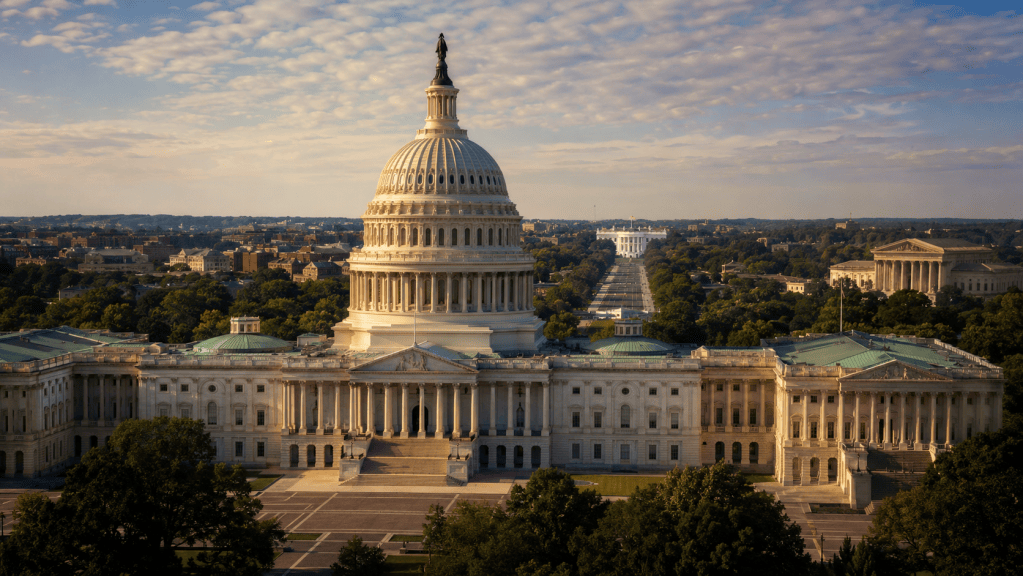
U.S. Capitol with the White House and Supreme Court in the distance, illustrating Congress’s constitutional role in checking executive power.
The Supreme Court’s recent decision allowing construction of President Trump’s White House ballroom to continue raises an issue that extends far beyond the ballroom itself.
On August 31, the Court stayed a lower-court injunction that would have halted above-ground construction. Importantly, the Court did not decide that the President had legal authority to undertake the project without congressional approval. Instead, the five-Justice majority concluded that the government was likely to prevail in showing that the National Trust for Historic Preservation lacked Article III standing to challenge it. The Court expressly said that it was not passing on the legality of the project. (Supreme Court decision)
That distinction matters.
A presidential action can potentially exceed the President’s lawful authority and yet escape judicial review because no plaintiff who objects to it can establish the concrete and particularized injury required by Article III. Indeed, Chief Justice John Roberts, joined by Justices Sotomayor, Kagan and Jackson, concluded in dissent that the ballroom construction was likely unlawful because Congress has expressly prohibited construction of buildings on federal grounds in the District of Columbia without congressional authorization. (Supreme Court decision)
We have seen versions of this problem before.
During President Trump’s first term, 215 members of Congress sued alleging that his receipt of benefits from foreign governments violated the Constitution’s Foreign Emoluments Clause. The D.C. Circuit dismissed the case because the individual legislators lacked standing to assert an institutional injury belonging to Congress. (D.C. Circuit opinion) Other litigation over the Emoluments Clauses ended without a definitive Supreme Court ruling on the merits. After Trump left office, the Supreme Court vacated judgments in two of the major cases and directed that they be dismissed as moot. (Congressional Research Service / Constitution Annotated)
Standing doctrine serves important purposes. Federal courts are not supposed to issue advisory opinions whenever someone believes a president has exceeded his authority. But the practical consequence is unavoidable: the judiciary cannot always be counted upon to police the boundary between presidential and congressional power.
Sometimes Congress has to do it itself.
That has implications for how CIVPAC evaluates candidates for the House and Senate.
Members of Congress are not simply representatives of a political party that happens to control or oppose the presidency. They are members of an independent constitutional branch. Appropriations, tariffs, war powers, oversight, confirmations, subpoenas and numerous other powers belong to Congress precisely because the Framers did not want them exercised solely by a president.
A candidate for Congress should therefore be willing to exercise those powers even when doing so means opposing a president of his or her own party.
That is becoming an increasingly important part of our endorsement decisions.
The difficulty is that genuine political independence has become uncommon in both parties. Members of Congress face enormous pressure from presidents, party leaders, activists and primary voters to treat loyalty to their party as more important than loyalty to the institution in which they serve.
When we have affirmative evidence that a candidate will resist that pressure, it should count heavily in the candidate’s favor.
Senator Susan Collins provides an example. We do not agree with every vote she casts. But she has demonstrated a willingness to defend congressional authority against a Republican president. She joined bipartisan legislation requiring congressional approval for presidential tariffs and opposed President Trump’s unilateral tariffs on Canada. (Collins on congressional tariff authority) On war powers, she has likewise maintained that sustained military action requires congressional authorization and, when the War Powers Act’s 60-day deadline was reached in the 2026 Iran conflict, voted to terminate continued hostilities absent further congressional approval. (Collins on war powers)
That kind of record matters.
When such evidence is absent, the calculation becomes more difficult.
If legislators of both parties normally support presidents of their own party, then electing members of the president’s party tends, as a practical matter, to weaken the legislative check on executive power. Electing members of the opposing party tends to strengthen it.
That does not mean CIVPAC should automatically endorse Democrats when a Republican occupies the White House, or Republicans when a Democrat does. Candidate quality, policy positions, respect for democratic institutions and the particular circumstances of the race still matter.
But other things being reasonably close, our burden of proof should change.
A congressional candidate from the president’s party should give us some reason to believe that he or she is prepared to be a legislator rather than simply a presidential ally. A demonstrated record of independence can satisfy that test. Mere assurances of independence should receive considerably less weight.
The Framers created three branches of government because they did not expect any one of them to be permanently trustworthy.
The courts cannot always intervene. When they cannot, Congress must be willing to be Congress.
Most political endorsements force a choice between two somewhat different questions: Who is the candidate you like best, and who is the candidate you actually want voters to support?
Alaska’s ranked-choice voting system largely removes that problem.
That is why our recommendation in this year’s U.S. Senate race may look a little unusual. We rank retired Petersburg teacher Daniel J. Sullivan Jr. first, former Representative Mary Peltola second, and incumbent Senator Dan S. Sullivan third. We recommend not ranking Gerald Heikes.
Although some may see Daniel J. Sullivan’s candidacy as a stunt built around his name, ranked-choice voting allows us to look past that novelty and recognize that, on policy and temperament, he presents a serious alternative.
We do not expect Daniel J. Sullivan Jr. to win. He received only a small share of the primary vote, has never held major public office, and became nationally known largely because he happens to share a name with the incumbent senator.
Then we looked at what he actually believes.
He sounds surprisingly like the kind of Republican we keep looking for and seldom find. He favors low taxes and a market-oriented economy, but he has criticized President Trump’s across-the-board tariffs for raising prices. He supports Ukraine. He accepts legitimate election results. He supports Alaska’s open-primary and ranked-choice system. He takes a moderate position on abortion and talks about political compromise as something necessary rather than shameful.
There are many things we still do not know about him. But ranked-choice voting allows us to put him first without pretending he is likely to become Alaska’s next senator.
Our second choice, Mary Peltola, is the candidate we would prefer in the likely decisive contest.
Peltola was an unusually independent Democrat during her service in the House. She supported Alaska oil and gas development, including the Willow project, while maintaining positions on firearms and other issues that frequently separated her from the national Democratic Party. She supports Ukraine and has been particularly good on an issue that increasingly matters to us: Congress reclaiming constitutional authority from the presidency over tariffs and war.
We disagree with her on important economic questions. Her proposed federal price-gouging prohibition is bad policy. So are some of her targeted tax subsidies. And she has opposed a carbon tax, which remains central to our climate policy.
Interestingly, we do not object to her support for Willow. Our test for approving a fossil-fuel project in the absence of a carbon tax is whether it would remain economic if carbon were properly priced. The available evidence suggests Willow would.
Incumbent Dan Sullivan presents a harder judgment.
He deserves genuine credit for refusing to participate in efforts to overturn the 2020 election. His support for Ukraine, NATO and an engaged American foreign policy is also substantially closer to our position than that of many Republicans today.
But during President Trump’s second term, his institutional independence has become harder to find. He has supported Trump’s broad tariffs, resisted congressional efforts to reclaim war powers during the Iran conflict, and repeatedly supported unusually controversial presidential nominees when other Republican senators were willing to say no.
Those were not normal nominees. They included a mix of inadequate qualifications, questionable competence and, in some cases, records or views that seemed counterproductive to the missions of the agencies they were chosen to oversee.
That is why we put the incumbent third.
We do not recommend ranking Gerald Heikes, whose ideological rhetoric and extreme policy positions place him well outside CIVPAC’s centrist approach.
Ranked-choice voting lets us make all of these distinctions without forcing them into a binary choice.
This was a close call. Husted is stronger on several issues, school choice, right-to-work principles, and the Hyde Amendment. He also deserves credit for supporting Ukraine and for rejecting election denial after January 6.
But his Senate record matters. On controversial nominees, Trump’s tariffs, and congressional war powers, Husted has repeatedly sided with the administration even when other Republican senators chose to break with it.
Brown has plenty of positions we dislike, particularly on protectionism, unions, and price controls. But in the political environment of 2026, we believe the stronger need is for an independent legislative check on executive power.
Under a different president and Congress, this endorsement might go the other way.
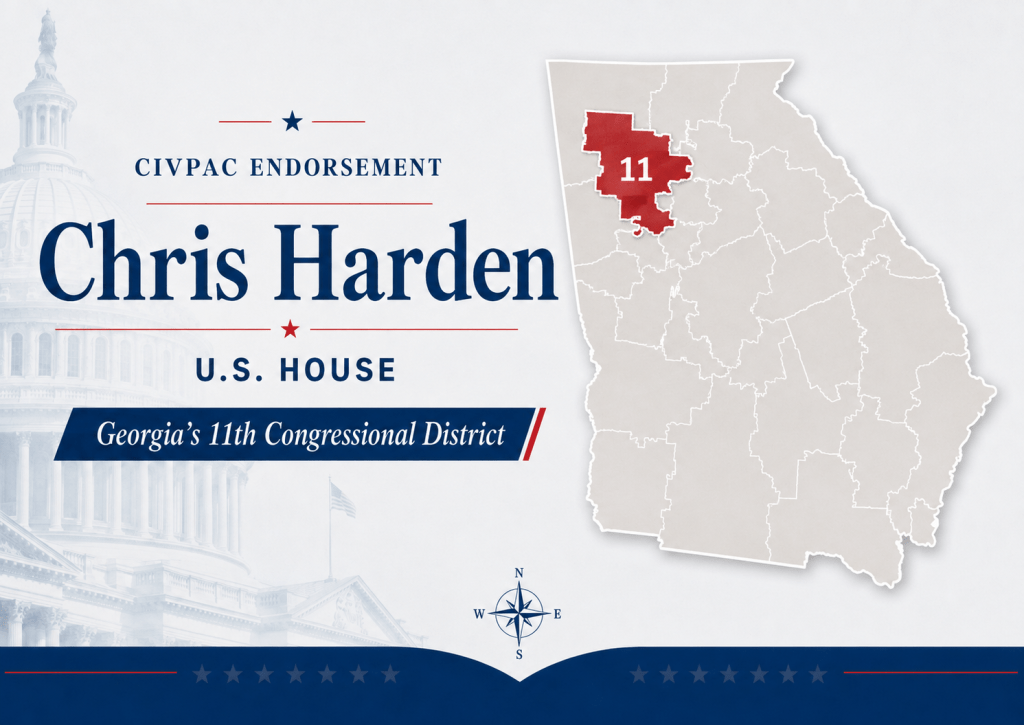
Our endorsement of Chris Harden for Congress in Georgia’s 11th District is an unusual one because we previously endorsed his Republican opponent, John Cowan, in the Republican primary.
At the time, we admired Cowan’s willingness to challenge Marjorie Taylor Greene, reject conspiracy politics, and speak frankly about Donald Trump and the MAGA movement. We thought we were supporting an independent-minded Republican. In any case, he was still the best option among those running in the Republican primary.
After watching Cowan during the run-off primary and the general-election campaign, we no longer believe that describes the candidate before us. Cowan now says he is “100% behind President Trump.” The independence we valued seems to have disappeared just when political ambition made it inconvenient.
Harden is hardly a finished product. He is a first-time candidate and, in our view, has more learning to do—particularly on economics and foreign policy. But his background in political science, history and law shows in his strong commitment to due process, constitutional protections and the rule of law. He also describes himself as a moderate Democrat and has explicitly said that he believes in market solutions.
Most important, Harden comes across as a decent and principled person.
We do not confuse decency with policy expertise. But expertise can be acquired. Character and political independence are harder to manufacture.
As we say in the endorsement, Chris Harden may be a diamond in the rough. In this race, we would rather send someone to Washington who still has things to learn than someone who appears willing to discard deeply held principles when they conflict with political ambition.
Centrist Independent Voter has endorsed Democrat James Talarico for the United States Senate from Texas over Republican Ken Paxton.
This is not an endorsement of every part of Talarico’s agenda. He is to our left on several economic issues, and we have significant disagreements with some of his proposals on taxes, spending and health care. But he is also a thoughtful and unusually interesting candidate who has shown a willingness to talk about policy in practical rather than purely ideological terms.
Paxton’s attempt to overturn the results of the 2020 presidential election, his close identification with Trumpism and his broader record raise fundamental concerns about institutional responsibility and the independence we expect from a United States senator.
Talarico offers Texas voters a very different kind of politics. We will disagree with him, sometimes substantially. But we believe he would bring greater respect for democratic institutions, greater independence of judgment and a more constructive approach to governing.
In a Texas Senate race that has become genuinely competitive, that is enough to make the choice clear.
Centrist Independent Voter has endorsed Senator Jack Reed in Rhode Island’s September 9 Democratic primary for the United States Senate.
Reed combines deep national-security experience with strong support for Ukraine, opposition to economically damaging tariffs and a record of practical bipartisan legislation. His judgment and institutional experience make him the strongest choice in the Democratic primary.
Centrist Independent Voter has endorsed Senator Chris Coons in Delaware’s September 15 Democratic primary for the United States Senate.
Coons has built the kind of record we would like to see more often in Congress: serious about American leadership abroad, willing to work across party lines and prepared to confront difficult fiscal and institutional questions rather than simply repeat his party’s preferred talking points.
He has been a strong supporter of Ukraine and America’s alliances, while supporting Israel’s security without treating support for Israel as an endorsement of every decision made by its government. He has also joined bipartisan efforts to address Social Security’s long-term finances and has opposed tariffs that raise costs for American consumers and businesses.
On immigration, Coons combines support for secure borders and enforcement with comprehensive reform and due-process protections. That approach is much closer to Centrist Independent Voter’s view than treating enforcement and humane immigration policy as opposing choices.
Coons faces three Democratic challengers, but none has made a persuasive case for replacing an experienced senator with his record of bipartisan and institutionally serious governing.