Most political endorsements force a choice between two somewhat different questions: Who is the candidate you like best, and who is the candidate you actually want voters to support?
Alaska’s ranked-choice voting system largely removes that problem.
That is why our recommendation in this year’s U.S. Senate race may look a little unusual. We rank retired Petersburg teacher Daniel J. Sullivan Jr. first, former Representative Mary Peltola second, and incumbent Senator Dan S. Sullivan third. We recommend not ranking Gerald Heikes.
Although some may see Daniel J. Sullivan’s candidacy as a stunt built around his name, ranked-choice voting allows us to look past that novelty and recognize that, on policy and temperament, he presents a serious alternative.
We do not expect Daniel J. Sullivan Jr. to win. He received only a small share of the primary vote, has never held major public office, and became nationally known largely because he happens to share a name with the incumbent senator.
Then we looked at what he actually believes.
He sounds surprisingly like the kind of Republican we keep looking for and seldom find. He favors low taxes and a market-oriented economy, but he has criticized President Trump’s across-the-board tariffs for raising prices. He supports Ukraine. He accepts legitimate election results. He supports Alaska’s open-primary and ranked-choice system. He takes a moderate position on abortion and talks about political compromise as something necessary rather than shameful.
There are many things we still do not know about him. But ranked-choice voting allows us to put him first without pretending he is likely to become Alaska’s next senator.
Our second choice, Mary Peltola, is the candidate we would prefer in the likely decisive contest.
Peltola was an unusually independent Democrat during her service in the House. She supported Alaska oil and gas development, including the Willow project, while maintaining positions on firearms and other issues that frequently separated her from the national Democratic Party. She supports Ukraine and has been particularly good on an issue that increasingly matters to us: Congress reclaiming constitutional authority from the presidency over tariffs and war.
We disagree with her on important economic questions. Her proposed federal price-gouging prohibition is bad policy. So are some of her targeted tax subsidies. And she has opposed a carbon tax, which remains central to our climate policy.
Interestingly, we do not object to her support for Willow. Our test for approving a fossil-fuel project in the absence of a carbon tax is whether it would remain economic if carbon were properly priced. The available evidence suggests Willow would.
Incumbent Dan Sullivan presents a harder judgment.
He deserves genuine credit for refusing to participate in efforts to overturn the 2020 election. His support for Ukraine, NATO and an engaged American foreign policy is also substantially closer to our position than that of many Republicans today.
But during President Trump’s second term, his institutional independence has become harder to find. He has supported Trump’s broad tariffs, resisted congressional efforts to reclaim war powers during the Iran conflict, and repeatedly supported unusually controversial presidential nominees when other Republican senators were willing to say no.
Those were not normal nominees. They included a mix of inadequate qualifications, questionable competence and, in some cases, records or views that seemed counterproductive to the missions of the agencies they were chosen to oversee.
That is why we put the incumbent third.
We do not recommend ranking Gerald Heikes, whose ideological rhetoric and extreme policy positions place him well outside CIVPAC’s centrist approach.
Ranked-choice voting lets us make all of these distinctions without forcing them into a binary choice.
Both candidates have strengths. Both have weaknesses. And under different national circumstances, I can easily imagine CIVPAC reaching the opposite conclusion.
Ashley Hinson has positions we like. She is generally more market-oriented than Turek. She supports right-to-work laws and school choice, positions substantially closer to our views on labor unions and K–12 education. She voted to accept the certified results of the 2020 presidential election and supported the Respect for Marriage Act. She is not simply an election-denying MAGA caricature.
Josh Turek, meanwhile, has plenty of positions we do not like.
He supports a wealth tax on billionaires. We do not. Our taxation, spending and debt policy favors a progressive tax system but puts considerable weight on economic efficiency, broad tax bases and long-term fiscal balance rather than new taxes on accumulated wealth.
Turek also supports federal food-price-gouging restrictions. We generally distrust price controls and laws that attempt to suppress price signals rather than address the underlying causes of scarcity.
He supports the PRO Act, which conflicts with our view that workers should be free to organize but that states should remain free to enact right-to-work laws. He would end school vouchers, while CIVPAC supports carefully designed experiments with vouchers and charter schools subject to common transparency and testing standards.
His foreign-policy views are also less developed than I would like in someone seeking a seat in the United States Senate.
So why endorse him?
Partly because endorsements are comparative judgments, not ideological purity tests.
Turek has demonstrated something we value enormously: an ability to represent people who do not necessarily share his party affiliation. Donald Trump carried his Iowa House district, yet Turek won it. He has crossed party lines on consequential votes and has been effective in a legislature overwhelmingly controlled by Republicans.
He is also substantially closer to us on abortion and personal liberty. And his combination of stronger border enforcement with a legal path for long-established undocumented residents is much closer to the compromise reflected in our immigration policy than either open-ended permissiveness or mass-deportation politics.
Turek also strongly opposes Trump’s broad tariffs. That puts him much closer to CIVPAC’s trade policy, which favors open trade, predictable rules and restoring greater congressional control over the use of tariffs.
Hinson, meanwhile, increasingly identifies herself with Donald Trump and his agenda. She has supported his broad tariff policies, which we regard as economically damaging and particularly inappropriate for an agricultural state.
She also voted against the 2026 Ukraine Support Act despite having previously expressed stronger support for resisting Russian aggression. CIVPAC’s Russia and Ukraine policy places considerable weight on deterrence, alliance reliability and denying Russia the benefits of territorial aggression.
Most importantly, the current political environment changes the weight we assign to these differences.
If Donald Trump and Trumpism were not dominant forces within the Republican Party, this endorsement might be different.
If Democrats controlled the presidency and Congress and the greater need were for a market-oriented check on the left, this endorsement might also be different.
In that environment, Hinson’s positions on taxes, school choice, labor policy and regulation might well carry greater weight.
But we do not make endorsements for an imaginary political system. We make them for the one that exists.
Today, institutional independence, constitutional restraint, respect for individual liberty, sensible trade policy, support for American alliances and a willingness by members of Congress to act as legislators rather than extensions of a president deserve unusual weight.
On balance, Turek comes out ahead.
Not by much.
That is why “endorsement by faint praise” seems about right. It is not meant as an insult to Turek. It is a recognition that serious political choices are often between imperfect alternatives.
CIVPAC’s purpose is not to find candidates with whom we agree on everything. It is to decide which available candidate is more likely to move government in a sensible, centrist and institutionally responsible direction.
In Iowa, by a narrow margin, we believe that candidate is Josh Turek.
The scarce resource is not money. It is ideas and judgment.
That is an odd thing for a political action committee to say.
Political action committees are supposed to ask for money. They are supposed to build lists, cultivate donors, send urgent emails, and explain why democracy, freedom, sanity, or civilization itself depends on a contribution before midnight.
We are not going to do that.
This is not because money never matters in politics. It does. But for an organization like CIVPAC, and for the kind of politics we are trying to encourage, money is not the scarce resource. Judgment is. Seriousness is. A willingness to think clearly about tradeoffs is. A willingness to support good candidates even when they are imperfect, and to oppose bad policies even when they come from one’s own side, is.
A recent Atlantic article by Idrees Kahloon makes the point sharply. Small-dollar donors were once imagined as the democratic answer to big money in politics. (CIVPAC has even taken that position itself.) Instead, the evidence increasingly suggests that small-dollar fundraising can reward outrage, ideological extremity, nationalized grievance, and performative politics. Kahloon cites examples of vast sums flowing into long-shot races because donors despised the opposing candidate: $55 million in small donations to Amy McGrath’s 2020 race against Mitch McConnell, $71 million to Jaime Harrison’s race against Lindsey Graham, and nearly $10 million already raised by Eileen Laubacher against Lauren Boebert in a Colorado district Donald Trump carried by 18 points in 2024. The problem is not civic engagement. The problem is that anger is easy to monetize, and anger does not allocate political resources wisely.
The underlying research by Zachary Albert and Raymond La Raja is even more sobering. Their book, Small Donors in US Politics, finds that small donors are not a representative cross-section of ordinary voters. They tend to be more socioeconomically advantaged, more intensely partisan, and more ideological than non-donors. They often give to high-profile, ideologically extreme, nationally visible candidates rather than to competitive local or down-ballot races where money might do more good.
There is a reasonable counterargument. Small donors are citizens. They are participating. Wealthy donors and dark money remain serious problems, and small-donor systems can sometimes broaden participation. (That is the case that CIVPAC was making.) The Brennan Center argues that critics overstate the role of small donors in polarization and that public financing can encourage candidates to raise money from their own constituents rather than chase national notoriety.
That is a fair caution. The lesson is not that small donors are bad people. The lesson is that money, including small money, can create bad incentives. A politics funded by emotional reaction can become a politics designed to produce emotional reaction. Candidates learn to perform for the donor class, not the electorate. Consultants learn to write the email that gets opened, not the argument that deserves to be believed. The system rewards the person who can make you furious faster than the person who can help you think.
Centrists should be especially wary of this trap.
There is a long history of expensive centrist efforts that produced far less than their funders hoped.
Americans Elect spent a reported $35 million in 2012 trying to build a centrist third-party vehicle and then failed to find a candidate who could meet its own support thresholds. That may well have been because in 2012 we were confronted by two major-party presidential candidates, Barack Obama and Mitt Romney, who, with the benefit of hindsight, feel remarkably centrist.
No Labels later raised tens of millions for a 2024 “unity ticket” effort; Reuters reported that the group said it had raised $50 million, even as its leaders warned that no viable candidates might emerge. The effort ultimately ended without a ticket because no candidate with a credible path to winning emerged.
Those two efforts alone involved roughly $85 million. Other centrist projects, reform organizations, unity campaigns, ballot-access drives, and good-government efforts add many millions more. Some of that work was honorable. Some of it may have helped indirectly. But the record should make us humble.
A large pile of money does not magically create a constituency. It does not change the fact that America’s winner-take-all elections make third-party politics brutally difficult. It does not substitute for the slow work of persuasion.
For CIVPAC, the juice is not worth the squeeze.
We do not need to become another organization that spends most of its energy raising money so that it can spend money asking for more money. We do not need to build a direct-mail machine, hire fundraising consultants, or discover which subject line produces the highest level of panic. We do not want to confuse political seriousness with fundraising success.
What we want is more valuable and harder to buy.
We want people to argue with us. We want people to tell us when we have missed something important about a race. We want local knowledge about candidates who are serious, practical, pro-democracy, and willing to govern rather than perform. We want better definitions of centrism — not mushy moderation, not splitting the difference, not “both sides” reflexes, but a politics grounded in liberal democracy, institutional stability, fiscal realism, and personal freedom. We believe in market economics — capitalism, if you like — not as a tribal slogan, but because markets usually work better than politics at allocating resources. We also believe in competent government where government is necessary.
We want readers who will ask: Is this candidate trying to solve problems or build a brand on the back of outrage and anger? Is this policy efficient, fair, and politically sustainable? Does this argument survive contact with facts? Does it respect tradeoffs? Does it strengthen democratic institutions or weaken them? Does it make compromise easier or harder?
That kind of engagement is more useful to us than a check.
CIVPAC’s endorsements are not, at this stage, kingmaking exercises. We are not pretending that our support will decide most races. Our endorsements are public markers: statements about the kind of politics we believe deserves support and the kind of politics we believe should be resisted.
That may sound modest. It is modest. But it is also honest.
The country does not lack political money. It lacks political judgment. It lacks citizens willing to say that some candidates on their own side are reckless, some candidates on the other side are responsible.
So no, we are not asking for your money.
We are asking for your attention, your criticism, your local knowledge, your arguments, and your willingness to help build a politics that rewards seriousness instead of outrage.
If that sounds like less than a contribution, it is not.
CIVPAC is pleased to announce that Ellen Beatty and Eugene “Gene” O’Sullivan have joined the CIVPAC Board of Governors.
CIVPAC’s Board reflects a range of perspectives across the political center, from center-left to center-right. While members do not agree on every issue, they share a commitment to evaluating policy based on evidence, tradeoffs, and real-world outcomes.
Ellen Beatty brings extensive senior financial and organizational experience, including service as Executive Vice President and Chief Financial Officer of NORC at the University of Chicago. Her career has included senior finance roles in research, energy, public accounting, and corporate management. Her experience adds to CIVPAC’s emphasis on fiscal realism, institutional competence, and practical governing judgment.
Gene O’Sullivan brings decades of senior financial, business, and civic experience. His background includes public accounting, manufacturing, corporate finance, nonprofit and university service, and long experience with the practical responsibilities of business leadership. His experience adds to CIVPAC’s emphasis on fiscal discipline, institutional competence, and practical judgment.
With the addition of Ellen and Gene, CIVPAC’s Board currently includes multiple former chief financial officers, professional economists, computer scientists, educators, nonprofit board members, people with government and national-security experience, and founders and operators of successful small businesses. That mix reflects CIVPAC’s belief that good policy requires more than good intentions. It requires fiscal realism, attention to incentives, respect for institutional limits, and practical experience with how decisions are implemented in the real world.
CIVPAC supports centrist policy positions and moderate candidates from either party, as well as independents, where there is a plausible path to success. CIVPAC promotes practical governing judgment, democratic institutions, personal freedom, market-compatible policy, and a stable international order.
We are grateful that Ellen and Gene have agreed to serve, and we look forward to the judgment and experience they will bring to CIVPAC’s work.
You can learn more about CIVPAC and the Board of Governors on our About Us page.
You can also read Ellen Beatty’s biography here and Eugene O’Sullivan’s biography here.
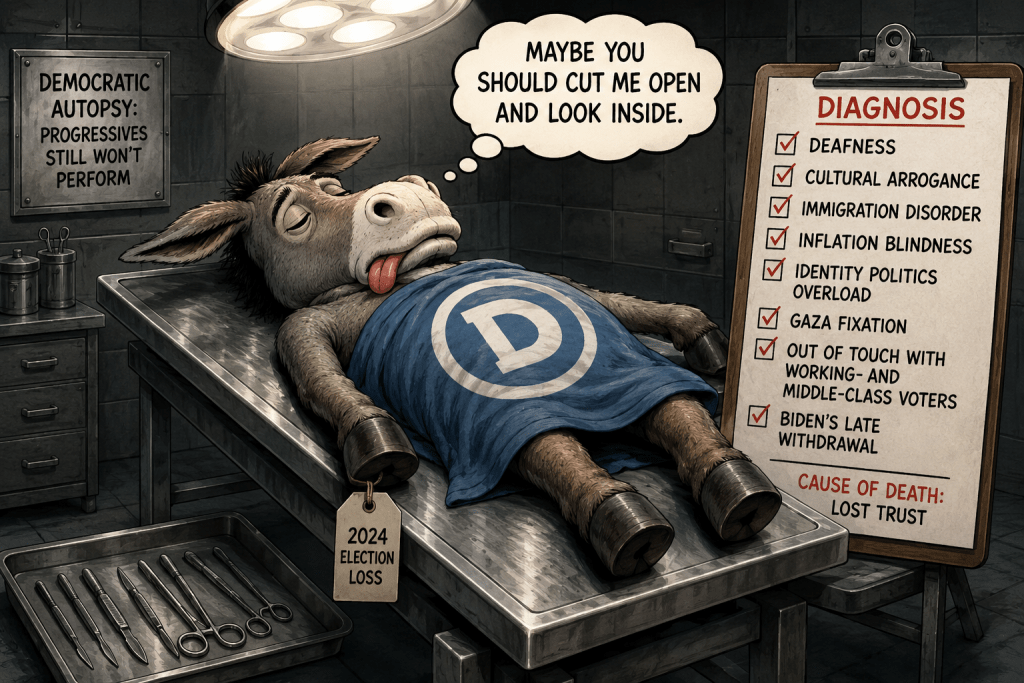
The progressive left has produced its own autopsy of the Democrats’ 2024 presidential loss. Some of it is useful. Much of it is predictable.
This post is about the progressive RootsAction autopsy, not the separate DNC/Rivera report later released by the Democratic National Committee. The RootsAction response was more progressive and self-confirming than the Rivera report.
The Rivera report appears more serious on voter groups Democrats lost and on the party’s failure to listen. But both reports still leave important questions underdeveloped, especially inflation, immigration, Biden’s governing coalition, Gaza cross-pressures, and the cultural alienation of working- and middle-class voters.
The RootsAction report is right that Democrats paid a price for President Biden’s decision to seek reelection and then withdraw only very late in the process. Biden ended his campaign on July 21, 2024, after a debate performance that intensified existing doubts about his age and capacity, leaving Democrats only a few months to define a new nominee and make the case against Donald Trump.
The report is also right that Democrats had a problem with younger voters. The RootsAction autopsy identifies “losing young voters,” “voter disenchantment,” Biden’s late withdrawal, working-class erosion, and Gaza as central reasons for Harris’s defeat. Tufts’ CIRCLE analysis found that young voters still favored Harris overall, but shifted right compared with 2020. AP reported that young men moved significantly toward Trump after a campaign that deliberately appealed to masculine identity through podcasts, sports, and nontraditional media.
So the progressive autopsy is not wrong about everything.
But it still seems to confirm progressive priors more than it confronts the hardest lessons of the election.
It wants Democrats to conclude that they lost because they were not progressive enough, not populist enough, not aggressive enough on Gaza, and not sufficiently mobilizing of the party’s base. Even if some of that were true, which I doubt, it does not explain the whole story. Most importantly, it ignores the issues that many working- and middle-class voters were actually reacting to: immigration disorder, inflation, cultural alienation, and the sense that Democrats were more comfortable speaking the language of elite progressivism than the language of ordinary Americans.
Biden’s Late Withdrawal Hurt Democrats
I agree with the progressive critique on this point: Biden’s decision not to withdraw earlier hurt Democrats.
Voters had serious doubts about his age and capacity long before the debate made those doubts impossible to dismiss. By waiting so long, Biden denied his party a normal primary process, denied voters a real choice among alternatives, and denied the eventual nominee the time needed to build a durable campaign identity.
The RootsAction report calls Biden’s decision to run again, and his refusal to step aside until late in the process, one of the central causes of the Democratic loss. That is fair.
But that explanation has limits. Biden’s late withdrawal hurt Democrats. It did not create all of the underlying problems Democrats faced. A stronger nominee might have performed better, but even a stronger nominee would have had to defend the record and rhetoric of the Democratic Party as voters experienced it.
That is where the progressive autopsy becomes much less persuasive.
The Young Male Problem Democrats Need to Understand
Democrats also appear to have a real problem with young men.
This should not be reduced to a crude claim that all young men are reactionary or that Democrats should imitate the online right. But the problem is real enough to deserve more serious attention than it often receives.
Many young men hear progressive rhetoric about privilege, identity, and DEI less as a call for fairness than as an accusation aimed at them personally. They are told they are beneficiaries of an unjust system at the same time many of them are struggling economically, socially, educationally, and professionally. That is not a recipe for political loyalty.
A healthy political party should be able to say two things at once: discrimination is real, and alienated young men are not all villains.
Too often, progressive rhetoric leaves no room for the second half of that sentence.
This does not mean Democrats should abandon equal opportunity or stop opposing discrimination. It does mean they should rethink language that sounds less like fairness and more like collective blame. A party that talks constantly about inclusion cannot afford to make a large group of voters feel preemptively excluded.
Trump exploited that opening. Democrats should ask why the opening existed.
Gaza Was Not the Main Problem for Most Voters
The progressive left is especially focused on Gaza. There is no question that Gaza mattered deeply to some voters, especially younger voters, progressive activists, Arab Americans, Muslim Americans, and some voters in Michigan. More than 100,000 Michigan Democratic primary voters cast ballots for “uncommitted,” a protest vote widely understood as a rebuke of Biden’s handling of the Israel-Hamas war.
But it is much harder to believe that the central lesson of 2024 is that Democrats failed because they did not tilt far enough toward Gaza activism.
That claim may be emotionally satisfying to parts of the progressive left. It is not a convincing explanation of the broader working-class and middle-class erosion Democrats experienced. Most voters were not living politically in foreign-policy protest politics. They were living with grocery bills, rent, immigration anxiety, cultural conflict, and frustration with a party that seemed surprised by voter concerns it should have seen coming.
Nor is it obvious that more pro-Gaza rhetoric would have been a net political winner. Democrats may have lost some voters because the Biden administration was too supportive of Israel for their taste. But they also risked losing other voters, including Jewish voters, pro-Israel Democrats, moderates, and voters alarmed by the tone of some campus protests, if the party had moved further in the other direction. A Forward poll taken during the campaign found that Jewish voters trusted Harris more than Trump to handle the Israel-Hamas war, but also saw Trump as more supportive of Israelis. That captures the tension Democrats faced.
In other words, Gaza was not a one-way political problem.
The progressive left counts the voters Democrats lost over Gaza. It is much less interested in counting the voters Democrats might have lost by sounding naïve, hostile, or morally confused about Israel.
For most Americans, the question was not whether Democrats had adopted the correct activist position on Gaza. The question was whether Democrats understood the country they were governing.
Immigration Was a Self-Inflicted Wound
Immigration is one of the most obvious issues the progressive autopsy underplays.
Working-class voters are not wrong to want a humane immigration system and a secure border. Those goals are not contradictory. They are the basic requirements of a functioning country.
Democrats spent too long treating border concerns as if they were merely a cover for xenophobia. That was politically foolish and substantively wrong. A country that cannot credibly manage its border will lose public trust, including trust among voters who support legal immigration and humane treatment of migrants.
AP VoteCast found that Trump tapped into deep economic anxiety among voters, and AP’s broader VoteCast work showed immigration and the economy were central issues in the 2024 electorate. That should not have shocked anyone. When voters believe the governing party has lost control of a basic function of government, they tend to punish that party.
Democrats can object to Trump’s cruelty, dishonesty, and demagoguery on immigration. They should. But opposing Trump is not enough. They also need a policy that persuades ordinary voters that the government can be compassionate without being naïve. They needed to come to that conclusion before it became politically obvious that they were only doing it because they had to do something.
That failure helps explain why Democrats lost in 2024.
The “They/Them” Ad Worked Because It Hit a Real Vulnerability
One of Trump’s most effective attacks was the “Kamala is for they/them, President Trump is for you” ad. The ad was ugly. It was designed to exploit cultural resentment. But Democrats should resist the temptation to dismiss its effectiveness as merely evidence of voter bigotry.
The ad worked because it told a simple story: Democrats are focused on a narrow set of elite cultural concerns; Trump is focused on you.
That story was unfair in many ways. It was also politically potent.
PBS reported during the campaign that anti-transgender political ads were dominating the airwaves, with ads supporting Trump attacking Harris over transgender issues. Some postelection analysis, including discussion of Democratic super PAC testing, suggested the “they/them” attack was among Trump’s more effective ads, though there was disagreement about how large its effect was.
The point is not that transgender Americans should be treated as political scapegoats. They should not be. The point is that Democrats had no clear answer when Republicans framed them as more concerned with the language and priorities of progressive activists than with the everyday concerns of ordinary voters.
That is a political problem.
The right answer is not cruelty. It is clarity. People of good will can address the real concerns of transgender Americans without appearing so open-minded that their brains fell out. The deeper problem is that progressives are often so busy signaling virtue to one another that they forget there are potential allies who can be persuaded if their concerns are treated with respect rather than derision. Democrats should defend the equal dignity of every American while also being willing to say no to unpopular, poorly defended, or symbolically extreme positions that most voters do not share.
This is where Democrats often confuse moral seriousness with activist maximalism. A humane society should protect vulnerable people from harassment, discrimination, and cruelty. But voters are also entitled to expect boundaries, prudence, and ordinary language. When Democrats cannot make those distinctions clearly, Republicans will make the distinctions for them — and not kindly.
A party that cannot make those distinctions will keep giving Republicans material for ads like that.
The Inflation Mistake Democrats Don’t Want to Own
The progressive autopsy is especially weak on inflation.
It is right that inflation badly hurt working- and middle-class voters. But it largely treats inflation as something Democrats failed to message properly or failed to blame sufficiently on others. That is too convenient.
Supply-chain disruptions mattered. Energy markets mattered. The war in Ukraine mattered. Federal Reserve policy mattered. But Democrats should also admit that Biden-era fiscal policy helped increase inflationary pressure. I have seen little persuasive evidence that inflation was caused by corporate pricing policies, as the RootsAction report asserts, that cannot be explained by ordinary market conditions. The simpler explanation is also the more economically plausible one: demand was pushed up while supply was still constrained.
The impulse behind the transfers was politically understandable. The country had just been through a pandemic. Millions of households had experienced economic disruption. Democrats wanted to prevent hardship, sustain demand, and avoid repeating the too-slow recovery that followed the Great Recession.
But policy has to be judged not only by its intentions, but by its timing and consequences.
By 2021, the problem was no longer simply inadequate demand. Supply chains were still disrupted. Production capacity was constrained. Labor markets were unsettled. In that environment, aggressive transfers risked increasing demand faster than the economy could increase supply. More dollars were chasing goods and services that could not be produced or delivered quickly enough.
That is a classic recipe for inflation.
Federal Reserve research has emphasized that post-pandemic inflation reflected the interaction of supply and demand forces. A 2025 Federal Reserve paper summarized the evidence by noting that demand factors became more relevant in 2021 and 2022, while supply factors also remained important. New York Fed research likewise estimated that aggregate demand shocks explained a large share of model-based inflation from late 2019 through mid-2022, with fiscal stimulus contributing significantly to that demand effect. San Francisco Fed research found that global supply-chain disruptions also contributed substantially to the run-up in inflation.
This does not mean that every dollar of inflation was caused by Biden’s policies. It was not. But Democrats too often spoke as if inflation were something that happened to them, rather than something their own policy choices helped aggravate.
Voters noticed the prices. They noticed the explanations. And they were not wrong to conclude that the people in power seemed surprised by an outcome that should have been easier to anticipate.
Inflation is not an abstract statistic to most voters. It is the grocery bill. It is rent. It is a car payment. It is the feeling that even a decent raise does not get you ahead. For working- and middle-class voters, inflation feels like betrayal by the governing class, especially when that class appears to dismiss their concerns as temporary, technical, or exaggerated.
Pointing to lower inflation numbers as success only exacerbated the political problem. People were upset because prices were so much higher than they had been, not merely because the current rate of inflation remained too high. Bringing the rate of inflation down was a real success, but failing to realize that was not what people were upset about was politically obtuse.
That is why the inflation mistake matters so much. It was not just an economic problem. It was a trust problem.
Biden Ran as a Moderate but Governed with the Progressive Coalition
Another issue the progressive autopsy avoids is the gap between Biden’s 2020 campaign image and the governing coalition that emerged afterward.
Biden won in 2020 largely as a reassuring, experienced, moderate Democrat. Many voters did not choose him because they wanted a progressive transformation of American politics. They chose him because they wanted Trump gone and because Biden seemed normal, decent, and comparatively centrist.
But once in office, Biden often governed as if the progressive wing had to be appeased at every turn. That does not mean every Biden policy was progressive or that progressives got everything they wanted. They did not. But the administration’s language, staffing, and policy instincts often seemed more aligned with activist priorities than with the moderate image Biden had projected in 2020.
That created a problem of expectations.
Some voters who supported Biden as a stabilizing centrist felt they had instead gotten a party preoccupied with immigration permissiveness, DEI rhetoric, aggressive spending, and cultural issues they did not understand or share.
The progressive autopsy treats this as a failure to mobilize the base. Centrists and independents should see something else: a failure to respect the voters who gave Biden his winning coalition in the first place.
The Working-Class Message Democrats Missed
The common thread is not that Democrats should become Republicans. They should not. Trumpism remains reckless, dishonest, divisive, and institutionally dangerous.
The lesson is that Democrats need to stop assuming every loss proves they should move further left.
Working-class voters did not need a lecture on ideological purity. They needed a party that understood their daily pressures. Many concluded that Democrats had been foolish on immigration, overly absorbed in DEI rhetoric, culturally distant, and at least partly responsible for inflation that hurt them badly.
AP VoteCast found that voters focused on the economy broke strongly for Trump, reflecting deep anxiety about an economy that, despite growth, many voters felt was not meeting the needs of the middle class. That finding should discipline every post-election theory. If an autopsy does not take inflation, affordability, immigration, and cultural alienation seriously, it is not really an autopsy. It is a factional argument.
That is the problem with the progressive report. It identifies some real wounds, but it avoids others because those wounds implicate progressive assumptions.
What a Serious Autopsy Would Say
A serious Democratic autopsy would say something like this:
Biden should have stepped aside earlier.
Democrats had a real problem with young voters, especially young men.
Gaza mattered to some voters, but it was not a significant reason most working- and middle-class voters moved away from Democrats.
Immigration disorder badly damaged the party’s credibility.
The “they/them” ad worked because Democrats had allowed themselves to be defined by unpopular cultural signals.
Biden-era fiscal stimulus was understandable in motive but excessive or poorly timed given supply constraints, and it contributed to inflationary pressure.
Biden ran as a moderate but governed too often as the head of a coalition trying to placate progressives.
And working-class voters concluded, not irrationally, that Democrats did not understand their lives.
That is the autopsy Democrats need. It is also the autopsy many progressives do not want.
The Centrist Lesson
For centrists and independents, the lesson is simple: voters are not ideological props.
They are allowed to have mixed views. They are allowed to want legal immigration and border security. They are allowed to support equal rights while resisting cultural coercion. They are allowed to appreciate government help during a crisis while objecting to inflation afterward. They are allowed to worry about discrimination and also dislike DEI rhetoric that sounds accusatory or unfair.
Good policy must be economically efficient, fair, respectful of personal freedom, and politically realistic. That standard is harder than slogans. It requires tradeoffs. It requires listening. It requires admitting when your own side made mistakes.
Trump has been a terrible president across so many different dimensions, and his personal conduct should have made him easy to defeat. Democrats’ failure to do so says something very powerful about the Democratic Party.
The progressive autopsy asks Democrats to believe that the party mostly failed because it lacked the courage to move left.
The evidence suggests a more uncomfortable conclusion: Democrats lost many voters because they stopped hearing them.
And a politics that cannot hear voters clearly will keep misunderstanding the country.
Good public policy should be economically efficient, fair, respectful of personal freedom, and politically realistic.
That last phrase — politically realistic — is important. It is also easy to misuse.
Too often, people say a proposal is “not politically realistic” when what they really mean is, “I don’t like it, and I don’t want to explain why.” It becomes a substitute for argument. Worse, it can become a way of avoiding difficult tradeoffs.
That is not what political realism should mean.
Political realism does not mean surrendering to current public opinion. It does not mean splitting every issue down the middle. It does not mean that reformers should never advocate for ideas that are unpopular today. And it certainly does not mean that the most cautious, least offensive position is always the right one.
Political realism means asking whether a policy can attract enough durable public consent to be enacted, implemented, and sustained.
That is a higher standard than simply asking whether a policy sounds good to the people who already agree with it.
Abortion and the Limits of Absolutism
Abortion is a good example because the extremes are so visible.
A total ban on abortion, with no meaningful exceptions for rape, incest, threats to the life or health of the mother, or catastrophic fetal abnormalities, is not politically realistic in most of the country. It may satisfy a deeply committed pro-life minority, but it asks too much of voters who do not share that absolute moral framework.
At the other extreme, abortion on demand at any time in pregnancy, funded by the government, is also not politically realistic. It may satisfy a deeply committed pro-choice minority, but it asks too much of voters who believe the moral status of the fetus changes as pregnancy progresses.
Political realism does not tell us exactly where the law should be. It does tell us that a durable policy probably has to acknowledge competing moral claims. A society as large and diverse as ours cannot govern abortion well by pretending that only one side’s moral concerns exist.
That does not mean every compromise is good. Some compromises are incoherent. Some are cruel. Some are designed merely to survive the next election. But a policy that refuses to recognize the moral seriousness of the other side is unlikely to last.
What Is Unrealistic Can Change
Political realism also requires humility.
Some ideas that are unrealistic at one point in history become realistic later. Same-sex marriage is the obvious example. Gallup first measured U.S. support for legal same-sex marriage at 27% in 1996. Support reached majority level in 2011, and Gallup measured support at 60% in 2015, the year the Supreme Court decided Obergefell v. Hodges.
That history matters.
If political realism had meant simply accepting public opinion as it existed in 1996, same-sex marriage would have been dismissed as unrealistic and therefore not worth pursuing. But advocates changed minds. They made arguments. They told stories. They appealed to fairness, family stability, and equal dignity.
In other words, they did not ignore political reality. They changed it.
That is the difference between political realism and political cowardice.
A politically realistic reformer may say, “The country is not there yet.” But the next sentence should be, “What would it take to get there?” Not every unpopular idea deserves that effort. But some do.
Many serious people believe a carbon tax is good policy but politically unrealistic in the United States. They may be right, at least for now. American voters do not like visible taxes. Energy prices are politically explosive. Opponents can easily describe a carbon tax as an attack on ordinary households, rural communities, and working people.
But that does not mean carbon pricing is inherently unrealistic. Other democratic countries have adopted carbon taxes or carbon-pricing systems. The World Bank reports that jurisdictions representing a substantial majority of global GDP have adopted some form of carbon pricing, including carbon taxes, emissions trading systems, or both, and about 28% of global greenhouse-gas emissions are covered by a direct carbon price.
So the question is not whether a carbon tax can exist in a democracy. It can.
The question is whether it can be designed and explained in a way that enough Americans can accept.
That means revenue use matters. Protection for low-income households matters. Border adjustments matter. The effect on domestic industry matters, but not simply because domestic firms deserve protection from competition. The larger issue is that a carbon tax loses much of its effectiveness if carbon-intensive production simply moves overseas and the United States imports the same goods from countries with weaker environmental standards.
A carbon tax that simply raises energy prices and leaves voters to wonder where the money went is probably doomed. A carbon tax paired with transparent revenue use, protection for low-income households, and border adjustments that reduce carbon leakage may still be difficult — but it is not fantasy.
Political realism should force better design. It should not end the conversation.
Social Security and the Politics of Arithmetic
Social Security is a different kind of example.
Almost everyone who looks seriously at the federal budget knows that Social Security cannot remain unchanged forever. The arithmetic does not care about campaign slogans. Longer life expectancy, demographic change, and benefit promises eventually require some combination of higher revenues, benefit adjustments, retirement-age changes, or broader fiscal reform.
And yet almost every specific proposal is politically dangerous.
Raise the retirement age? You hurt people in physically demanding jobs.
Raise payroll taxes? You reduce take-home pay and increase labor costs.
Trim benefits for higher-income retirees? You weaken the link between contributions and benefits.
Borrow more? You push the problem onto younger taxpayers.
So politicians often do what politicians do best: avoid the issue while accusing the other side of secretly planning to destroy the program.
Political realism here does not mean doing nothing. It means recognizing that reform has to be gradual, transparent, and probably grandfathered. It means giving people time to adjust. It means refusing to pretend that there is a painless answer.
Sometimes political realism is not about finding a popular solution. It is about finding the least unfair way to admit reality.
Immigration Reform and Mutual Distrust
Immigration is another area where political realism gets abused.
There is probably a broad political deal available in theory: stronger border enforcement, a more rational legal immigration system, and humane treatment for some long-resident undocumented immigrants, especially those brought here as children.
But the deal repeatedly fails because neither side trusts the other.
Many conservatives believe legalization will happen but enforcement will never follow. Many progressives believe enforcement will become harsh and permanent while humane reforms are delayed or abandoned. Both sides have historical reasons for suspicion.
The distrust is made worse by the way both sides talk about demographics. Some on the right have embraced paranoid claims that Democratic elites are intentionally trying to “replace” existing voters through immigration. That rhetoric is dangerous and should be rejected. But some progressive and Democratic commentators have also treated demographic change as politically or morally encouraging, and Democratic strategists at times assumed that a more diverse electorate would naturally benefit their party. That is very different from a deliberate replacement plot, but it helps explain why some voters hear demographic language as threatening. In a diverse country, demographic change should not be treated as a partisan weapon. Immigration policy needs public consent, and public consent becomes much harder when one side sees immigration as cultural displacement and the other side appears too comfortable with that perception.
Political realism requires acknowledging that distrust.
It is not enough to say, “Comprehensive immigration reform polls well.” Lots of things poll well in the abstract. The real question is whether voters believe the government will actually enforce the parts they care about and protect the people they think deserve protection.
That means sequencing matters. Credibility matters. Administrative competence matters. The details are not details. They are the policy.
Many people say they want affordable housing. Many of the same people oppose new housing near them.
That is not a minor obstacle. It is the obstacle.
A purely technocratic housing reformer can say, correctly, that restrictive zoning reduces supply and raises prices. But that does not make neighborhood opposition disappear. People worry about traffic, schools, parking, neighborhood character, property values, and simple change.
Some of those fears are exaggerated. Some are selfish. Some are real.
Political realism does not mean giving every homeowner a veto over new housing. That is how we got the problem. But it does mean recognizing that reform may need to be phased in, paired with infrastructure, handled partly at the state level, and framed around opportunity, property rights, and affordability rather than simply denouncing every opponent as a NIMBY.
Again, political realism should improve the policy. It should not be an excuse for paralysis.
Trade, Industrial Policy, and the Return of Hard Questions
Trade policy is another area where yesterday’s political realism may no longer be today’s.
A generation ago, the elite consensus in favor of free trade was very strong. It was not entirely wrong. Trade increases efficiency, lowers costs, expands markets, and raises living standards overall.
But the distributional effects were too often minimized. Some communities paid a very high price. Some workers were told, in effect, that the economy was better off even if they were not. That may be true in a narrow economic sense, but it is politically poisonous.
Trade also became the political face of economic disruption that was often driven at least as much by technology and automation. Factories did not just move overseas; they also became more productive, more automated, and less labor-intensive. Even if the United States had closed itself off from trade, many manufacturing jobs would probably still have disappeared. The timing and location of the losses might have been different, and trade clearly played a role in some communities, but the deeper force was not trade alone. It was the combination of global competition, technological change, automation, and changing consumer demand.
That distinction matters because blaming trade alone can lead to the wrong cure. If the real pressure is partly automation, then tariffs may raise costs without bringing back the world people remember.
Now the pendulum has swung toward protectionism and industrial policy. Some of that is understandable, especially given China, supply-chain fragility, and national-security concerns. But broad protectionism is not a serious answer either. It can raise costs, invite retaliation, protect inefficient firms, and reduce economic growth.
A politically realistic position has to hold more than one thought at a time.
We should defend the benefits of trade. We should take national-security vulnerabilities seriously. We should be cautious about industrial policy becoming a pork barrel. And we should stop pretending that workers harmed by trade, immigration, automation, or some combination of all three can be placated with empty retraining rhetoric.
That is not as satisfying as a slogan. But slogans are part of how we got here.
The Misuse of “Politically Unrealistic”
The phrase “politically unrealistic” can be useful. It can also be lazy.
It is useful when it forces people to ask hard questions:
Can this policy pass? Can it survive the next election? Can it be implemented competently? Can voters understand it? Can the losers be treated fairly? Can the policy survive contact with interest groups, courts, bureaucracy, and the budget?
Those are serious questions.
But “politically unrealistic” becomes lazy when it is used to avoid argument.
I have heard people dismiss market-based climate policy as unrealistic when they really object to energy taxes. I have heard people dismiss entitlement reform as unrealistic when they really do not want to identify who should pay more or receive less. I have heard people dismiss immigration compromise as unrealistic when they really do not want compromise. I have heard people dismiss basic-income proposals as unrealistic when they really do not want to rethink the welfare state.
Sometimes “politically unrealistic” means “voters will never accept it.”
Sometimes it means “interest groups will kill it.”
Sometimes it means “I do not like it.”
Those are not the same argument.
What CIVPAC Means
When CIVPAC describes public policy as politically realistic, the point is not that politics should be reduced to polling.
The point is that governing requires consent.
A policy that cannot be explained cannot be sustained. A policy that ignores obvious losers will create backlash. A policy that depends on voters being fooled will eventually fail. A policy that treats half the country as morally illegitimate is unlikely to produce stable government.
But political realism also requires courage.
It requires telling voters that some things cost money. It requires telling interest groups that they cannot have everything. It requires telling activists that intensity is not the same as majority support. It requires telling moderates that compromise is not always available, and telling reformers that good ideas still need political strategy.
Political realism is not an excuse to avoid hard arguments. It is a demand that we make them honestly.
That is the standard CIVPAC tries to apply.
CIVPAC will not always get the balance right. No one does. But the goal is to be clear about the tradeoffs, honest about the constraints, and open to changing our view when public opinion, evidence, or circumstances change.
“What is politically realistic?” should not be the end of the conversation.