A couple of days ago, I heard Felix Frisch discuss Promise to America with Elie Honig on SiriusXM. I came away thinking that we had found an organization that belongs on CIVPAC’s list of centrist resources.
Promise to America is an effort to give moderate Democrats something they have often lacked: a simple, affirmative statement of what they believe. It was developed by a group of young political organizers working with Democratic Representatives Tom Suozzi of New York and Adam Gray of California—the only two Democrats who captured Republican-held House districts won by Donald Trump in 2024.
The organization is directed by Felix Frisch, the 20-year-old son of former Colorado congressional candidate Adam Frisch. Felix worked on his father’s two campaigns and says he drove more than 50,000 miles through western and southern Colorado. That experience appears to have taught him something national political organizations sometimes forget: candidates must listen to the voters they need to persuade, not merely repeat the views of the activists.
Promise to America asks Democratic candidates and elected officials to embrace six broad principles:
Growth, competition and broadly shared prosperity
Safety, security and human dignity
Fiscal discipline
Government that works
Free speech, respect and common purpose
Confident patriotism and national renewal
The pledge summarizes those principles in unusually direct language:
“We are capitalist, not socialist.”
“We want safety, not lawlessness.”
“We are responsible, not reckless.”
“We believe government should solve problems, not create them.”
“We are mainstream, not extreme.”
“We are proud, not ashamed of America.”
CIVPAC agrees with all six statements.
That does not mean that slogans are a substitute for policy. Saying that government should be fiscally responsible is easier than identifying which programs should be reduced, which taxes should be increased or which promises should be reconsidered. Supporting secure borders does not by itself tell us what a workable immigration system would look like. Supporting capitalism does not relieve government of the responsibility to preserve competition, protect opportunity and address genuine market failures.
But political organizations need both policies and an identity. Voters want to know not only what a candidate proposes to do, but also what kind of person—or party—they are being asked to trust.
Promise to America offers a recognizable identity: economically pragmatic, socially tolerant, patriotic, serious about public safety, supportive of effective government and willing to persuade people who do not already agree.
That is a useful answer to the impression that Democrats must choose between offering no clear governing philosophy and adopting the philosophy of the democratic socialist left.
The pledge’s emphasis on persuasion may be especially important. American elections are not won by assembling the purest possible collection of beliefs. They are won by building coalitions. That requires candidates to speak respectfully to voters who may disagree with them on abortion, guns, immigration, taxes, policing, climate policy or cultural questions.
A political party that treats disagreement as evidence of moral failure will steadily shrink the number of people it can represent.
The Democratic Party needs people who understand that defeating MAGA politics requires winning voters outside safely Democratic cities and districts. The party cannot build a durable national majority by telling culturally moderate, working-class, rural and suburban voters that they must accept every position favored by the progressive left.
Centrists should not limit themselves to warning Democrats about what they must reject. They need to describe what they are for.
Promise to America has made a promising start.
Its principles do not constitute a complete governing program, but they describe a political temperament that is badly needed: confident without being arrogant, patriotic without being uncritical, market-oriented without being indifferent, and moderate without being timid.
We are therefore adding Promise to America to CIVPAC’s list of centrist organizations. We hope its candidates and supporters will move beyond a pledge to develop specific, credible policies. It took CIVPAC years to develop our current portfolio of centrist public policies. Promise to America has existed for only a few weeks.
We also hope Democratic leaders will listen to people such as Tom Suozzi and Adam Gray, who have demonstrated that they can win voters in places where elections are genuinely contested.
And we will be watching Felix Frisch. It is encouraging to hear a young political leader speak about persuasion, pluralism and coalition-building with a maturity that is often missing from American politics.
Democrats can win everywhere without accepting everyone who can win somewhere.
A bigger political tent can welcome many people, but only if it is firmly anchored by shared democratic principles.
I am not a Democrat. CIVPAC is not a Democratic organization. We support Democrats, Republicans, and independents when we think they represent a more responsible, centrist, democratic, and politically realistic alternative.
So any advice I offer Democrats is, by definition, unsolicited. But the Democratic Party is one of the two major governing parties in the United States. Its internal arguments matter even to those of us who do not belong to it.
Two Ideas in Tension
Right now, Democrats seem caught between two ideas that are both partly right.
The first is the “win everywhere” idea. I have argued before that both parties should try to compete beyond their comfort zones. A serious national party should not write off whole regions, classes, religions, or cultures. Democrats should want candidates who can compete in cities, suburbs, small towns, working-class communities, and rural areas. They will not all sound alike, and they should not all sound alike.
A party that wants to govern the whole country should try to understand the whole country.
The second idea is James Carville’s warning about the Democratic Socialists of America and the far-left edge of the Democratic coalition. Carville has argued that Democrats need to consider something close to a schism with some DSA-aligned candidates. His point is blunt but not foolish: if candidates who reject core assumptions of liberal democracy, pluralism, public safety, capitalism, or America’s basic alliances run under the Democratic label, Republicans will use those candidates to define the entire party.
That is not paranoia. That is politics.
But there is an obvious tension. How can Democrats “win everywhere” if they are also drawing sharper boundaries around who belongs in the party?
The answer is that “win everywhere” does not mean “accept everyone who can win somewhere.”
A Big Tent Still Needs a Floor
A democratic political party has to be broad. It has to include people who disagree on taxes, health care, immigration, policing, climate, foreign policy, and cultural issues. It has to make room for candidates who fit their communities. A Democrat running in rural Georgia should not have to sound like a progressive activist from Brooklyn. A Democrat running in Brooklyn should not have to sound like a rural Georgia moderate.
Local variation is not the problem. It is the point.
But a party also needs a floor. It needs some basic commitments that define what the party is and what it is not. For Democrats, that floor should include liberal democracy, constitutional government, pluralism, public safety, a regulated market economy, individual rights, and a foreign policy that does not treat America’s democratic allies as morally indistinguishable from its adversaries.
That still leaves room for a wide range of Democrats. It leaves room for progressives, moderates, labor liberals, suburban pragmatists, Black church Democrats, national-security Democrats, and former Republicans who broke with Trump over democracy and the rule of law.
But it does not require Democrats to treat every anti-capitalist, anti-police, anti-Israel, anti-party, or anti-pluralist candidate as merely one more flavor in the big tent.
That is the mistake Carville is reacting against.
The Fetterman Test
I thought about this while rereading my earlier post, “A Centrist on the Road.” On that trip, I spoke with a Democratic Party activist from a northeastern state. She described herself as left wing but not far left wing. We agreed that Democrats needed to reach voters outside their normal constituencies. But she also reportedly wrote Senator John Fetterman urging him to leave the Democratic Party.
That struck me then, and strikes me even more now, as a perfect illustration of the problem.
It is easy to say the party should broaden its coalition. It is harder to accept the actual people who make a broader coalition possible.
A party cannot become more competitive in Pennsylvania, Ohio, Wisconsin, Georgia, Arizona, North Carolina, or Maine if it treats every culturally heterodox Democrat as a betrayal. If Democrats want to win outside safe blue territory, they need candidates who sound plausible outside safe blue territory.
The Fantasy of Purification
There is also a darker suspicion, held in some quarters, that some DSA and far-left Democrats do not mind seeing moderate Democrats lose in competitive districts. Moderate losses weaken the party’s center of gravity. They make it easier for ideological activists to argue that the old coalition has failed and that the party must be remade in their image.
The fantasy seems to be that if the Democratic Party becomes uniformly left wing enough, millions of hidden voters will suddenly emerge from the woodwork and propel it to national power. That theory has always struck me as closer to faith than analysis. It ignores the voters who actually decide competitive elections. It also treats losing winnable seats as an acceptable price for ideological purification.
That is not “win everywhere.” That is lose strategically and call it progress.
Disagreement Is Not Disqualification
The right answer is not to purge the left. Nor is it to purge the center. The right answer is to distinguish between disagreement and disqualification.
Disagreement is normal coalition politics. A Democrat who is more cautious on spending, more supportive of policing, more hawkish on foreign policy, or more skeptical of progressive cultural language should not be pushed out of the party. Such candidates may be exactly what Democrats need in places where they currently lose.
Disqualification is different. A candidate who rejects liberal democracy, excuses political violence, denies basic pluralism, or treats the Democratic Party merely as a ballot line to be captured is not simply a different kind of Democrat. That candidate is challenging the party’s identity.
So the lesson is simple:
Do not purge the center in the name of ideological purity.
Do not absorb the anti-liberal left in the name of coalition unity.
That is not hypocrisy. It is coalition discipline.
The Same Advice Applies to Republicans
I would offer Republicans the same unsolicited advice. There are elements on the far right that seem to have found a home in the Republican Party — indeed, may have seized control of much of it — and they may have permanently damaged the Republican brand. But that is a subject for another post.
The Goal Is a Stronger Tent
The broader principle applies to both parties. A healthy party should be wide enough to hold real disagreement and strong enough not to collapse under the weight of people who do not believe in the core principles of the coalition itself.
When CIVPAC began, we expected much of our work to involve supporting center-left and center-right candidates in primaries, with the hope of nudging both parties toward the political center. That task has changed. Increasingly, CIVPAC finds itself supporting conventional left-wing or right-wing candidates against more extreme alternatives that, not long ago, would have seemed unlikely to gain serious traction in American politics.
When this effort began, through CIVPAC’s predecessor organization, the New Independent Party, the national political world was still recognizable. The 2012 presidential race was Mitt Romney against Barack Obama. CIVPAC would have had criticisms of both candidates, but both were serious, constitutional, mainstream figures. The distance between that world and today’s politics explains why CIVPAC’s task has changed.
Espaillat is not a centrist Democrat. He is a mainstream progressive Democrat with a reliable party-line voting record. But the question in NY-13 is not whether voters should choose a centrist over a progressive. The question is whether Democratic primary voters should replace an experienced incumbent with Darializa Avila Chevalier, a democratic-socialist challenger backed by Mayor Zohran Mamdani.
That race is part of a larger pattern. Mamdani has endorsed three congressional candidates in New York: Avila Chevalier in NY-13, Brad Lander in NY-10, and Claire Valdez in NY-7. CIVPAC is not making endorsements in all three races at this time. But the slate matters because it has become a national signal about the direction of the Democratic Party in its most heavily Democratic urban districts.
Deep-blue primaries are not politically isolated. New York City helps shape the Democratic Party’s national brand. When candidates running on democratic-socialist, movement-left politics become the face of the party in highly visible urban districts, voters outside New York notice. So do Republican media and campaign strategists.
If Democrats believe Mamdani’s strategy and the candidates he is backing are likely to succeed nationally, they should ask why Fox News is so eager to make that strategy visible to voters outside New York City.
CIVPAC does not object to new candidates merely because they are new. Parties need competition, new voices, and serious challenges to complacency. Nor does CIVPAC believe incumbents are entitled to renomination. But not every insurgency is an improvement.
This is one of those situations. The work now feels less like gently nudging the parties toward the center than trying to keep the planets from being flung out of the solar system.
Our concern is the road to “Blue MAGA.” We do not mean that left-wing populism and Trumpism are identical. They are not. But both can reward tribal certainty, ideological escalation, contempt for persuasion, and the belief that political intensity is a substitute for broad public appeal.
In NY-13, CIVPAC believes the better choice is clear. Representative Espaillat is not a CIVPAC ideal candidate, but he offers experience, institutional knowledge, and continuity. Replacing him with a movement-left challenger would strengthen the very tendency CIVPAC has warned about: the temptation to make deep-blue urban politics the face of the national Democratic Party.
That is bad politics for Democrats and bad politics for the country.
CIVPAC therefore endorses Representative Adriano Espaillat in the Democratic primary for the U.S. House in New York’s 13th Congressional District.
AI-generated symbolic image of a blue road roller paving the road to “Blue MAGA.”
Democrats have spent years warning, correctly, that Trumpism has damaged American politics. But one lesson they should not take from Trumpism is that politics is only about mobilizing the most emotionally committed members of the base.
That way lies what some have called “Blue MAGA.”
By “Blue MAGA,” we do not mean that left-wing populism is identical to Trumpism. It is not. Nor do we mean that Democrats should reject working-class appeal, fresh candidates, economic populism, or a willingness to fight. Democrats may need more of some of those things.
By “Blue MAGA,” we mean the temptation to copy some of MAGA’s worst political habits: tribal loyalty, contempt for persuasion, and the belief that emotional intensity is a substitute for broad public appeal. We realize that this term can be used in a variety of ways. We think, right now, it most accurately applies to the illiberal-left, with its fondness for analysis by slogan and its intolerance for anyone, even those within the same party, who holds opposing views.
Democrats face this temptation now. After years of Trump, many Democratic primary voters understandably want candidates who sound angry, uncompromising, and morally certain. That may feel satisfying. It may even win some blue districts and blue cities. But it is a poor strategy for winning red, pink, and purple places where Democrats need converts, independents, moderates, suburban voters, disaffected Republicans, and people who are tired of politics as permanent combat.
Georgia offered a useful test.
Geoff Duncan was not a conventional Democrat. That was the point. He was a former Republican lieutenant governor who broke with Trump over election integrity and paid a political price inside his own party. Democrats did not need to agree with Duncan on every issue to recognize the strategic value of his candidacy. If the defense of democracy is as important as Democrats say it is, then a pro-democracy former Republican should have been treated as an asset, not an intruder.
Instead, Democrats chose a more conventional path. Keisha Lance Bottoms won the Democratic nomination for governor without a runoff. She is a well-known Democrat and a serious political figure. But her nomination also raises the familiar question: are Democrats trying to build a broader governing coalition, or are they choosing candidates who make the base feel more comfortable? The problem is not that Bottoms is unserious. The problem is that Duncan offered a different kind of coalition opportunity.
This is not just a Georgia problem. It is a national problem for Democrats in red and purple territory. The party cannot say it wants to win everywhere while rejecting candidates who might appeal to people who do not already think like Democratic primary voters.
The point is not that every former Republican should be welcomed uncritically. Parties need standards. Candidates who switch parties for convenience or ambition should be examined carefully. But Duncan’s break with Trump was not a minor branding choice. It went to the central institutional question of the last several years: whether elected officials would defend election integrity when pressured by their own side.
If Democrats cannot make room for that, they should stop pretending that defending democracy is a coalition project.
The road to “Blue MAGA” is paved by the belief that the other side’s extremism justifies our side’s extremism. It is paved by the assumption that persuasion is weakness, that moderation is betrayal, and that candidates should be judged first by whether they make activists feel seen.
That road may produce candidates who sound good in a primary and lose races that were winnable. It may also produce candidates who win in heavily Democratic places but govern in ways that drive away the voters needed to build durable majorities nationally.
This does not mean Democrats should reject efforts to recruit new candidates. They should do the opposite. A stale bench, safe résumés, and candidates who speak only to existing Democratic primary voters will not solve the party’s problem. Candidate recruitment matters.
But “new blood” is not automatically the same thing as better blood. There is a difference between recruiting candidates who can broaden the party’s appeal and recruiting candidates who simply give activists a more satisfying fight. Democrats need candidates who can win voters they do not already have, not candidates who merely express the frustrations of voters they already do.
Groups trying to build a stronger Democratic bench may be doing important work. Some of that work points in the right direction. Democrats need candidates with compelling stories, state and district ties, practical experience, and the ability to speak beyond the party’s current coalition. But the test should not be novelty alone. The question is whether they expand the party’s reach or merely intensify its internal mood.
There are promising models.
Democrats should be looking for more candidates in the mold of Roy Cooper in North Carolina, Josh Shapiro in Pennsylvania, Daniel Lurie in San Francisco, and, in Georgia, the opportunity Geoff Duncan represented. These are not identical figures, and they come from different political environments. But they share something important: they try to solve problems in a way that reaches beyond the most ideological voters in their own coalition.
Cooper showed that a Democrat could win statewide in a Republican-leaning state by projecting steadiness, moderation, and practical concern for schools, health care, and economic development. Shapiro has shown a similar ability in Pennsylvania, combining mainstream Democratic commitments with a governing style that does not seem designed primarily for activist approval. Lurie offers a different but related lesson from a deeply Democratic city: even in blue places, voters may be hungry for competence, public order, housing reform, economic recovery, and a government that works.
That is the kind of new blood Democrats should want. Not candidates who merely intensify the party’s internal mood, but candidates who expand its reach.
There are also warning signs that the search for new faces is veering off course.
Kara Eastman defeated a more moderate Democrat in Nebraska’s 2nd Congressional District and then lost the general election twice, including in 2020 when Joe Biden carried the district’s electoral vote. Randy Bryce became a national progressive celebrity as “Iron Stache,” raised money, won attention, and still failed to turn Wisconsin’s 1st Congressional District blue. Paula Jean Swearengin offered a compelling Appalachian populist story in West Virginia, won the Democratic Senate nomination, and lost by more than 40 points.
These examples do not prove that every moderate would have won. They do show that biography, anger, online enthusiasm, and populist rhetoric are not substitutes for persuading the voters who actually decide red and purple races.
Graham Platner points to a current version of the same risk. His outsider profile, veteran biography, rural appeal, and anti-establishment message are exactly why some Democrats find him exciting. But that is also why his candidacy is a useful test. Populist energy, outsider branding, and intense primary enthusiasm may not survive contact with a general electorate.
A candidate like Zohran Mamdani may be viable in New York City. That does not mean the same style travels well to Maine, Georgia, Nebraska, Pennsylvania, North Carolina, or other places Democrats must compete if they want governing majorities. CIVPAC does not argue that left populists can never win anywhere. We argue that Democrats are making a mistake if they treat deep-blue or idiosyncratic-city success as a model for red and purple territory.
The recent mayoral results in New York City, Washington, D.C., and San Francisco are worth taking seriously because they say something about the Democratic brand when general-election constraint is weak. In places where the real contest is often the Democratic primary, voters and activists can reveal what kind of politics they prefer when they do not have to worry very much about Republican opposition.
New York and D.C. point in one direction. Zohran Mamdani’s victory in New York City and Janeese Lewis George’s victory in the D.C. mayoral primary suggest that left-populist politics has real strength in some of the party’s most visible urban centers. That matters nationally because New York and Washington are not just local governments. They are symbols. They help define what many voters elsewhere think Democrats are becoming.
San Francisco points in a different direction. Daniel Lurie’s victory did not make San Francisco conservative. It remains one of the most liberal cities in America. But it did suggest that even deeply liberal voters can become impatient with public disorder, visible dysfunction, housing paralysis, downtown weakness, and a city government that does not seem able to execute. In San Francisco, pragmatic competence became the change candidate. That is a brand image that could have national appeal.
That contrast is important. The problem is not that Democrats should never nominate left-populists in cities where left-populists can win. The problem is treating those victories as a national model. A style of politics that can win New York City or Washington, D.C. may still damage the Democratic brand in Maine, Georgia, Nebraska, Pennsylvania, North Carolina, or other places where Democrats need voters who do not already identify with the party’s most progressive urban wing.
This is another reason candidate recruitment matters. Deep-blue cities can become laboratories for policy innovation, but they can also become laboratories for national brand damage. When Democrats are unconstrained by serious general-election competition, they should ask not only what their local primary electorate wants, but what their choices tell the rest of the country about the party they are building.
Progressives sometimes make a mirror-image argument: that centrist Democrats in red or purple states damage the national Democratic brand by making the party look cautious, compromised, or insufficiently committed to progressive change. That argument should not be dismissed out of hand. Party brands are real, and candidates in one state can affect how voters see the party elsewhere. But a national party is not a boutique ideological label. It is a coalition built to govern a large, diverse country. A party that cannot tolerate candidates who fit West Virginia, Georgia, North Carolina, Maine, or Pennsylvania may preserve a cleaner brand, but it will have fewer seats, less power, and less ability to enact anything at all.
Joe Manchin offers a related lesson from the other direction. Manchin was not a model national Democrat, and many Democrats understandably found him infuriating given their policy preferences. He protected the filibuster, resisted major parts of President Biden’s domestic agenda, defended fossil-fuel interests important to West Virginia, and often used his leverage in ways that frustrated Democratic leaders.
CIVPAC does not share every Manchin position. But the strategic fact remains: he could win a Senate seat in West Virginia as a Democrat. A party that can hold a Senate seat in West Virginia through a moderate Democrat is stronger than a party that treats such figures as embarrassments and then watches the seat become unwinnable.
That lesson applies beyond Manchin. A party serious about building a durable governing coalition cannot demand that every candidate in every state sound like the median activist in a national primary. It has to tolerate members who fit their states, represent different electorates, and sometimes frustrate national party priorities.
That is what coalition politics means.
CIVPAC’s view is different from both partisan purity and performative moderation. Parties should nominate candidates who can govern effectively and appeal beyond their own faction. That sometimes means choosing a Democrat. Sometimes it means choosing a Republican. In rare cases, like Angus King of Maine, it might mean supporting an independent with a plausible path to success.
It is fine to lose after making the strongest possible case to the voters. It is something else to lose after rejecting the better candidate because the better candidate did not flatter the party’s internal mood.
When that happens, the answer to the party that loses the general election is simple: you had a better choice. You chose not to take it.
The Rivera report on the Democrats’ 2024 loss is an odd document.
It appears to contain some useful insights. It also appears unfinished, poorly rolled out, and only grudgingly released. The Democratic National Committee held the report for months before releasing it under internal pressure. DNC Chair Ken Martin then distanced himself from it, saying he was “not proud” of the product and that it did not meet his standards. The DNC also attached a disclaimer saying it could not verify many of the report’s claims because it had not received the underlying sourcing, interviews, or supporting data.
That is not how a serious political party should handle a serious post-election review.
Still, buried inside the Rivera report is an idea that both parties should take seriously: Democrats need to organize everywhere to win everywhere.
That phrase matters.
In fact, it may be the key to a healthier American politics.
What “Win Everywhere” Should Mean
I would take “win everywhere” more literally than political consultants usually do.
Obviously, no party will actually win every race. Politics is competitive. If one party improves, the other party will adapt. Some districts are deeply Republican. Others are deeply Democratic. Not every race is polled, and not every race can realistically be close in any given cycle.
But the aspiration should be clear:
A healthy political party should try to make every election genuinely contestable.
Conceptually, every serious party should want to nominate candidates who could poll within the margin of error before Election Day if voters were paying attention and both parties were competing seriously.
That is not because every candidate will win. They will not.
It is because the discipline of trying to win everywhere would force both parties to become better.
A Democrat running in rural Georgia should not sound like a faculty-lounge progressive from Brooklyn. A Republican running in suburban Maryland should not sound like he is auditioning for a Trump rally. Candidates should fit their communities while still reflecting their party’s broad principles.
That is what political parties are supposed to do.
They are supposed to persuade.
Why the Impossibility Is the Point
The reason “win everywhere” cannot fully succeed is also the reason it is so important.
If Democrats became more competitive in rural America, small towns, the South, and working-class communities, Republicans would have to adapt. They could not rely as easily on Trump loyalty, cultural resentment, and the assumption that Democrats are unacceptable by default.
If Republicans became more competitive in cities, suburbs, college towns, and diverse metropolitan areas, Democrats would have to adapt too. They could not rely as easily on progressive cultural shorthand, demographic assumptions, or opposition to Trump as a substitute for persuasion.
That competitive response is exactly what the country needs.
The goal is not permanent one-party dominance. The goal is healthier competition.
When both parties have to compete everywhere, both parties have to listen. They have to recruit better candidates. They have to moderate their language. They have to understand local concerns. They have to stop treating entire categories of voters as either deplorable or morally superior.
In short, both parties would have to become less obnoxious.
That may be the best argument for “win everywhere.”
Democrats’ Bad Habit: “Failure to Communicate”
The Rivera report appears more reasonable than the progressive response to it because it recognizes real Democratic weaknesses with men, rural voters, non-college voters, Latino voters, irregular voters, and voters in Middle America and the South. AP reported that the report criticized Democrats’ focus on identity politics and said Harris “wrote off rural America.” Reuters similarly reported that the report faulted Democrats for failing to engage men, rural voters, non-college-educated voters, and irregular voters.
That is useful.
But Democrats often make the same mistake after losing: they describe the defeat as a failure to communicate.
Sometimes that is true. Sometimes the message was unclear, the candidate was poorly defined, the campaign failed to respond, or the party did not show up.
But sometimes voters heard the message clearly enough and did not like it.
That distinction matters.
Immigration was not merely a communication problem. Inflation was not merely a communication problem. DEI rhetoric was not merely a communication problem. Cultural overreach was not merely a communication problem. The Trump campaign’s “they/them” ad was effective not simply because Democrats failed to answer it, but because many voters already suspected the party had become too willing to indulge the cultural left.
A party that wants to win everywhere cannot treat every voter disagreement as a misunderstanding.
It has to ask whether voters understood the party’s priorities and rejected them.
The Democratic Lesson
For Democrats, “win everywhere” means more than opening field offices in red counties.
It means becoming plausible to voters outside deep-blue cultural environments.
That does not mean becoming Republican. It does not mean abandoning civil rights, immigration reform, climate policy, abortion rights, or concern for vulnerable groups.
It means learning to speak about those issues in a way that does not sound contemptuous of ordinary people.
Democrats need to stop assuming that voters who dislike immigration disorder are xenophobes. They need to stop assuming that voters who dislike DEI rhetoric are racists. They need to stop assuming that voters who reject progressive language about gender are bigots. They need to stop confusing academic vocabulary with moral seriousness.
People of good will can address the real concerns of transgender people without appearing so open-minded that their brains fell out.
A party that wants to win everywhere has to be able to say that.
It also has to be honest about inflation. Biden-era transfers were politically understandable during COVID, but in retrospect the additional fiscal stimulus was poorly timed. When supply chains were still broken and production capacity was constrained, aggressive transfers increased demand faster than supply could respond. That made inflation more likely, and Democrats then paid the political price for seeming surprised by a result that should have been easier to anticipate.
That is not a messaging problem.
It is a judgment problem.
The Republican Lesson
Republicans need the same discipline.
A Republican Party that wants to win everywhere cannot define “Republican” as “loyal to Donald Trump.”
It cannot treat every dissenting conservative as a RINO. It cannot indulge election denial, cruelty, corruption, or authoritarian rhetoric and then wonder why it struggles in suburbs, cities, college towns, and diverse communities.
A serious Republican Party should have room for fiscal conservatives, libertarians, national-security conservatives, business conservatives, social conservatives, moderates, and populists. Those factions will disagree. That is what political parties are for.
But when loyalty to one man becomes the organizing principle, a party stops being a coalition and becomes a personal vehicle.
That is bad for Republicans. It is also bad for the country.
If Republicans wanted to win everywhere, they would need candidates who could speak to voters who care about fiscal discipline but reject chaos. They would need candidates who can talk about crime without sounding cruel, immigration without sounding bigoted, religion without sounding theocratic, and patriotism without sounding authoritarian.
That would make the Republican Party better.
The Virtuous Cycle
Here is the point that matters most.
If one party seriously tried to win everywhere, the other party would have to respond.
That response would create a virtuous cycle.
If Democrats competed seriously in rural and working-class districts, Republicans would have to stop taking those voters for granted. If Republicans competed seriously in urban and suburban districts, Democrats would have to stop taking those voters for granted.
More races would become real contests. More candidates would have to persuade. More voters would matter. Fewer politicians could survive by appealing only to activists, donors, cable-news audiences, or primary electorates.
That is how American politics could improve.
Not because one party becomes dominant.
Because both parties become less complacent.
A healthy democracy does not require one party to win everywhere. It requires both parties to believe they should try.
Why This Matters to CIVPAC
CIVPAC’s interest is not in helping Democrats win for the sake of Democrats, or Republicans win for the sake of Republicans.
Our interest is in making both parties better.
The country benefits when Democrats are forced to understand rural, religious, working-class, culturally moderate, and non-college voters. The country also benefits when Republicans are forced to understand urban, suburban, secular, immigrant, educated, and racially diverse voters.
Both parties need to compete for voters who are not already on their side.
That is how parties become less ideological, less arrogant, and less captured by their loudest activists.
It is also how voters get better choices.
Too many Americans are politically homeless because each party has learned to survive by making the other party unacceptable. Democrats rely on fear of Trump. Republicans rely on fear of the cultural left. Both strategies can work electorally. Neither strategy produces a healthy democracy.
“Win everywhere” offers a better discipline.
It says: do not write off voters. Do not caricature communities. Do not nominate candidates who can only speak to the converted. Do not assume that the other party’s failures are enough to excuse your own.
The Right Lesson From Rivera
The Rivera report may be unfinished. It may be poorly sourced. It may be incomplete. It reportedly sidesteps some of the hardest questions, including Biden’s decision to seek reelection, and the rushed elevation of Harris after Biden withdrew.
But the “win everywhere” idea is right.
The Democrats need it. Republicans need it too.
A party that wants to govern the whole country should try to understand the whole country. It should put forward candidates who can compete in places where the party usually loses. It should want every voter to believe that their vote matters and that both parties are capable of speaking to them.
That is not naïve. It is the competitive logic democracy is supposed to produce.
The country does not need one party to win everywhere.
It needs both parties to try.
That effort would force each party to listen more, preach less, and nominate candidates who can appeal beyond their own base.
That is the virtuous cycle American politics badly needs.
Of course, not everyone would welcome this. The activist wings of both parties benefit from safe-seat politics. Progressive activists have more power when Democrats only need to win deep-blue primaries. MAGA activists have more power when Republicans only need to win deep-red primaries. A genuine effort to win everywhere would weaken both groups because it would force candidates to persuade voters outside the ideological comfort zone. That is one reason the strategy is so attractive. It would return power from activists to voters.
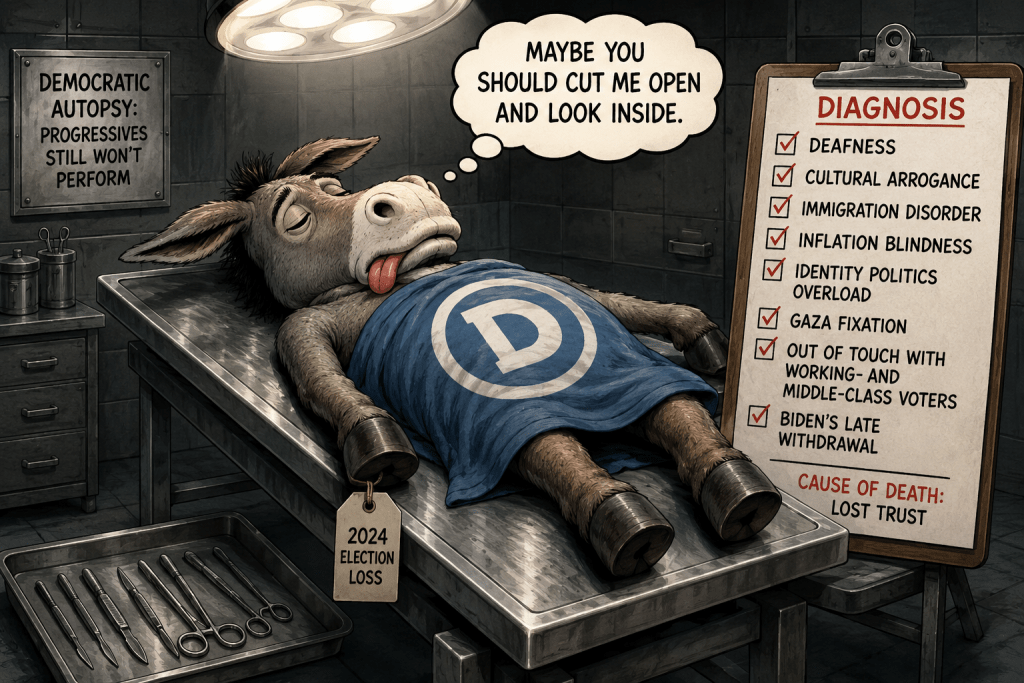
The progressive left has produced its own autopsy of the Democrats’ 2024 presidential loss. Some of it is useful. Much of it is predictable.
This post is about the progressive RootsAction autopsy, not the separate DNC/Rivera report later released by the Democratic National Committee. The RootsAction response was more progressive and self-confirming than the Rivera report.
The Rivera report appears more serious on voter groups Democrats lost and on the party’s failure to listen. But both reports still leave important questions underdeveloped, especially inflation, immigration, Biden’s governing coalition, Gaza cross-pressures, and the cultural alienation of working- and middle-class voters.
The RootsAction report is right that Democrats paid a price for President Biden’s decision to seek reelection and then withdraw only very late in the process. Biden ended his campaign on July 21, 2024, after a debate performance that intensified existing doubts about his age and capacity, leaving Democrats only a few months to define a new nominee and make the case against Donald Trump.
The report is also right that Democrats had a problem with younger voters. The RootsAction autopsy identifies “losing young voters,” “voter disenchantment,” Biden’s late withdrawal, working-class erosion, and Gaza as central reasons for Harris’s defeat. Tufts’ CIRCLE analysis found that young voters still favored Harris overall, but shifted right compared with 2020. AP reported that young men moved significantly toward Trump after a campaign that deliberately appealed to masculine identity through podcasts, sports, and nontraditional media.
So the progressive autopsy is not wrong about everything.
But it still seems to confirm progressive priors more than it confronts the hardest lessons of the election.
It wants Democrats to conclude that they lost because they were not progressive enough, not populist enough, not aggressive enough on Gaza, and not sufficiently mobilizing of the party’s base. Even if some of that were true, which I doubt, it does not explain the whole story. Most importantly, it ignores the issues that many working- and middle-class voters were actually reacting to: immigration disorder, inflation, cultural alienation, and the sense that Democrats were more comfortable speaking the language of elite progressivism than the language of ordinary Americans.
Biden’s Late Withdrawal Hurt Democrats
I agree with the progressive critique on this point: Biden’s decision not to withdraw earlier hurt Democrats.
Voters had serious doubts about his age and capacity long before the debate made those doubts impossible to dismiss. By waiting so long, Biden denied his party a normal primary process, denied voters a real choice among alternatives, and denied the eventual nominee the time needed to build a durable campaign identity.
The RootsAction report calls Biden’s decision to run again, and his refusal to step aside until late in the process, one of the central causes of the Democratic loss. That is fair.
But that explanation has limits. Biden’s late withdrawal hurt Democrats. It did not create all of the underlying problems Democrats faced. A stronger nominee might have performed better, but even a stronger nominee would have had to defend the record and rhetoric of the Democratic Party as voters experienced it.
That is where the progressive autopsy becomes much less persuasive.
The Young Male Problem Democrats Need to Understand
Democrats also appear to have a real problem with young men.
This should not be reduced to a crude claim that all young men are reactionary or that Democrats should imitate the online right. But the problem is real enough to deserve more serious attention than it often receives.
Many young men hear progressive rhetoric about privilege, identity, and DEI less as a call for fairness than as an accusation aimed at them personally. They are told they are beneficiaries of an unjust system at the same time many of them are struggling economically, socially, educationally, and professionally. That is not a recipe for political loyalty.
A healthy political party should be able to say two things at once: discrimination is real, and alienated young men are not all villains.
Too often, progressive rhetoric leaves no room for the second half of that sentence.
This does not mean Democrats should abandon equal opportunity or stop opposing discrimination. It does mean they should rethink language that sounds less like fairness and more like collective blame. A party that talks constantly about inclusion cannot afford to make a large group of voters feel preemptively excluded.
Trump exploited that opening. Democrats should ask why the opening existed.
Gaza Was Not the Main Problem for Most Voters
The progressive left is especially focused on Gaza. There is no question that Gaza mattered deeply to some voters, especially younger voters, progressive activists, Arab Americans, Muslim Americans, and some voters in Michigan. More than 100,000 Michigan Democratic primary voters cast ballots for “uncommitted,” a protest vote widely understood as a rebuke of Biden’s handling of the Israel-Hamas war.
But it is much harder to believe that the central lesson of 2024 is that Democrats failed because they did not tilt far enough toward Gaza activism.
That claim may be emotionally satisfying to parts of the progressive left. It is not a convincing explanation of the broader working-class and middle-class erosion Democrats experienced. Most voters were not living politically in foreign-policy protest politics. They were living with grocery bills, rent, immigration anxiety, cultural conflict, and frustration with a party that seemed surprised by voter concerns it should have seen coming.
Nor is it obvious that more pro-Gaza rhetoric would have been a net political winner. Democrats may have lost some voters because the Biden administration was too supportive of Israel for their taste. But they also risked losing other voters, including Jewish voters, pro-Israel Democrats, moderates, and voters alarmed by the tone of some campus protests, if the party had moved further in the other direction. A Forward poll taken during the campaign found that Jewish voters trusted Harris more than Trump to handle the Israel-Hamas war, but also saw Trump as more supportive of Israelis. That captures the tension Democrats faced.
In other words, Gaza was not a one-way political problem.
The progressive left counts the voters Democrats lost over Gaza. It is much less interested in counting the voters Democrats might have lost by sounding naïve, hostile, or morally confused about Israel.
For most Americans, the question was not whether Democrats had adopted the correct activist position on Gaza. The question was whether Democrats understood the country they were governing.
Immigration Was a Self-Inflicted Wound
Immigration is one of the most obvious issues the progressive autopsy underplays.
Working-class voters are not wrong to want a humane immigration system and a secure border. Those goals are not contradictory. They are the basic requirements of a functioning country.
Democrats spent too long treating border concerns as if they were merely a cover for xenophobia. That was politically foolish and substantively wrong. A country that cannot credibly manage its border will lose public trust, including trust among voters who support legal immigration and humane treatment of migrants.
AP VoteCast found that Trump tapped into deep economic anxiety among voters, and AP’s broader VoteCast work showed immigration and the economy were central issues in the 2024 electorate. That should not have shocked anyone. When voters believe the governing party has lost control of a basic function of government, they tend to punish that party.
Democrats can object to Trump’s cruelty, dishonesty, and demagoguery on immigration. They should. But opposing Trump is not enough. They also need a policy that persuades ordinary voters that the government can be compassionate without being naïve. They needed to come to that conclusion before it became politically obvious that they were only doing it because they had to do something.
That failure helps explain why Democrats lost in 2024.
The “They/Them” Ad Worked Because It Hit a Real Vulnerability
One of Trump’s most effective attacks was the “Kamala is for they/them, President Trump is for you” ad. The ad was ugly. It was designed to exploit cultural resentment. But Democrats should resist the temptation to dismiss its effectiveness as merely evidence of voter bigotry.
The ad worked because it told a simple story: Democrats are focused on a narrow set of elite cultural concerns; Trump is focused on you.
That story was unfair in many ways. It was also politically potent.
PBS reported during the campaign that anti-transgender political ads were dominating the airwaves, with ads supporting Trump attacking Harris over transgender issues. Some postelection analysis, including discussion of Democratic super PAC testing, suggested the “they/them” attack was among Trump’s more effective ads, though there was disagreement about how large its effect was.
The point is not that transgender Americans should be treated as political scapegoats. They should not be. The point is that Democrats had no clear answer when Republicans framed them as more concerned with the language and priorities of progressive activists than with the everyday concerns of ordinary voters.
That is a political problem.
The right answer is not cruelty. It is clarity. People of good will can address the real concerns of transgender Americans without appearing so open-minded that their brains fell out. The deeper problem is that progressives are often so busy signaling virtue to one another that they forget there are potential allies who can be persuaded if their concerns are treated with respect rather than derision. Democrats should defend the equal dignity of every American while also being willing to say no to unpopular, poorly defended, or symbolically extreme positions that most voters do not share.
This is where Democrats often confuse moral seriousness with activist maximalism. A humane society should protect vulnerable people from harassment, discrimination, and cruelty. But voters are also entitled to expect boundaries, prudence, and ordinary language. When Democrats cannot make those distinctions clearly, Republicans will make the distinctions for them — and not kindly.
A party that cannot make those distinctions will keep giving Republicans material for ads like that.
The Inflation Mistake Democrats Don’t Want to Own
The progressive autopsy is especially weak on inflation.
It is right that inflation badly hurt working- and middle-class voters. But it largely treats inflation as something Democrats failed to message properly or failed to blame sufficiently on others. That is too convenient.
Supply-chain disruptions mattered. Energy markets mattered. The war in Ukraine mattered. Federal Reserve policy mattered. But Democrats should also admit that Biden-era fiscal policy helped increase inflationary pressure. I have seen little persuasive evidence that inflation was caused by corporate pricing policies, as the RootsAction report asserts, that cannot be explained by ordinary market conditions. The simpler explanation is also the more economically plausible one: demand was pushed up while supply was still constrained.
The impulse behind the transfers was politically understandable. The country had just been through a pandemic. Millions of households had experienced economic disruption. Democrats wanted to prevent hardship, sustain demand, and avoid repeating the too-slow recovery that followed the Great Recession.
But policy has to be judged not only by its intentions, but by its timing and consequences.
By 2021, the problem was no longer simply inadequate demand. Supply chains were still disrupted. Production capacity was constrained. Labor markets were unsettled. In that environment, aggressive transfers risked increasing demand faster than the economy could increase supply. More dollars were chasing goods and services that could not be produced or delivered quickly enough.
That is a classic recipe for inflation.
Federal Reserve research has emphasized that post-pandemic inflation reflected the interaction of supply and demand forces. A 2025 Federal Reserve paper summarized the evidence by noting that demand factors became more relevant in 2021 and 2022, while supply factors also remained important. New York Fed research likewise estimated that aggregate demand shocks explained a large share of model-based inflation from late 2019 through mid-2022, with fiscal stimulus contributing significantly to that demand effect. San Francisco Fed research found that global supply-chain disruptions also contributed substantially to the run-up in inflation.
This does not mean that every dollar of inflation was caused by Biden’s policies. It was not. But Democrats too often spoke as if inflation were something that happened to them, rather than something their own policy choices helped aggravate.
Voters noticed the prices. They noticed the explanations. And they were not wrong to conclude that the people in power seemed surprised by an outcome that should have been easier to anticipate.
Inflation is not an abstract statistic to most voters. It is the grocery bill. It is rent. It is a car payment. It is the feeling that even a decent raise does not get you ahead. For working- and middle-class voters, inflation feels like betrayal by the governing class, especially when that class appears to dismiss their concerns as temporary, technical, or exaggerated.
Pointing to lower inflation numbers as success only exacerbated the political problem. People were upset because prices were so much higher than they had been, not merely because the current rate of inflation remained too high. Bringing the rate of inflation down was a real success, but failing to realize that was not what people were upset about was politically obtuse.
That is why the inflation mistake matters so much. It was not just an economic problem. It was a trust problem.
Biden Ran as a Moderate but Governed with the Progressive Coalition
Another issue the progressive autopsy avoids is the gap between Biden’s 2020 campaign image and the governing coalition that emerged afterward.
Biden won in 2020 largely as a reassuring, experienced, moderate Democrat. Many voters did not choose him because they wanted a progressive transformation of American politics. They chose him because they wanted Trump gone and because Biden seemed normal, decent, and comparatively centrist.
But once in office, Biden often governed as if the progressive wing had to be appeased at every turn. That does not mean every Biden policy was progressive or that progressives got everything they wanted. They did not. But the administration’s language, staffing, and policy instincts often seemed more aligned with activist priorities than with the moderate image Biden had projected in 2020.
That created a problem of expectations.
Some voters who supported Biden as a stabilizing centrist felt they had instead gotten a party preoccupied with immigration permissiveness, DEI rhetoric, aggressive spending, and cultural issues they did not understand or share.
The progressive autopsy treats this as a failure to mobilize the base. Centrists and independents should see something else: a failure to respect the voters who gave Biden his winning coalition in the first place.
The Working-Class Message Democrats Missed
The common thread is not that Democrats should become Republicans. They should not. Trumpism remains reckless, dishonest, divisive, and institutionally dangerous.
The lesson is that Democrats need to stop assuming every loss proves they should move further left.
Working-class voters did not need a lecture on ideological purity. They needed a party that understood their daily pressures. Many concluded that Democrats had been foolish on immigration, overly absorbed in DEI rhetoric, culturally distant, and at least partly responsible for inflation that hurt them badly.
AP VoteCast found that voters focused on the economy broke strongly for Trump, reflecting deep anxiety about an economy that, despite growth, many voters felt was not meeting the needs of the middle class. That finding should discipline every post-election theory. If an autopsy does not take inflation, affordability, immigration, and cultural alienation seriously, it is not really an autopsy. It is a factional argument.
That is the problem with the progressive report. It identifies some real wounds, but it avoids others because those wounds implicate progressive assumptions.
What a Serious Autopsy Would Say
A serious Democratic autopsy would say something like this:
Biden should have stepped aside earlier.
Democrats had a real problem with young voters, especially young men.
Gaza mattered to some voters, but it was not a significant reason most working- and middle-class voters moved away from Democrats.
Immigration disorder badly damaged the party’s credibility.
The “they/them” ad worked because Democrats had allowed themselves to be defined by unpopular cultural signals.
Biden-era fiscal stimulus was understandable in motive but excessive or poorly timed given supply constraints, and it contributed to inflationary pressure.
Biden ran as a moderate but governed too often as the head of a coalition trying to placate progressives.
And working-class voters concluded, not irrationally, that Democrats did not understand their lives.
That is the autopsy Democrats need. It is also the autopsy many progressives do not want.
The Centrist Lesson
For centrists and independents, the lesson is simple: voters are not ideological props.
They are allowed to have mixed views. They are allowed to want legal immigration and border security. They are allowed to support equal rights while resisting cultural coercion. They are allowed to appreciate government help during a crisis while objecting to inflation afterward. They are allowed to worry about discrimination and also dislike DEI rhetoric that sounds accusatory or unfair.
Good policy must be economically efficient, fair, respectful of personal freedom, and politically realistic. That standard is harder than slogans. It requires tradeoffs. It requires listening. It requires admitting when your own side made mistakes.
Trump has been a terrible president across so many different dimensions, and his personal conduct should have made him easy to defeat. Democrats’ failure to do so says something very powerful about the Democratic Party.
The progressive autopsy asks Democrats to believe that the party mostly failed because it lacked the courage to move left.
The evidence suggests a more uncomfortable conclusion: Democrats lost many voters because they stopped hearing them.
And a politics that cannot hear voters clearly will keep misunderstanding the country.