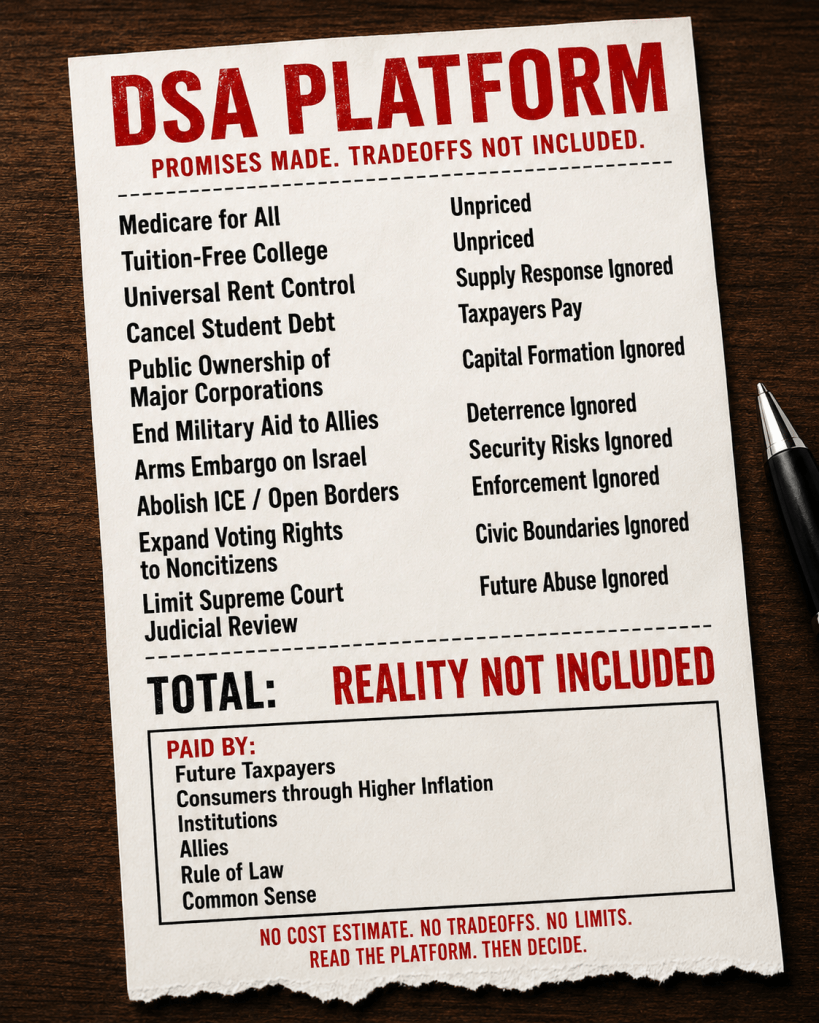
The DSA Platform Is Worse Than the Slogan

Satirical receipt labeled “DSA Platform,” listing major policy promises with tradeoffs marked as ignored and a total reading “Reality Not Included.”

DSA promises benefits without taking tradeoffs seriously. Read the platform. Then decide.

CIVPAC believes readers should see the Democratic Socialists of America (DSA) platform for themselves.

The current DSA program is available here: Democratic Socialists of America Platform.

We encourage people to read it. Not excerpts. Not hostile summaries. Not campaign rhetoric from opponents. The platform itself.

Doing so is clarifying.

DSA does not merely argue for a more generous welfare state, a somewhat higher minimum wage, stronger unions, or more aggressive health-care reform. Some of its proposals overlap with familiar progressive politics, but the platform’s underlying diagnosis and proposed direction are much more radical.

DSA says the capitalist system is the cause of major social harms and calls for a socialist society in which the largest corporations are placed under public ownership and democratic control. It calls for universal rent control, tuition-free public higher education with no out-of-pocket room and board costs, cancellation of all student-loan debt, Medicare for All with no premiums, co-pays, or deductibles, a 32-hour workweek with no reduction in pay or benefits, a wealth tax, and public ownership over major transportation and energy infrastructure and natural resources.

On foreign policy, it calls for ending military and economic aid and weapons sales to Israel, greatly reducing the U.S. military budget, closing overseas bases, bringing troops home, ending economic sanctions on countries such as Cuba, Venezuela, and Iran, and allowing workers to migrate freely across borders without restrictive immigration controls. It also calls for ending immigrant detention and deportations, immediate amnesty for all immigrants regardless of current immigration status, and access to jobs, labor rights, and social services for all immigrants.

On constitutional structure, it calls for voting rights for noncitizens, proportional representation, expansion of the House of Representatives, abolition of the Senate filibuster, replacement of the Electoral College with a national popular vote, and limits on the Supreme Court’s power of judicial review.

This platform is not Denmark. It is not Franklin Roosevelt. It is not a slightly more aggressive version of mainstream Democratic liberalism.

It is a sweeping ideological program built on bad diagnosis, magical financing, weak attention to incentives, and dangerous institutional assumptions.

DSA’s platform does not become serious merely because it attaches itself to familiar grievances. High housing prices do not prove that markets have failed. In many high-cost places, the problem is that housing markets have been systematically constrained by zoning restrictions, permitting delays, local veto points, parking mandates, height limits, environmental-review abuse, and political resistance to new supply. DSA’s answer is more public control. CIVPAC’s answer is to ask what is preventing supply from responding to demand — and then try to fix that.

High medical costs do not prove that more government control is the answer. Many of the worst distortions in American health care come from decades of tax preferences, mandates, cross-subsidies, public reimbursement rules, restricted competition, employer-based coverage, and government-shaped incentives. A serious reform agenda would ask how to preserve access, restore price discipline, reduce administrative waste, and create better incentives for patients, providers, insurers, and taxpayers. DSA instead treats the problem as if government promises can repeal scarcity.

Student debt is rarely a social injustice. It is also the result of personal borrowing decisions, institutional pricing power, weak cost discipline, political encouragement of debt-financed education, and a culture that too often treated college borrowing as an entitlement regardless of expected return. Blanket cancellation shifts costs from borrowers to taxpayers, including many people who did not attend college, paid their debts, chose less expensive schools, or made other sacrifices.

The same pattern appears throughout the platform. DSA begins with moral language and ends with government command. It treats every grievance as proof of capitalism’s failure and every government promise as if it were self-financing, self-administering, and immune from abuse. It gives too little attention to costs, incentives, capital formation, administrative capacity, unintended consequences, individual responsibility, public safety, democratic allies, and constitutional limits.

CIVPAC’s objection is not that government has no role. As our philosophy and broader policy positions make clear, government has important roles: protecting civil rights, maintaining public order, supporting basic research, correcting genuine market failures, providing a safety net, protecting the environment, enforcing contracts, defending the country and our allies, and helping ensure that opportunity is not limited by accident of birth.

But there is a vast difference between responsible public policy and the belief that most social problems can be solved by transferring more power to government or politically favored collectives.

The DSA platform repeatedly assumes away the hardest questions. Who pays? Who decides? What happens when supply falls in response to incentives? What happens when capital leaves? What happens when rent control reduces construction or maintenance? What happens when public systems are captured by unions, bureaucracies, or political machines? What happens when immigration enforcement is effectively abolished? What happens when sanctions are removed from hostile regimes? What happens when American military power retreats and authoritarian states fill the vacuum? What happens when judicial review is weakened and the next illiberal majority inherits that precedent?

These are not technical quibbles. They are the questions serious people ask before giving government more power.

DSA’s foreign-policy platform is especially troubling. A politics that calls for ending arms sales to Israel, drastically reducing American military power, closing overseas bases, ending sanctions on regimes such as Cuba, Venezuela, and Iran, and loosening immigration controls to the point of practical non-enforcement is not merely idealistic. It is a worldview. It is a worldview in which American power is treated as the central danger, democratic allies are treated with deep suspicion, and hostile regimes are often treated as victims of American policy rather than responsible for their own actions.

That worldview is wrong.

CIVPAC believes the United States should use power prudently. We do not support reckless intervention, blank checks, or indifference to civilian suffering. But prudence is not retreat. A stable international order depends in part on American strength, alliances, deterrence, and a willingness to distinguish democratic allies from authoritarian adversaries and terrorist organizations.

The platform’s institutional proposals also deserve scrutiny. Some election reforms may be worth considering. CIVPAC itself supports reforms such as open primaries and ranked-choice voting where they improve representation and reduce extremism. But DSA’s broader institutional program points toward a major restructuring of constitutional government. Limiting judicial review, weakening existing checks, and redesigning institutions in the name of “working-class democracy” should not be treated as harmless reform language. Constitutional limits matter most when a political movement is convinced of its own moral certainty.

The deeper issue is not any single plank. It is the attitude toward power.

DSA’s platform imagines that if the “right” people control the state, the state can guarantee housing, health care, education, jobs, wages, migration rights, climate transformation, public ownership, and international justice. History gives us many reasons to doubt that premise. Economics gives us many more.

The center should not be embarrassed to say this plainly.

Markets are imperfect. Government is also imperfect. Private power can be abused. Public power can be abused too. Capitalism requires rules, but rules require discipline. Social insurance is valuable, but promises require funding. Compassion is admirable, but compassion that refuses to recognize costs becomes fantasy. Democracy requires majority rule, but liberal constitutional democracy also requires limits, rights, courts, pluralism, private civil society, and protection for those who lose the next election.

DSA’s platform is not simply too far left. It is unserious about the constraints that make free societies governable.

That is why CIVPAC’s 2026 endorsements emphasize practical governance over ideological performance, including our most recent endorsements of Greg Stanton, in Arizona, and Haley Stevens, in Michigan.

That is also why CIVPAC believes voters should read the DSA platform.

Do not take our word for it. Read the platform. Then ask whether this is the direction the Democratic Party, or the country, should go.

CIVPAC believes the answer is no.

CIVPAC welcomes comments, corrections, and opposing views. Please share your thoughts on our Contact Us page or leave a comment below. If you are commenting on a particular candidate or race, please include that in your comment.


The Other 250th Anniversary: Adam Smith and the Discipline of Markets

Portrait of Adam Smith, Scottish economist and moral philosopher.

Adam Smith, author of The Wealth of Nations and The Theory of Moral Sentiments. Public domain image via Wikimedia Commons.

In 2026, Americans will celebrate the 250th anniversary of the Declaration of Independence. That anniversary deserves attention. But there is another 250th anniversary worth remembering: the publication of Adam Smith’s The Wealth of Nations in 1776.

The two anniversaries are not unrelated. The modern case for political liberty and the modern case for economic liberty developed in the same historical moment. Both reflected suspicion of concentrated power. Both challenged inherited systems of privilege. Both assumed that ordinary people should have more freedom to make decisions without permission from distant authorities.

That does not mean Adam Smith should be treated as a simple mascot for free-market politics. He was not that. Smith was a moral philosopher as well as an economist. He understood self-interest, but he also understood vanity, overconfidence, monopoly, privilege, collusion, and the human tendency to justify one’s own advantage as public virtue.

That is one reason Smith remains useful. He does not fit comfortably into modern slogans.

Smith respected markets because markets allow people to cooperate without central command. They allow millions of people, each with limited knowledge, to produce, exchange, save, invest, specialize, and adapt. Prices carry information. Competition disciplines producers. Voluntary exchange allows people to pursue their own plans while often creating value for others.

But Smith did not worship businessmen. He famously warned that people in the same trade rarely gather without the conversation ending in some effort to raise prices or conspire against the public. That is not a minor aside. It is central to Smith’s understanding of political economy. Business interests often seek protection from competition. They may ask government for tariffs, subsidies, licensing rules, monopoly privileges, regulatory barriers, or other arrangements that protect incumbents at public expense.

Smith defended competition, not collusion. He defended voluntary exchange, not monopoly. He defended commercial society, not crony capitalism.

Markets Deserve a Presumption, Not Worship

CIVPAC’s view is not that markets always work perfectly. They do not. Markets can be distorted by monopoly power, externalities, public goods, asymmetric information, fraud, and poorly designed rules. They can also produce outcomes that society may choose to modify for distributional reasons.

But markets deserve a presumption in their favor because they do several things government usually cannot do as well. They coordinate dispersed information. They reward production that others value. They allow decentralized choice. They permit experimentation. They create incentives for efficiency and innovation. They also limit concentrations of power by allowing people to work, buy, sell, invest, and organize without asking government to allocate every opportunity.

This is where Smith connects to Friedrich Hayek and Milton Friedman.

Hayek emphasized the knowledge problem. No central planner can possess all the local, changing, practical information embedded in prices, preferences, technology, costs, and circumstances. Markets are not merely a moral preference. They are information systems.

Friedman emphasized the relationship between economic freedom and political freedom. If government controls employment, capital, prices, production, education, housing, and access to opportunity, political liberty becomes fragile. A person who depends on the state for livelihood is less free to dissent from the state.

Those arguments can be overstated. Monopoly power can threaten liberty. Fraud can undermine consent. Pollution can impose costs on unwilling parties. Government is also necessary to enforce contracts, protect property, maintain courts, provide public goods, restrain violence, and preserve the rules under which markets function.

But the connection between markets and freedom is real. A society that weakens market institutions too casually should not be surprised when it also weakens individual independence.

Economics Is Not Conservative, but It Is Disciplined

Some people think economics is inherently conservative. That is not quite right.

Economics can support many policies associated with the left. Externalities can justify environmental regulation or carbon pricing. Public goods can justify national defense, basic research, infrastructure, and disease surveillance. Asymmetric information can justify rules in insurance, finance, medicine, food safety, and consumer markets. Monopoly power can justify antitrust and utility regulation. Diminishing marginal utility of income and wealth can support progressive taxation and redistribution.

Progressive policy does not have to be anti-economic. It can be stated in economic terms.

But economics imposes discipline. It asks uncomfortable questions of every political tendency. What is the market failure? How large is it? Is the proposed intervention likely to solve it? What incentives will the remedy create? Who pays? What happens at the margin? Are we correcting an efficiency problem, redistributing income, protecting liberty, or responding to a government-created distortion?

Nor is it enough to show that a market is imperfect. Markets are imperfect because human beings are imperfect. Governments are made of the same material. Public officials, regulators, legislators, voters, interest groups, and experts all have incomplete information and imperfect incentives.

A market imperfection therefore does not automatically justify government intervention. The relevant question is comparative: is the proposed intervention likely to improve the result after taking account of government error, political capture, administrative cost, incentive effects, and unintended consequences?

That places a real burden of proof on intervention. The burden is not impossible to meet. Pollution, monopoly power, fraud, public goods, and severe information failures may justify public action. Distributional objectives may justify redistribution. But the imperfection should be substantial enough, and the remedy plausible enough, to justify replacing one imperfect process with another.

The status quo is not presumed perfect. It is merely presumed to be the condition that must be improved upon, not just criticized.

The Difference Between Market Failure and Market Dislike

This distinction separates CIVPAC’s approach from democratic socialism and Marxism.

Marxist analysis often begins from the premise that capitalism itself is inherently exploitative. In that framework, market outcomes are suspect because they are market outcomes. The central issue is not whether there is a particular externality, monopoly, information failure, public good, or government distortion. The central issue is ownership, class power, and control over production.

Some democratic socialists hold a softer version of that view. Others are closer to ordinary social democrats who accept markets but want more redistribution and regulation. But the instinct is often similar: market outcomes require political correction because markets are assumed to reflect unequal power rather than legitimate exchange.

CIVPAC begins differently.

We begin with the presumption that markets are valuable institutions. They are not perfect. They are not sacred. But they are essential mechanisms for coordinating human activity, transmitting information, dispersing power, and preserving individual choice.

That presumption can be overcome. Government intervention may be justified. But the justification should be explicit. Is the problem monopoly power? An externality? A public good? Asymmetric information? A distributional objective? A threat to democratic institutions? A government rule that prevents the market from functioning properly?

If the answer is only “we do not like the outcome,” that may begin a moral or political conversation. It does not complete an economic argument.

Smith Was Suspicious of Business Too

Smith’s understanding of markets was more subtle than many modern arguments that invoke him.

He knew that merchants and manufacturers often prefer protection from competition. They may present their private interests as national interests. They may seek rules that raise prices, restrict entry, or shift risk to the public. The fact that a business asks for a policy does not mean the policy is pro-market. It may be anti-market.

This is one reason CIVPAC is skeptical of both anti-business populism and business-friendly corporatism.

The anti-business populist sees corporate power and assumes the solution is to punish or restrict business. The corporatist sees business success and assumes the public interest is served by helping incumbent firms. Smith warns against both mistakes.

A market economy requires competition, not merely private ownership. It requires open entry, not protection for insiders. It requires rules of fair dealing, not favoritism. When businesses seek subsidies, tariffs, regulatory barriers, licensing restrictions, or protection from competition, they are not defending free markets. They are often trying to escape them.

Overconfidence Is Also Part of the Human Condition

Smith also understood something modern behavioral economics later formalized: human beings are overconfident.

He wrote of the “over-weening conceit” many people have in their own abilities and the “absurd presumption” people often have in their own good fortune. That observation helps explain why risky professions can become overcrowded and why people take chances that look irrational from the outside.

This matters for policy. Markets involve error. People misjudge. Investors chase returns. Entrepreneurs fail. Consumers overpay. Voters misunderstand. Politicians overpromise. Experts overestimate what they know.

The fact that people make mistakes does not prove that government should make choices for them. Government officials are also human. They have their own incentives, blind spots, overconfidence, constituencies, and institutional biases. The question is not whether markets produce mistakes. They do. The question is whether a proposed intervention is likely to reduce error or merely move it into a political process with weaker feedback and fewer exit options.

Markets do not make people wise. But they create feedback. Losses, prices, competition, entry, exit, and consumer choice discipline error in ways political systems often resist.

Housing as an Example

Housing policy illustrates why language discipline matters.

It is easy to say that America has a “housing shortage” or that housing is “unaffordable.” Those phrases are familiar. They may point toward a real problem. But they can also smuggle in assumptions.

Housing has not literally disappeared. In high-demand communities, housing can still be bought or rented by households with enough income or wealth. The more precise problem is that, in many jurisdictions, housing prices and rents have risen faster than residents, buyers, employers, and local governments would have expected only a few years ago. Housing therefore requires a larger share of income or wealth than many households reasonably planned for.

That is a supply-constrained price problem.

In many places, state and local governments have restricted the ability of housing supply to respond to demand. Zoning rules, permitting delays, parking mandates, density limits, environmental-review processes, and neighborhood veto points prevent markets from adjusting normally. When quantity cannot adjust, prices do more of the work.

A democratic-socialist interpretation may begin with the idea that housing is too expensive because capitalism treats homes as commodities and allows profit-seeking actors to exploit need. A market-oriented institutional interpretation asks a different question: what is preventing supply from responding?

The answer is often government.

That does not mean no government should act. It means government should act on the actual distortion. If government rules are preventing homes from being built, the solution is to reform those rules. Demand subsidies or symbolic attacks on disfavored buyers may be politically satisfying, but they do not solve the underlying problem.

This is the Smith-Hayek-Friedman lesson in practice. Let prices convey information. Let markets respond. Do not let incumbent interests use government to prevent competition. Intervene where there is a real market failure or distributional objective, but do not mistake every disliked price signal for proof that markets have failed.

The CIVPAC Standard

The lesson of The Wealth of Nations is not that business should always win. It is not that government should never act. It is not that inequality is irrelevant or that markets are morally self-justifying.

The lesson is that prosperity and liberty require institutions that channel self-interest toward useful production, competition, innovation, and exchange. Those institutions include markets, but also courts, property rights, contract enforcement, stable money, public goods, antitrust where appropriate, and rules against fraud, coercion, and favoritism.

CIVPAC’s standard is therefore straightforward:

Before government intervenes in a market, identify the problem.

Is it a market failure? A public good? An externality? Monopoly power? Asymmetric information? A distributional objective? A government-created distortion? Does the proposed remedy address the actual problem? What incentives and unintended consequences will it create?

That is not a left-wing or right-wing checklist. It is a discipline.

Smith’s anniversary is worth celebrating because he helped teach the modern world that free exchange, specialization, and competition can produce enormous public benefit without central direction. It is also worth celebrating because Smith was wise enough not to confuse markets with merchants, capitalism with monopoly, or self-interest with virtue.

The country could use more of that wisdom.

At a time when both parties are tempted by populist villain-hunting, economic nationalism, industrial favoritism, and distrust of institutions, Adam Smith remains a useful corrective. He reminds us that markets are powerful not because business is noble, but because competition disciplines self-interest. He reminds us that government is necessary, but also easily captured. He reminds us that ordinary people know things planners do not. He reminds us that liberty depends not only on elections, but on the ability of people to make choices in their economic lives.

The 250th anniversary of the Declaration of Independence will rightly celebrate political liberty. The 250th anniversary of The Wealth of Nations should remind us that economic liberty is part of the same inheritance.

Both require institutions. Both require discipline. And both require skepticism toward concentrated power, whether it comes from government, business, or movements convinced that they alone know how society should be ordered.

Mamdani’s Congressional Slate and the Democratic Brand

Symbolic solar system illustration showing MAGA and “Blue MAGA” planets breaking away from their orbits.

AI-generated symbolic illustration of MAGA and “Blue MAGA” breaking political orbit.

CIVPAC has endorsed Representative Adriano Espaillat in the Democratic primary for New York’s 13th Congressional District.

When CIVPAC began, we expected much of our work to involve supporting center-left and center-right candidates in primaries, with the hope of nudging both parties toward the political center. That task has changed. Increasingly, CIVPAC finds itself supporting conventional left-wing or right-wing candidates against more extreme alternatives that, not long ago, would have seemed unlikely to gain serious traction in American politics.

When this effort began, through CIVPAC’s predecessor organization, the New Independent Party, the national political world was still recognizable. The 2012 presidential race was Mitt Romney against Barack Obama. CIVPAC would have had criticisms of both candidates, but both were serious, constitutional, mainstream figures. The distance between that world and today’s politics explains why CIVPAC’s task has changed.

Espaillat is not a centrist Democrat. He is a mainstream progressive Democrat with a reliable party-line voting record. But the question in NY-13 is not whether voters should choose a centrist over a progressive. The question is whether Democratic primary voters should replace an experienced incumbent with Darializa Avila Chevalier, a democratic-socialist challenger backed by Mayor Zohran Mamdani.

That race is part of a larger pattern. Mamdani has endorsed three congressional candidates in New York: Avila Chevalier in NY-13, Brad Lander in NY-10, and Claire Valdez in NY-7. CIVPAC is not making endorsements in all three races at this time. But the slate matters because it has become a national signal about the direction of the Democratic Party in its most heavily Democratic urban districts.

Deep-blue primaries are not politically isolated. New York City helps shape the Democratic Party’s national brand. When candidates running on democratic-socialist, movement-left politics become the face of the party in highly visible urban districts, voters outside New York notice. So do Republican media and campaign strategists.

If Democrats believe Mamdani’s strategy and the candidates he is backing are likely to succeed nationally, they should ask why Fox News is so eager to make that strategy visible to voters outside New York City.

CIVPAC does not object to new candidates merely because they are new. Parties need competition, new voices, and serious challenges to complacency. Nor does CIVPAC believe incumbents are entitled to renomination. But not every insurgency is an improvement.

This is one of those situations. The work now feels less like gently nudging the parties toward the center than trying to keep the planets from being flung out of the solar system.

Our concern is the road to “Blue MAGA.” We do not mean that left-wing populism and Trumpism are identical. They are not. But both can reward tribal certainty, ideological escalation, contempt for persuasion, and the belief that political intensity is a substitute for broad public appeal.

In NY-13, CIVPAC believes the better choice is clear. Representative Espaillat is not a CIVPAC ideal candidate, but he offers experience, institutional knowledge, and continuity. Replacing him with a movement-left challenger would strengthen the very tendency CIVPAC has warned about: the temptation to make deep-blue urban politics the face of the national Democratic Party.

That is bad politics for Democrats and bad politics for the country.

CIVPAC therefore endorses Representative Adriano Espaillat in the Democratic primary for the U.S. House in New York’s 13th Congressional District.