
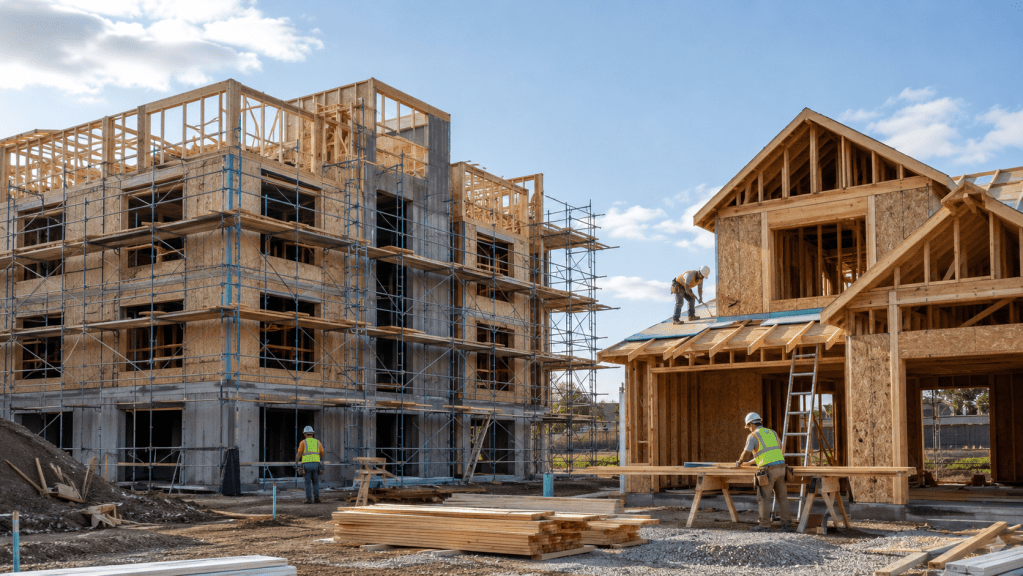
AI-generated symbolic illustration of multifamily housing construction next to a single-family home.
The bipartisan 21st Century ROAD to Housing Act is a useful step in the right direction. It is not a complete solution to rising housing costs. No federal bill was likely to be. But the bill has one major virtue: it at least recognizes that the central problem is on the supply side.
That matters.
The Problem Is a Supply-Constrained Price Problem
CIVPAC uses terms like “housing shortage” and “housing affordability” cautiously. Housing has not disappeared. Even in the most high-demand communities, housing can still be bought or rented by households with enough income or wealth. The problem is more specific: in many jurisdictions, housing prices and rents have risen much faster than residents, buyers, employers, and local governments would have expected only a few years ago. Housing therefore requires a larger share of income or wealth than many households reasonably planned for.
That is the practical affordability problem. It is not best understood as a literal shortage. It is better understood as a supply-constrained price problem. Demand has grown in desirable regions, but state and local rules have often prevented supply from responding in a normal market fashion. When quantity cannot adjust, prices do more of the work.
That is why the ROAD to Housing Act deserves credit. Its better provisions focus on supply, financing, manufactured housing, permitting, federal program modernization, and regulatory barriers. Those are the right subjects. Housing costs cannot be reduced merely by giving buyers more money to bid for housing that public policy has made difficult to build. Nor can the problem be solved by finding unpopular buyers and keeping them out of the market.
For too long, housing policy has often leaned toward demand-side answers: subsidies, credits, assistance programs, and other tools that help some households pay more for housing. Those policies may sometimes be defended as redistribution rather than market correction. But if they are not matched by increased supply, they can push more purchasing power into constrained markets and increase prices for everyone else.
The stronger parts of the ROAD to Housing Act point in a better direction. They recognize that housing policy should make it easier to build, finance, renovate, and occupy homes. That does not mean the bill is transformative. It does mean that Congress is beginning to talk about the right side of the market.
The Investor Restriction Is Politically Attractive but Economically Weak
The bill also contains a provision that illustrates the political temptation both parties now face: restricting large institutional investors from buying additional single-family homes.
That provision is easy to understand politically. “Homes are for people, not corporations” is a powerful slogan. Progressives dislike Wall Street landlords. Populists of all stripes dislike large financial firms outbidding families. Both parties get to present themselves as standing up for ordinary homebuyers against distant corporate power.
Institutional investors are also more likely to be attracted to markets where supply is already constrained. They do not need to create the constraint. They can profit from it. If local rules prevent enough housing from being built in response to demand, expected rents and home prices rise. That is precisely the kind of market condition that attracts yield-seeking capital.
That does not make institutional investors the source of the problem. It means they may be responding to a problem that government restrictions have already helped create.
There are documented abuses by large corporate landlords, including deceptive fees, unfair security-deposit practices, poor maintenance practices, and aggressive eviction procedures. Those abuses deserve enforcement, just as similar abuses by non-corporate landlords would deserve enforcement.
The stronger public-policy concern would arise if large corporate landlords were able to use scale, local concentration, or political power to prevent other landlords — corporate and non-corporate — from competing against them. At this point, CIVPAC has seen no compelling evidence that this kind of exploitation of market power is the central cause of rising housing costs either locally or nationally.
Even where market power exists, the proper remedy is targeted: transparency, enforcement, and, where appropriate, antitrust action. It is not a broad limitation on corporate ownership as such.
As national housing policy, the institutional-investor restriction is mostly populist performance.
A sound market intervention usually begins with a market failure: an externality, a public good, monopoly power, serious information failure, or some comparable reason why voluntary exchange will not produce a good result. The institutional-investor restriction does not clearly meet that test. It is not obvious that large institutional ownership is the central source of rising housing costs nationally, and there is no strong evidence that corporate ownership is the main reason homes have become more expensive in high-demand communities.
The strongest argument against institutional investors is not that they explain national housing-cost increases. They do not. The stronger argument is more localized: in some markets, large investors may compete aggressively for lower-priced single-family homes that would otherwise be plausible first homes for individual buyers.
That concern should not be dismissed. But it still points back to supply. If entry-level homes, townhouses, duplexes, condominiums, and smaller rental units are difficult to build, then every buyer is forced into a more zero-sum contest over the existing stock. Corporate buyers are merely a surrogate for renters in this competition. The better remedy is to make it easier to build the kinds of housing that reduce that zero-sum competition.
The provision also does not directly create supply. It does not shorten the permitting process. It does not make local zoning less restrictive. It does not lower construction costs. It does not add infrastructure, train construction workers, approve duplexes, legalize apartments near transit, reduce parking mandates, or limit neighborhood veto power.
At most, it changes who may buy some existing homes. That may shift ownership from one class of buyers to another. But it does not address the underlying constraint.
It may also have costs. Many households need or prefer single-family rentals. They may be relocating, rebuilding credit, saving for a down payment, recovering from divorce, uncertain about employment, or unwilling to take on maintenance risk. A professionally managed rental home can serve a real market need. If policy discourages rental capital too broadly, it may reduce rental options, renovation investment, and future build-to-rent supply.
The current version of the proposal appears to avoid the most disruptive step: it does not force large institutional owners to sell homes they already own. That makes the provision less damaging. It also makes it less powerful. If institutional demand is already down in many markets and existing portfolios are not being disgorged, the near-term effect is likely to be modest.
A toothless symbolic provision may be better than a destructive symbolic provision. But CIVPAC prefers policy that addresses the problem directly rather than satisfying the public desire for a villain.
Government Rules Are a Central Part of the Problem
The deeper problem is closer to Ronald Reagan’s famous warning, though in a more precise form. In housing, government is often not merely failing to solve the problem. Government is a large part of the problem. More precisely, state and local governments have allowed zoning rules, permitting systems, parking mandates, density limits, environmental-review processes, and neighborhood veto points to restrict supply in places where demand is strongest.
The solution should address the problem. If the problem is that government has made it too hard to build homes, the answer is not primarily to punish one disfavored class of buyers. The answer is to make it legal, predictable, and economically feasible to build more housing.
That does not mean every community should look the same. Nor does it mean abolishing local planning. Local governments should still plan for infrastructure, schools, transportation, stormwater, parks, and neighborhood design. But local control should not become local veto power over a region’s housing needs.
Nor should the workforce-housing argument be overstated. In a functioning market, higher housing costs in high-cost areas should be reflected, at least partly, in wages. Employers that need workers in expensive labor markets should expect to pay more for them. Targeted housing subsidies can therefore become an indirect subsidy to employers by shifting part of the cost of attracting labor from businesses to taxpayers.
With a fixed housing stock, subsidies also do not necessarily reduce transportation burdens. They may simply change who lives closer to the job center and who is pushed farther away. That is why CIVPAC is cautious about policies that try to micromanage which workers live in which communities. The better question is whether government restrictions are preventing housing supply from responding to demand.
If state or local rules make it unnecessarily difficult to build, then prices do more of the adjustment than quantity. That is the distortion public policy should address.
The Hardest Reforms Are Likely to Be State Reforms
That is why the hardest and most important housing reforms are likely to occur at the state level.
States created most local governments and delegate much of their land-use authority to municipalities and counties. States can therefore set the rules under which local governments exercise that authority. They can limit exclusionary zoning. They can legalize accessory dwelling units. They can reduce minimum lot sizes. They can prevent excessive parking mandates. They can allow duplexes, triplexes, townhouses, and apartments in more places. They can require by-right approval when projects comply with clear standards. They can make it harder for localities to use process as a substitute for prohibition.
State-level reform is not merely deregulation. It is a correction of local political incentives. Local zoning is often democratic governance functioning exactly as incumbent property owners want it to function. Existing residents have votes, organization, and direct financial interests. Future residents have none of those advantages because they do not yet live there. That creates a predictable bias toward restriction.
A higher level of government therefore has a legitimate role in limiting the exclusionary powers of lower levels of government. This is not hostility to planning. It is recognition that local control should not allow municipalities or counties to impose regional costs by preventing normal market response.
The federal government can help. It can reform federal programs. It can support manufactured housing, rural housing, small-dollar mortgages, disaster recovery, and infrastructure. It can reward jurisdictions that allow more housing and stop subsidizing jurisdictions that refuse to grow. It can collect data, improve financing, reduce unnecessary federal delays, and use grants to encourage better local and regional policy.
But Washington cannot by itself solve a problem rooted in zoning maps, planning boards, environmental-review processes, parking rules, neighborhood vetoes, and local political incentives. The federal government can point the road. States have to clear many of the obstacles.
Praise the Direction, Not the Populist Theater
That is why the ROAD to Housing Act should be praised, but not romanticized.
Its strongest message is that rising housing costs in high-demand places require a supply-side response. That is an important bipartisan breakthrough. It suggests that both parties are beginning to understand that housing costs cannot be addressed simply by subsidizing demand or denouncing unpopular market participants.
Its weakest message is that institutional investors are a central cause of the problem. They are not. They may be a problem in some markets and should not be exempt from scrutiny. But the broad increase in housing costs was not created by corporate landlords. It was created by years in which construction was held below what less restrictive markets would likely have produced, combined with excessive land-use restrictions, infrastructure bottlenecks, rising costs, and political systems that gave existing residents too much power to block future residents.
CIVPAC supports the supply-side direction of the bipartisan housing effort. We welcome a housing debate that focuses on removing barriers to building more homes, improving financing, and making the market work better.
But policymakers should resist the temptation to treat housing policy as a morality play in which the problem is solved by identifying a villain. The country does not need more symbolic attacks on disfavored buyers. It needs more homes. And if government rules are a central reason those homes are not being built, then government reform has to be central to the solution.
The right test for housing policy is simple: does it make it easier to build, finance, and occupy more housing in places where people want and need to live?
By that standard, much of the ROAD to Housing Act deserves support. The institutional-investor restriction deserves skepticism. And the next stage of serious housing reform will have to happen where the most important barriers remain: in the state laws and local rules that determine whether housing can be built at all.The bipartisan 21st Century ROAD to Housing Act is a useful step in the right direction. It is not a complete solution to rising housing costs. No federal bill was likely to be. But the bill has one major virtue: it at least recognizes that the central problem is on the supply side.