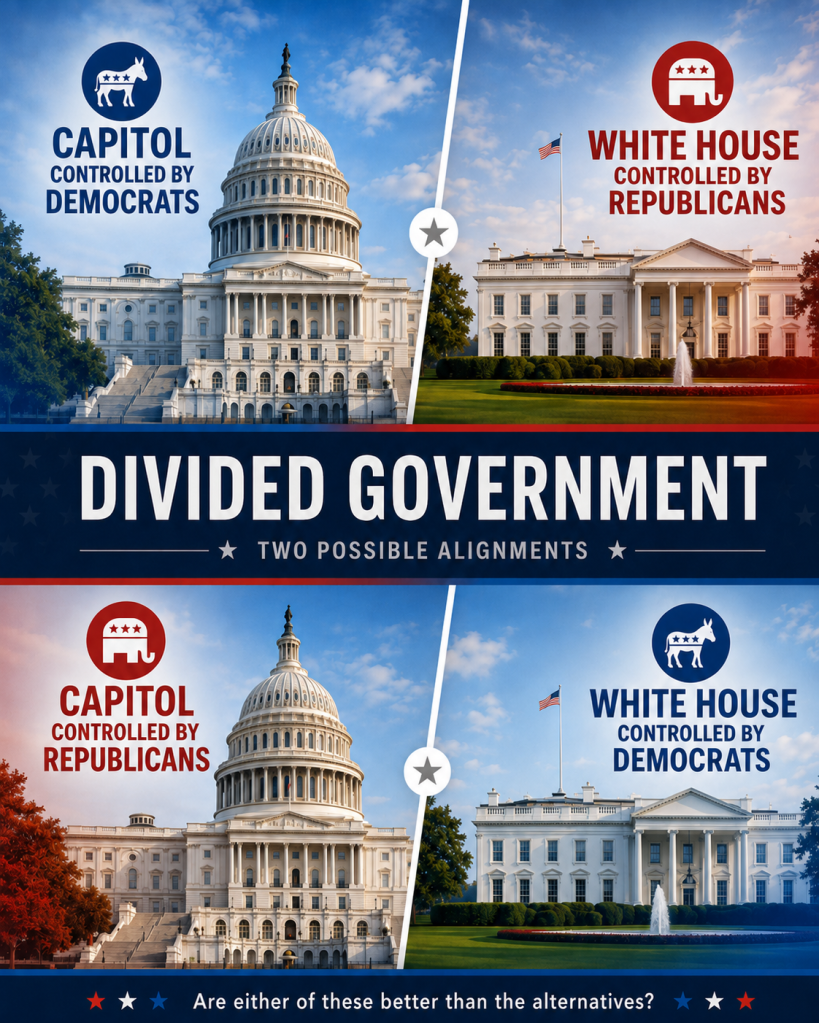
Why CIVPAC Sometimes Favors Divided Government

Two stacked illustrations of divided government: one shows a Democratic-controlled Capitol and Republican-controlled White House; the other reverses the parties, asking whether either arrangement is better than unified government.

CIVPAC does not favor Democratic control of Congress or Republican control of Congress in the abstract.

Our concern is institutional balance.

The Constitution assumes that Congress will defend its institutional role against the executive. In practice, party loyalty often overwhelms institutional responsibility. Members of Congress too often behave less like members of a separate branch of government and more like members of the president’s party team.

Divided government is not ideal. It is a second-best safeguard. If Congress will not check a president because it is Congress, perhaps an opposition-party Congress will check a president because it is the opposition party.

That is not a perfect solution. Divided government can produce obstruction, gridlock, posturing, and crisis. But it may still be safer than unified partisan control when party loyalty is too strong and institutional restraint is too weak.

In 2026, this principle may lead CIVPAC to favor some Democratic candidates as a check on this Republican executive. That should not be mistaken for a general endorsement of Democratic control of Congress.

In a different cycle, if Democrats held the White House — especially under a DSA-aligned or far-left president — the same principle could lead CIVPAC to favor Republican control of Congress, if Republicans nominate candidates fit to serve as a constitutional check.

Our preference is not partisan control. Our preference is constitutional balance, institutional restraint, and resistance to one-party overreach.

The more hopeful answer is that one of the two major parties might become moderate enough, responsible enough, and institutionally serious enough to be trusted with unified power. If that happened, divided government would be less necessary. But neither party has yet earned that level of trust.

This connects directly to CIVPAC’s idea of a true win-everywhere strategy.

Winning everywhere means nominating candidates who can actually represent the voters in the places they hope to serve. It means being broad enough, serious enough, and trusted enough to compete where the party’s national brand is weak. It also means having a national brand that does not make that impossible.

Too often, both parties say they want to win everywhere while behaving as if every district should be represented by the same national ideological brand.

A party captured by its ideological base cannot really win everywhere. It can win safe seats. It can hope for favorable waves. But it cannot rebuild trust in places where voters fear that unified party control would become ideological overreach.

A true win-everywhere strategy requires rejecting extreme ideological litmus tests, nominating candidates suited to their districts, respecting constitutional limits, and showing voters that winning power would not become permission for factional domination.

Candidate selection matters, even if success or failure of the party is inevitable in that state or district.

When Democratic primary voters choose practical center-left candidates over far-left or DSA-aligned alternatives, they make the Democratic Party more governable and more trustworthy. When Republican primary voters choose practical center-right candidates over MAGA, election-denying, or authoritarian-populist alternatives, they do the same for the Republican Party.

The center is not asking the two parties to become identical. Disagreement within constitutional boundaries is healthy. But there is a difference between ordinary policy disagreement and a politics that treats institutions as obstacles, opponents as enemies, and victory as permission to dominate.

Democracy is not stable merely because elections are held. It also requires parties that can be trusted with power, leaders who respect limits, and voters who reward seriousness over performance.

CIVPAC’s position is therefore straightforward: divided government may be necessary when neither party has earned full trust. The better long-term answer is for at least one party — and ideally both — to become moderate, responsible, and institutionally serious enough to be trusted with power.

The first party to learn that lesson may not merely win more elections.

It may deserve to govern.

Until then, please remember that even if your side wins by substantial majority, you do not have a mandate to pursue your wildest dreams. You have an opportunity to demonstrate that you can be trusted with power.


Property Is Not Sacred. It Is Useful.

Stylized revolutionary-era crowd holding a red banner reading “Property Is Theft,” illustrating Proudhon’s famous critique of private property.

“Property is theft” is a powerful slogan. But slogans are not systems.

There was a time when a line like “property is theft” would have struck me as profound.

It is a great line. Short, shocking, morally charged, and almost impossible to forget. I remembered it for decades, although I managed to attach it to the wrong author. The phrase is Proudhon’s, not Bukharin’s, as I used to think. My memory apparently filed it somewhere in the Russian revolutionary theory drawer, between Mikhail Bakunin, who would have embraced the phrase, and Nikolai Bukharin, who might have rejected it.

That probably says something about how memory works. It also says something about how political slogans work. The best ones do not merely state a proposition. They lodge.

In high school, I was not immune to that kind of language. I had been raised working class and skeptical of inherited privilege. I had seen enough of the world to know that property was not distributed according to virtue. Some people inherited homes, money, confidence, connections, and second chances. Others inherited bills, caution, and a smaller sense of what was possible. A slogan like “property is theft” did not sound absurd to me.

And it is a phrase worth taking seriously.

Private property is not morally innocent. It can create opportunity, but it can also preserve exclusion. It can reward work, but it can also reward inheritance, luck, monopoly, political influence, and proximity to power. It can create independence, but it can also give some people power over the lives and labor of others.

So I understand the appeal of Proudhon’s line. I also understand why young people drawn to socialism, democratic socialism, or other critiques of capitalism find it clarifying. It takes the world as they see it — unequal, unfair, tilted toward owners — and gives that perception a moral vocabulary.

But slogans are not systems. CIVPAC’s broader approach to political philosophy starts from that distinction.

The strongest argument for private property is not that it is sacred. It is not that God, nature, or metaphysics somehow assigned each parcel of land, each factory, each share of stock, or each bank account to its current owner. Property rights are human institutions. They are created, defined, limited, taxed, inherited, transferred, regulated, and enforced by law.

The better argument for private property is practical.

Societies that protect private property are generally richer, more productive, more innovative, and better able to sustain broad prosperity. People invest, build, save, lend, borrow, repair, improve, and take risks in part because they expect to keep most of what they create. Societies that reject private property sometimes starve. Secure property rights are one of the great foundations of economic life.

Without them, people do not become morally purified. They become poorer.

The political argument may be even more important. Hayek and Friedman were right: economic power and political power cannot be completely separated. If the state controls jobs, housing, investment, credit, production, and the means of livelihood, it controls much more than “the economy.” It controls the practical conditions under which people speak, organize, dissent, publish, worship, move, and live.

A person who can lose only an argument is freer than a person who can lose his livelihood. A society with many employers, many property owners, many newspapers, many associations, many sources of income, and many centers of power gives dissidents room to breathe. A society in which all economic life runs through the state may promise equality, but it gives political authority a terrifying lever.

That does not make laissez-faire a sufficient theory of justice. It is not. Markets can fail. Private power can become abusive. Property can be accumulated in ways that undermine opportunity and democracy. A serious defense of private property has to include taxation, antitrust, public goods, environmental rules, social insurance, and limits on fraud, coercion, and monopoly.

But that is very different from treating property itself as theft.

A better formulation is that private property is not sacred, but it is indispensable. It is not a natural right floating above politics, but it is one of the institutions through which both prosperity and freedom become possible.

This is where I part company with the slogan. Proudhon’s line does not tell us how to build a free and prosperous society. It identifies a wound, but not a cure.

The old socialist and anarchist writers were not stupid. Many of them saw genuine injustice. Some of their questions remain good questions. Who owns? Who works? Who benefits? Who has power? Who is excluded? Those questions should still be asked.

But the history of the twentieth century should make us cautious about answers that concentrate economic power in the name of justice. When politics absorbs property, politics absorbs nearly everything.

That is why I defend private property, but not as an idol. I defend it as a practical institution, one that must be bounded by law and judged by its consequences. It helps make people richer. It can help keep power dispersed. It gives individuals, families, businesses, newspapers, churches, unions, universities, and civic organizations some space outside the direct command of the state.

Jefferson did not follow Locke’s familiar formulation of natural rights as life, liberty, and property. He chose “life, liberty, and the pursuit of happiness.” That does not mean property was unimportant to the Founders. It means property was not the highest end. Property was one of the institutions through which people could pursue security, independence, prosperity, and happiness. It was a means, not the whole moral purpose of the political order.

Property is not theft. Property is not sacred either.

Property is a tool. Like all powerful tools, it can be used badly. But without it, we are not merely poorer. We are less free.

A Bigger Tent Needs Stronger Stakes

Democrats can win everywhere without accepting everyone who can win somewhere.

Large open canvas tent filled with people, anchored by stakes labeled liberal democracy, constitutional government, pluralism, public safety, regulated market economy, individual rights, and democratic allies.

A bigger political tent can welcome many people, but only if it is firmly anchored by shared democratic principles.

I am not a Democrat. CIVPAC is not a Democratic organization. We support Democrats, Republicans, and independents when we think they represent a more responsible, centrist, democratic, and politically realistic alternative.

So any advice I offer Democrats is, by definition, unsolicited. But the Democratic Party is one of the two major governing parties in the United States. Its internal arguments matter even to those of us who do not belong to it.

Two Ideas in Tension

Right now, Democrats seem caught between two ideas that are both partly right.

The first is the “win everywhere” idea. I have argued before that both parties should try to compete beyond their comfort zones. A serious national party should not write off whole regions, classes, religions, or cultures. Democrats should want candidates who can compete in cities, suburbs, small towns, working-class communities, and rural areas. They will not all sound alike, and they should not all sound alike.

A party that wants to govern the whole country should try to understand the whole country.

The second idea is James Carville’s warning about the Democratic Socialists of America and the far-left edge of the Democratic coalition. Carville has argued that Democrats need to consider something close to a schism with some DSA-aligned candidates. His point is blunt but not foolish: if candidates who reject core assumptions of liberal democracy, pluralism, public safety, capitalism, or America’s basic alliances run under the Democratic label, Republicans will use those candidates to define the entire party.

That is not paranoia. That is politics.

But there is an obvious tension. How can Democrats “win everywhere” if they are also drawing sharper boundaries around who belongs in the party?

The answer is that “win everywhere” does not mean “accept everyone who can win somewhere.”

A Big Tent Still Needs a Floor

A democratic political party has to be broad. It has to include people who disagree on taxes, health care, immigration, policing, climate, foreign policy, and cultural issues. It has to make room for candidates who fit their communities. A Democrat running in rural Georgia should not have to sound like a progressive activist from Brooklyn. A Democrat running in Brooklyn should not have to sound like a rural Georgia moderate.

Local variation is not the problem. It is the point.

But a party also needs a floor. It needs some basic commitments that define what the party is and what it is not. For Democrats, that floor should include liberal democracy, constitutional government, pluralism, public safety, a regulated market economy, individual rights, and a foreign policy that does not treat America’s democratic allies as morally indistinguishable from its adversaries.

That still leaves room for a wide range of Democrats. It leaves room for progressives, moderates, labor liberals, suburban pragmatists, Black church Democrats, national-security Democrats, and former Republicans who broke with Trump over democracy and the rule of law.

But it does not require Democrats to treat every anti-capitalist, anti-police, anti-Israel, anti-party, or anti-pluralist candidate as merely one more flavor in the big tent.

That is the mistake Carville is reacting against.

The Fetterman Test

I thought about this while rereading my earlier post, “A Centrist on the Road.” On that trip, I spoke with a Democratic Party activist from a northeastern state. She described herself as left wing but not far left wing. We agreed that Democrats needed to reach voters outside their normal constituencies. But she also reportedly wrote Senator John Fetterman urging him to leave the Democratic Party.

That struck me then, and strikes me even more now, as a perfect illustration of the problem.

It is easy to say the party should broaden its coalition. It is harder to accept the actual people who make a broader coalition possible.

A party cannot become more competitive in Pennsylvania, Ohio, Wisconsin, Georgia, Arizona, North Carolina, or Maine if it treats every culturally heterodox Democrat as a betrayal. If Democrats want to win outside safe blue territory, they need candidates who sound plausible outside safe blue territory.

The Fantasy of Purification

There is also a darker suspicion, held in some quarters, that some DSA and far-left Democrats do not mind seeing moderate Democrats lose in competitive districts. Moderate losses weaken the party’s center of gravity. They make it easier for ideological activists to argue that the old coalition has failed and that the party must be remade in their image.

The fantasy seems to be that if the Democratic Party becomes uniformly left wing enough, millions of hidden voters will suddenly emerge from the woodwork and propel it to national power. That theory has always struck me as closer to faith than analysis. It ignores the voters who actually decide competitive elections. It also treats losing winnable seats as an acceptable price for ideological purification.

That is not “win everywhere.” That is lose strategically and call it progress.

Disagreement Is Not Disqualification

The right answer is not to purge the left. Nor is it to purge the center. The right answer is to distinguish between disagreement and disqualification.

Disagreement is normal coalition politics. A Democrat who is more cautious on spending, more supportive of policing, more hawkish on foreign policy, or more skeptical of progressive cultural language should not be pushed out of the party. Such candidates may be exactly what Democrats need in places where they currently lose.

Disqualification is different. A candidate who rejects liberal democracy, excuses political violence, denies basic pluralism, or treats the Democratic Party merely as a ballot line to be captured is not simply a different kind of Democrat. That candidate is challenging the party’s identity.

So the lesson is simple:

Do not purge the center in the name of ideological purity.

Do not absorb the anti-liberal left in the name of coalition unity.

That is not hypocrisy. It is coalition discipline.

The Same Advice Applies to Republicans

I would offer Republicans the same unsolicited advice. There are elements on the far right that seem to have found a home in the Republican Party — indeed, may have seized control of much of it — and they may have permanently damaged the Republican brand. But that is a subject for another post.

The Goal Is a Stronger Tent

The broader principle applies to both parties. A healthy party should be wide enough to hold real disagreement and strong enough not to collapse under the weight of people who do not believe in the core principles of the coalition itself.

The goal is not a smaller tent.

The goal is a stronger tent.

A Centrist on the Road: Conversations About American Politics

A depiction of the Gand Canyon.

A Centrist on the Road

I recently traveled through the American Southwest. The scenery was spectacular, and the spring climate was remarkably pleasant.

Travel has a way of producing conversations that are different from ordinary social life. You meet people briefly, often in beautiful or unfamiliar places, and sometimes talk more freely than you might at home. Other times, of course, people avoid anything controversial.

During this recent travel, I had a few conversations about public policy and the state of American politics. Sometimes views were offered openly. In other cases, they emerged only after questions. None of the conversations were confrontational.

What struck me most, however, was not the number of political conversations, but how few there were. Despite making my interest in politics clear more than once, most people avoided the subject almost entirely.

That itself seemed revealing.

Democratic Party Politics

The easiest conversation to begin was with someone who had volunteered an interest in politics. This person had been active in Democratic Party politics and described their own views as left wing, but not far left wing.

We agreed on a number of things, including the need for Democrats to reach voters outside their normal constituencies. I shared the CIVPAC website and asked for reactions. My suspicion is that the site may have been reviewed, but it did not generate much enthusiasm.

I heard, from someone else, the view that Senator John Fetterman of Pennsylvania should leave the Democratic Party. I found that revealing. Fetterman still votes with Democrats the overwhelming majority of the time. He is also exactly the kind of culturally heterodox Democrat who may be able to reach voters the party otherwise struggles to reach.

It may be easier to accept the concept of a broader coalition in the abstract than to accept the reality of sharp disagreement from members of one’s own coalition.

A Competitive Senate Race

Another conversation concerned a competitive Senate race in the Northeast. The person I spoke with knew the race well and was clearly dissatisfied with the available choices.

The reaction was not enthusiastic support for one side so much as exhaustion with the alternatives. The sense I took away was not ideological excitement, but political fatigue.

For CIVPAC, races like this are difficult. A candidate may be more centrist on a number of public policy issues than most members of that candidate’s party and may even have broken with party leadership on some important questions. But that same candidate may also have supported party leadership on many other issues in ways that weaken any claim to independence.

At the same time, the opposing candidate may hold views on socialism, foreign policy, public safety, or political violence that many moderates find difficult to accept.

The conversation itself was short. Unlike my exchange with the Democratic activist, this did not feel like a conversation with someone trying to shape the future of a party. It felt more like a conversation with someone tired of choosing among imperfect options.

My suspicion is that this kind of voter may be more representative of the broader electorate than the activists who dominate so much political discussion.

Immigration and Economic Dislocation

I have also encountered strong views about immigration, especially when people believe immigration has affected their own economic prospects.

The H-1B visa program for highly skilled workers is a good example. At the national level, expanding the supply of skilled labor may increase growth, reduce costs, and support innovation. That is the standard economic argument, and it has real force.

But the individual experience can look very different. Someone who invests time and money in retraining for a technology-related career, only to find the door closed, may experience immigration policy not as an abstraction, but as a personal economic threat.

I am not in a position to judge whether any particular person’s career disappointment was caused by foreign labor competition. Labor markets are complicated, and individual outcomes rarely have a single cause.

But the feeling is real. And politically, feelings of unfairness matter.

Policies that appear efficient at a national level can still generate resentment and distrust if people experience the burdens and benefits as unfairly distributed. A politics that ignores those concentrated costs should not be surprised when affected voters become angry.

International Politics

Another conversation turned to European politics, immigration, and nationalism. The person was very familiar with European politics and followed political developments there closely.

The views expressed did not fit neatly into standard American categories. There was concern about democratic backsliding and authoritarian politics, but also some sympathy for European leaders who had taken a harder line on immigration. The argument was that immigration restrictions may have protected some countries from social and public-safety problems experienced elsewhere in Europe. There was also interest in pro-natalist policies, including benefits and protections for new parents.

This was not a wholehearted endorsement of European nationalism. Nor was it a full-throated condemnation.

What interested me most, however, was how poorly the conversation fit American political categories. A person with cross-border experience expressing partial sympathy for nationalist European leaders because of concerns about immigration, crime, and demographics does not fit comfortably into the ideological narratives that dominate American politics.

For myself, I viewed recent political change in parts of Europe, including the defeat of Viktor Orbán’s Fidesz party in Hungary, with guarded optimism. Guarded because it is never immediately clear how a new government will actually govern. Optimistic because cooperation with democratic allies and support for Ukraine matter a great deal.

Real voters are often more complicated than our political labels.

Conclusions

There is nothing remotely scientific about gathering political impressions while traveling. But informal conversations sometimes reveal things that polls cannot.

I had only a handful of political conversations. Despite making my interest in politics clear, most people I encountered did not express political views at all.

I increasingly think that silence itself may say something important.

Most people may simply be exhausted by the current political environment. They may also be reluctant to expose their views to criticism from people they do not know well. In many social settings, politics increasingly feels less like a conversation and more like a potential social risk.

People naturally search for conversational ground with strangers. Passing on an obvious invitation to discuss politics may therefore tell us quite a bit.

I also suspect that some vocal people already have relatively fixed political identities and voting behavior. But the quieter majority may still be politically available in ways activists and highly engaged partisans often underestimate.

Both parties should recognize that and act accordingly.

In retrospect, I also wish I had identified myself more strongly as a centrist independent and not simply as someone interested in politics. I wonder whether that would have changed some of the conversations — or perhaps encouraged more of them.

Maybe next time.