
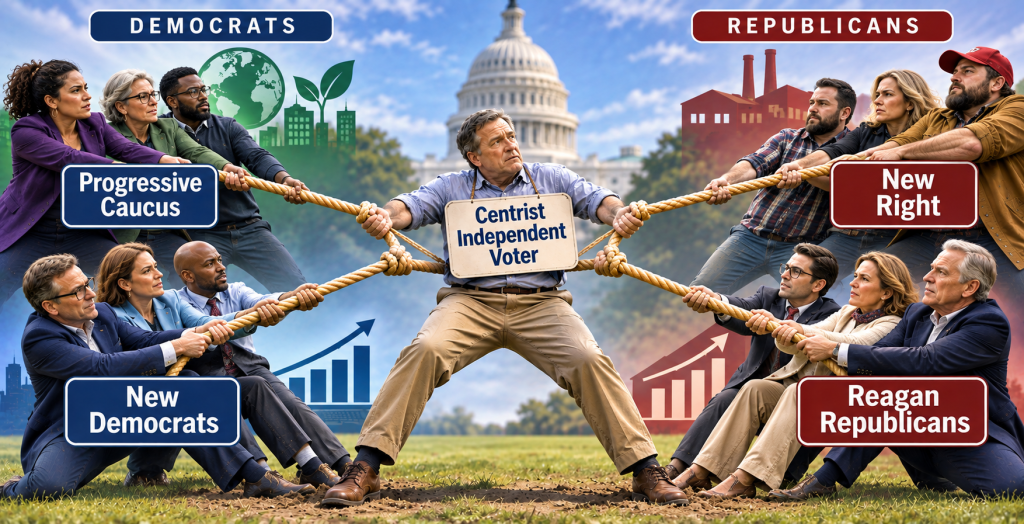
In his November 11 New York Times essay, Republicans Have Two Paths Out of This. They’d Better Choose Wisely, Oren Cass, chief economist of American Compass, presents an important choice facing Republicans following the 2026 elections. Will the party return to the market-oriented conservatism associated with Ronald Reagan, or embrace the more economically interventionist, nationalist philosophy Cass calls the New Right?
Cass clearly favors the latter. He argues that traditional Republican economic policies have placed too much emphasis on investors, corporations, and unfettered markets, and too little on American workers, families, and communities.
I welcome the debate. Indeed, I think it is overdue. But if either philosophy is to provide the foundation for a durable governing majority, it must appeal not merely to Republicans but also to a substantial number of centrist independent voters.
That is the constituency that the Centrist Independent Voter Political Action Committee (CIVPAC) seeks to represent. CIVPAC does not presume that centrist independent voters agree about everything or that its views reflect the views of all or even a majority of centrist independent voters. We don’t have the data to back up that claim. But we do believe that our views reflect those of a significant portion of centrist independent voters. CIVPAC’s philosophy emphasizes economic efficiency, fairness, personal freedom, and political realism. Those principles sometimes conflict, requiring judgment about difficult tradeoffs, as is the case with all political philosophies.
I should also acknowledge that I am not indifferent to which philosophy prevails within the Republican Party. As I explain in my biography on the CIVPAC website, Reagan’s enthusiasm for markets and his approach to foreign policy were the principal reasons I found him appealing, despite substantial reservations about his social policies.
My experience at the Department of Energy during the Carter and Reagan administrations helped shape those views. I witnessed firsthand the benefits of deregulation, much of which had begun under President Carter, but continued under Reagan. I also admired Reagan’s willingness to confront the Soviet Union. While I was sympathetic to Reaganism in economics and foreign policy, I was never particularly comfortable with the Republican Party’s positions on social issues.
Consequently, I approach Cass’s proposed alternative with considerable sympathy for some of its objectives, but serious reservations about abandoning important elements of Reagan’s legacy.
Although Cass’s New York Times essay provides the occasion for this response, my discussion also draws on his writings elsewhere and on policy proposals published by American Compass. Where appropriate, I distinguish between Cass’s own positions and those advanced by the organization.
Before turning to our disagreements with Oren Cass, I want to acknowledge his willingness to criticize President Trump when he believes criticism is warranted. Following the January 6, 2021, attack on the Capitol, Cass condemned Trump’s conduct, described his actions following the election as impeachable offenses, and argued that he should be removed from office. More recently, while supporting tariffs as an instrument of economic policy, Cass criticized the Trump administration’s abrupt implementation of them, arguing that it imposed unnecessary costs and disruptions that a more gradual and predictable approach could have avoided. We commend his willingness to distinguish between support for a political leader or policy objective and approval of the means employed to pursue it.
Markets, Government, and the Common Good
Cass is right that economic policy should be judged by its effects on people’s lives, not simply by the performance of financial markets or the profitability of corporations.
But I question his characterization of traditional market-oriented economics.
Markets are not ends in themselves. Their great virtue is that they coordinate the activities of millions of individuals and businesses without requiring government officials to determine what should be produced, how it should be produced, or who should produce it. There is an irony in the New Right’s criticism of socialism. Its own enthusiasm for industrial policy undermines one of the strongest economic arguments against socialism: that markets generally allocate resources more effectively than governments.
That does not mean markets always work perfectly. Externalities, monopoly power, information problems, and other market failures provide legitimate reasons for government intervention.
The question is how to address those failures without sacrificing the enormous informational and incentive advantages of decentralized decision-making.
Cass’s enthusiasm for directing investment toward what he considers productive economic activity raises a fundamental question: Who decides which activities are productive?
That distinction is much harder to make than his arguments sometimes suggest.
Government certainly has responsibilities in supporting basic research, infrastructure, national defense, and other activities where markets alone may produce inadequate results. But those responsibilities do not establish that government is generally better equipped than investors and businesses to determine the most productive uses of capital.
Trade, Workers, and Economic Adjustment
Cass places considerable emphasis on the harm international trade has done to particular industries and communities.
That harm is real. Society has sometimes been insufficiently attentive to the costs imposed on individuals whose employment is disrupted by trade, automation, or other changes in the economy.
But the benefits of international trade are also real. Restrictions on trade raise prices, reduce competition, protect inefficient producers, and ultimately lower living standards.
I agrees of course that free trade is strengthened by reciprocity with our trading partners and that government intervention to correct truly unfair trading practices is justified.
CIVPAC’s trade policy favors free trade accompanied by more effective assistance for displaced workers, including retraining and support for geographic mobility.
Cass may object that geographic mobility undermines existing communities, and it can have that effect if the change is large and rapid. But the nation is also a community and geographic mobility helps to knit that community together.
I have lived and worked in seven states, moving several times in pursuit of better opportunities. I recognize that relocating can be difficult, particularly for people with strong family and community ties. But I also believe that the ability and willingness to move have contributed enormously to American economic dynamism and to our sense of belonging to a larger national community.
We should help people make those adjustments rather than attempt to prevent economic change.
There are legitimate national-security exceptions to the general case for free trade. The disruptions of the COVID pandemic demonstrated the danger of relying on excessively concentrated supply chains. Strategic stockpiles, alternative sources of supply, and some domestic production capacity may be justified for critical goods.
But national security does not necessarily mean that everything must be manufactured in the United States. Canada and other reliable allies can be important parts of secure supply chains.
Moreover, private businesses already have substantial incentives to diversify their sources of supply. Government intervention should be directed toward identifiable risks that private markets are unlikely to address adequately.
A broad policy of protecting domestic manufacturing, as Cass suggests, is a very different proposition.
Wages, Organized Labor, and Immigration
Cass deserves credit for focusing attention on workers who have not shared fully in the benefits of economic growth.
But his preferred remedies raise additional questions.
For example, he advocates a direct wage subsidy, calculated from a worker’s hourly wage and added to each paycheck. I would generally prefer expanding the Earned Income Tax Credit, which directs assistance to lower-income working households based on their earnings and family circumstances.
Both the EITC and his proposed wage subsidies create some distortions in terms of the incentives for work and career advancement, but the EITC has the advantage of already existing. I think Cass has the burden of proof to demonstrate that his proposal is clearly superior.
On organized labor, CIVPAC agrees that workers should have the right to organize and bargain collectively. That right should be protected by fair procedures, including secret-ballot elections and neutral administration of labor law.
But organized labor can also acquire market power that imposes costs on consumers, other workers, and the broader economy. Those concerns are particularly significant in the public sector, where political influence and collective bargaining may create conflicts different from those in private employment.
I am especially skeptical of proposals to give employees or other stakeholders formal representation in corporate governance. Their interests deserve consideration in the context of serving shareholder interests, but that does not necessarily mean they should share authority over decisions for which they do not bear the same financial responsibilities.
When directors can justify their decisions by appealing to the interests of one constituency rather than another, accountability becomes elusive.
A board that serves many masters often serves none.
Cass also sees tighter labor markets resulting from immigration restrictions as a means of strengthening workers’ bargaining power.
Immigration does affect labor markets, although the effects differ among workers and industries. Restricting the supply of lower-skilled labor may benefit some existing workers while imposing costs on employers, consumers, and other workers.
We should recognize those tradeoffs rather than assume that increasing wages through restrictions on labor supply necessarily improves overall economic welfare. Politics can sometimes create a trap in which significant harm to a very small portion of the population can overwhelm the importance of a much larger harm to society as a whole because the focused harm has a greater political impact. A political strategy based on this phenomenon will eventually be revealed for what it is, or at least I hope so.
Highly skilled immigration raises somewhat different questions, and Cass has expressed support for attracting workers with valuable skills. CIVPAC also supports a more merit based immigration system, but merit has many dimensions.
The appropriate immigration policy should consider the economic and social contributions of immigrants at different skill levels, the costs they may impose, and the country’s capacity to absorb newcomers. It should not be driven exclusively by a desire to restrict labor supply to favor one group for political purposes.
Corporations, Finance, and Competition
Cass’s criticism of the financialization of the American economy is one of the areas where I have the greatest difficulty with his analysis.
He seems to regard some activities associated with financial markets, including share repurchases, as inherently less productive than investment in physical assets.
But the purpose of the financial system is to allocate capital to its most valuable uses.
When a corporation lacks attractive opportunities to invest its earnings, returning that money to shareholders may be precisely the right decision. Shareholders can reinvest it in other businesses with better opportunities.
As a corporate Chief Financial Officer, I operated under a simple principle:
Corporations should never do for their shareholders things that their shareholders could do better for themselves.
A corporation should not retain money merely because its management or the government would prefer it to control more capital.
That does not mean financial markets are beyond criticism. Excessive risk-taking, conflicts of interest, and institutions whose failure threatens the broader economy can justify regulatory intervention. CIVPAC describes a more market-oriented approach to such regulation in its policy position on Regulation and Financial Markets
Distinguishing productive from unproductive financial activity is not nearly as straightforward as Cass suggests.
CIVPAC does, however, see room for greater attention to antitrust policy.
Competition serves purposes beyond keeping prices low. It also encourages innovation, limits concentrations of economic and political power, and provides consumers with meaningful alternatives.
The acquisitions of Instagram and WhatsApp by Facebook, now Meta, illustrate the issue. Greater competition among social-media platforms might have given consumers meaningful choices about privacy, data collection, and business practices.
I would be sympathetic to revisiting some of those combinations on antitrust grounds.
That approach is quite different from proposals published by American Compass to regulate social-media platforms like public utilities. I am not even sure what this means since the product of public utilities is typically a commodity like electricity, water, or natural gas. The product of social-media companies is far more amorphous, and not easily regulated.
Families, Communities, and Education
Cass argues that government should recognize the importance of families and communities rather than treating all individual preferences as equally valuable from a social perspective.
There is much to agree with here.
Children are enormously important to society, and ensuring that they receive adequate nutrition, health care, and education serves both individual and collective interests.
But beyond those responsibilities, decisions about whether to marry, have children, or pursue a particular family arrangement should remain primarily matters of personal choice.
Government should be cautious about attempting to prescribe how people ought to live their lives.
Education is an area where I see substantial common ground with Cass.
CIVPAC supports improving both the quality and accessibility of education. CIVPAC also believes public financial assistance should be available for qualified vocational and technical training, not simply traditional college education.
But I would not automatically finance expanded vocational opportunities by reducing support for universities. Higher education serves purposes beyond preparing students for their first jobs. An educated citizenry capable of independent thought is itself a valuable public good.
There is another area in which I want to give Cass considerable credit. He has explicitly challenged Christian nationalism and the notion that conservative politics must rest on a particular religious foundation.
His willingness to make that distinction is important.
CIVPAC strongly embraces the separation of church and state. As explained in our Educational Content policy, we believe Americans should enjoy freedom both of and from religion, and that government should remain secular.
We recognize the important contributions religious institutions make to individuals and communities. Indeed, religious freedom may be strengthened rather than weakened by protecting religious institutions from government involvement.
CIVPAC’s K–12 education policy also reflects concern about using public funds for religious indoctrination.
Cass’s criticism of Christian-nationalist politics is a significant point of agreement, even though it does not necessarily mean that he shares every element of our approach to church-state separation.
Taxes, Entitlements, and Fiscal Responsibility
Cass deserves credit for confronting the federal government’s deteriorating fiscal position.
CIVPAC agrees that deficits cannot be addressed simply by promising faster economic growth or another round of tax reductions.
CIVPAC’s taxation and debt policy emphasizes both expenditure discipline and adequate revenue. We are not categorically opposed to higher taxes on high-income households, as he suggests, where they can be justified as part of a coherent fiscal program. I might even go further because significant revenue gains without significant economic distortion may also require increasing taxes on the middle class. Not a popular political view but a serious debate about fiscal discipline must entertain the possibility.
Tax policy should consider incentives as well as distributional objectives.
For example, combined federal and state corporate income-tax rates in the United States are already reasonably competitive with those in other developed economies. There is little reason to assume that substantially increasing them would be costless.
I am also skeptical of relying on broad tariffs as a continuing source of federal revenue. The economic distortions imposed by tariffs make them an unattractive alternative to more efficient taxes.
The same concern applies to the financial transaction tax included in American Compass’s aggressive budget scenario, which could increase the cost of capital allocation.
CIVPAC supports restoring the system’s long-term actuarial soundness through a combination of gradual benefit reforms and additional revenues, including adjustments to the retirement age and the taxable earnings ceiling. Our Social Security policy explains that approach.
Medicare raises somewhat different questions. Greater cost-sharing, as included in American Compass’s moderate budget scenario, may improve incentives, provided beneficiaries are protected against catastrophic financial exposure.
The larger point is that fiscal responsibility requires examining both sides of the budget. It is not enough to identify desirable programs or attractive tax changes without explaining how the resulting commitments will be financed. American Compass deserves credit for publishing an illustrative budget that makes some of these difficult tradeoffs explicit, even where I disagree with the choices.
Climate Change and Environmental Policy
Climate change illustrates what I see as an inconsistency in Cass’s approach to markets. He readily supports government intervention to address the distributional consequences of market outcomes, but is much less willing to intervene to correct the environmental externality associated with greenhouse-gas emissions. He acknowledges that climate change creates real problems, but places considerable emphasis on adapting to its consequences rather than preventing them. Adaptation is certainly necessary, but it is not a substitute for mitigation. That would be rather like responding to air pollution by improving treatment for emphysema while doing little to discourage the pollution that causes it.
CIVPAC favors a substantial carbon tax combined with a border adjustment.
The objective is to require producers and consumers to take account of the environmental costs of greenhouse-gas emissions while allowing markets to determine the most economical ways of reducing them.
Government need not decide in advance whether the answer should be nuclear power, renewable energy, carbon capture, increased efficiency, or technologies not yet developed.
A carbon tax provides incentives for all those approaches to compete.
It could also generate substantial revenue, some of which could help address the federal government’s fiscal and Social Security problems.
Cass has criticized carbon taxation and generally favors approaches emphasizing domestic energy production and the reduction of government subsidies.
CIVPAC agrees that governments should be cautious about selecting preferred energy technologies. But eliminating subsidies without addressing the underlying environmental externality leaves a serious market failure unresolved.
This is an area where I believe the market-oriented approach offers a more coherent solution than either extensive government subsidies or simply leaving the problem unaddressed.
Cass argues that unilateral American efforts will have limited impact on a global problem. That is a legitimate concern, but it does not establish that American action is futile. A carbon tax combined with a border adjustment or carbon tariff could provide incentives for reducing emissions both domestically and abroad. The relevant question is whether those benefits justify the costs, not whether the United States can solve the problem by itself.
There is an important distinction between pursuing the national interest and assuming that the national interest can be served by acting alone. The United States cannot by itself prevent nuclear proliferation, maintain an open international trading system, or deter aggression. Yet we recognize that American leadership and international cooperation can advance our national interests in all three areas. Climate change should not be treated differently simply because the problem is global.
We would welcome a more substantive discussion of that question from Cass and American Compass.
Foreign Policy and National Defense
My most serious reservations about Cass’s proposed direction concern foreign policy.
I agree that American allies should contribute more to their own defense. NATO has made substantial progress in this regard, and the alliance’s 2025 agreement calls for members to devote at least 3.5 percent of GDP to core defense requirements by 2035, together with additional security-related expenditures.
But there is a fundamental difference between insisting that allies bear a greater share of the burden and retreating from America’s international security commitments.
The international system created after World War II, including NATO and our alliances in Asia, has served important American interests.
Those arrangements have helped deter aggression, encouraged economic cooperation, and reduced incentives for countries to develop independent nuclear arsenals.
I worry that a substantial American withdrawal would create opportunities for Russia and China to expand their influence and encourage allies to reconsider their dependence on American protection not by providing their own but by aligning their policies with Russia and China.
CIVPAC’s foreign policy and national defense position emphasizes the importance of strong alliances backed by credible military capabilities. CIVPAC supports maintaining U.S. defense expenditures at no less than 3 percent of GDP in peacetime.
American Compass’s illustrative budget, in its aggressive scenario, would reduce U.S. defense spending to roughly 2 percent of GDP by 2034. This is an illustrative institutional budget scenario, not necessarily Cass’s personal preferred spending target, but it illustrates how differently the organization may assess the resources required for American security. That budget difference has major strategic implications.
Cass has argued for a more reciprocal international order in which allies assume substantially greater responsibility for their own security. That is a reasonable subject for debate, especially in terms of the best way to accomplish it without undermining our long term objectives.
The practical implications need much greater clarification.
Significant Unanswered Questions
Cass raises important questions, and on several issues I find substantial common ground with him. I particularly appreciate his willingness to challenge Christian nationalism and some of Trump’s worst behavior, because support for Christian nationalism and Trump are frequently associated with the New Right.
Nevertheless, as with some candidates CIVPAC has considered for endorsement, I am left with significant unanswered questions.
Some concern the economic proposals. How would government distinguish productive from unproductive business activity? How much protectionism would be justified, and for how long? What evidence would demonstrate that government intervention was producing benefits greater than its costs? How would the proposed commitments fit together within a sustainable federal budget?
Foreign Policy
The most consequential questions, however, concern foreign policy.
Cass argues that European allies should assume much greater responsibility for their own defense. But just how far would he reduce America’s commitments?
Would he contemplate withdrawal from NATO, or merely a diminished American role? Would the American nuclear umbrella that undergirds NATO remain intact? If that guarantee were withdrawn or weakened, how would the alliance deter future Russian aggression?
Would countries such as Germany and Poland feel compelled to develop nuclear weapons of their own? And what would a comparable reduction in American commitments mean for the security calculations of Japan and South Korea, particularly in the face of China’s growing military power?
These are not peripheral questions. The answers could determine whether Cass’s proposed strategy produces a more sustainable international security arrangement or a considerably more dangerous world.
The Limits of Political Power
We began by acknowledging Cass’s willingness to criticize Trump’s conduct following the 2020 election and the manner in which his tariffs were imposed. This raises a broader question for Cass and the New Right: What principles should constrain the exercise of executive authority and political power more generally, even when those constraints impede the achievement of what they regard as desirable policy objectives? How should those principles apply to the respective responsibilities of Congress, the president, and the courts, and what institutional restraints should remain inviolable regardless of which party holds power?
Ultimately, whether Cass’s philosophy would appeal to centrist independent voters also depends upon the alternatives presented by the two parties. That is the subject for another conversation.
I welcome the debate he has initiated. Serious political arguments should be judged not simply by whether their objectives are attractive, but by whether their proposals are workable, their consequences have been adequately considered, and their advocates are prepared to answer difficult questions.
Those are standards CIVPAC tries to apply in its candidate evaluations. They are equally appropriate when evaluating a proposed governing philosophy.